Category Archives: “to be”

What to revise to improve writing

Students often think revising means editing, that is, making small changes. Adding an apostrophe or improving spelling is not revising.  Revising means making significant improvements to writing.  Revising is the process by which okay writing becomes great.

So what exactly is revising?  Here are some examples, though there are many more.
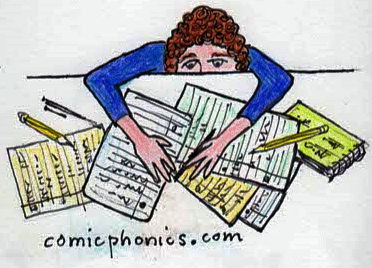
Change weak (nonspecific) verbs to specific verbs.  If possible rewrite the verb to be (is, are, was, were) and come, go, give, take, get, start, put, look, and see, but not say or said.

  • I got tired raking leaves, so I came inside and took a nap.  This becomes, After I tired from raking, I snuggled on my bed and napped.

After weak verbs, find infinitives or nouns that can be turned into strong verbs.

  • When the car started to spin, Mom took her foot off the gas pedal. This becomes, When the car spun, Mom released the gas pedal.

Use active, not passive verbs.

  • The apple was eaten by Mary. This becomes, Mary ate the apple.

Change long nouns (e.g., encouragement, contamination, habitation) to verbs.

  • Use moderation in your dietary habits. This becomes Moderate your diet.

Combine frequent small sentences (fewer than 10 words) to add sophistication to writing.

  • That’s my brother. His name is Akhil.  He is seven.  He can write a two-wheeler.  This becomes My seven-year-old brother, Akhil, can ride a two-wheeler.

Delete a sentence with just one bit of new information and put that information in another sentence to eliminate wordiness.

  • The baby fell out of the carriage. The carriage rolled down the hill.  This becomes, The baby fell out of the carriage which rolled down the hill.

Combine sentences to eliminate wordiness.

  • My uncle was wounded playing football. He played for the University of Georgia twenty years ago. He played before I was born.  This becomes, My uncle broke his leg playing football for the University of Georgia twenty years ago, before I was born.

Identify the sentence structures used (simple, compound, complex and compound-complex).  Rewrite the sentences to create more complicated simple sentences and easy-to-understand complex sentences, and to eliminate most compound sentences.

  • I watched the Rose Bowl Parade on TV, and I enjoyed it. I could not believe the floats!  They were covered with flowers, seeds, leaves, and other living things.  I hope, when I am older, to see the parade in person.  This becomes, I enjoyed watching the Rose Bowl Parade on TV.  Flowers, seeds, leaves and other living things covered the floats.  Someday, I hope to see that unbelievable parade in person.

Limit the number of dependent clauses in sentences to two.

  • The resort where we vacationed used to be a private club that attracted millionaires in the 19th century who arrived by train before wealthy people had air conditioning. This becomes, We vacationed at a resort that used to be a private club for millionaires.  In the 19th century, wealthy people arrived there by train.  They wanted to escape the heat in an era before air conditioning.

Change first words of sentences to add variety. 

  • See previous changes.

Count the number of words in each sentence.  Average them.  Aim for an average of 14 to 18 words with some longer and some shorter.  If the average is 10 or below, increase the number of words per sentence.  If the average is 20 or above, decrease the number of words per sentence.  Don’t count the number of words per sentence until you have made other changes or you will need to recount.

How to avoid overusing the verb “to be”

Eliminating the verb “to be” (is, are, was, were) from writing can improve your writing noticeably.  Yet eliminating “to be” verbs poses two problems.  First, easy-to-think of synonyms (seems, become) do not improve upon the weakness of “to be” verbs.  Second, students don’t want to take the time to think through strong alternatives.

Consider ways to help readers remember characters’ names.

Yet, strong alternatives exist.  Once students familiarize themselves with these alternatives, they will use them.

Alternative one:  Use an appositive.  Instead of writing, “Mario is my best friend.  He is on my soccer team,” write “Mario, my best friend, plays soccer on my team.”

Alternative two:  Keep the meaning but change the words and the sentence structure.  Instead of writing, “My sister was so disappointed when she didn’t get into Duke,” write “My sister moped around the house for days after she didn’t receive an acceptance from Duke.”

Alternative three:  Stick the idea in another sentence, and sometimes change the word order.  Instead of writing, “Olivia was overjoyed.  She was selected for the part of Annie in her school play,” write, “When Olivia learned she secured the role of Annie in her school play, she shrieked and danced through the house.”

To eliminate “to be” verbs as main verbs, students need to know the difference between main verbs and helping verbs.  Main verbs can usually be changed in the three ways mentioned above, but many helping verbs cannot be changed.  When writing the progressive verb tenses, forms of the verb “to be” need to be used as helping verbs, such as in “I am writing Grandma an email” or “The elephant had been trumpeting for her lost calf.”

When I tutor students, I ask them to write while I observe.  As questions arise, we discuss them.  Many times I see a sentence with the verb “to be” appear on a google doc only to be erased a moment later by my student and rewritten a different way, a better way—all without my saying a word.

My hope is that students apply the same thinking when I am not present.  One time a student of mine took an important writing exam.  I asked him if he did various things, and he replied, “Miss Kathy, I could hear your voice in my head.”  What a compliment!

Revisiting eight ideas to improve your writing

In my past blog, I suggested eight ideas to improve your writing.  In my next paragraph, I will ignore those suggestions and write poorly.  See if you can find eight examples of poor writing in this next paragraph.

A reader contacted this blogger a few days ago.  She informed me that there were good ideas in my most recent blog, and moreover, she suspected this blogger could utilize that blog to compose another blog that contradicts the advice of the first blog, and thereby set up a challenge to locate the poor writing and to attract a multitude of readers like her who are puzzle aficionados.  I listened to my reader’s admonition, and this paragraph is my response.

Spoiler alert:  The following paragraphs expose the poor writing.  Are you ready?

  • “This blogger” draws attention to the writer of the blog in a way that the word “I” does not. As the writer of the blog, I need to refer to myself in the paragraph.  But I should choose an inconspicuous way to do that.


  • “She informed me” draws attention to the way she spoke which is unimportant. “She informed” is better written as “she said.”  “Said” is an inconspicuous word.


  • “There were” puts the subject later in the sentence. “There were good ideas” could be better written as “my blog contained good ideas.”


  • “Moreover” and “thereby” are transition words that interrupt the flow of the sentence. “Moreover” is better said as “and.” “Thereby” is better said not at all in this paragraph. It is not needed.


  • “Admonition” is a four-syllable word and “aficionados” is a six-syllable word. Both draw attention to themselves because many readers might not know what the words mean.  It’s better to stick to simpler vocabulary (“advice” and “fans”) in a blog meant for children as well as ESL students and adults.


  • The second sentence in the three-sentence paragraph is 59 words long—far too many words for readers trying to understand the writer’s message. The sentence should be broken down into three or four simpler sentences.


  • “She informed me that” introduces and indirect quote. Use direct quotes whenever possible so readers can hear for themselves the vocabulary, the tone, the grammar and the inferences of the speaker.


  • And lastly, the paragraph is five lines long.  Is that too long?  Maybe, maybe not.  It is the longest paragraph of this blog, so it might look long–and intimidating–to some readers.  This is especially true because it extends the width of the blog.  Yet because the second sentence is so long, the paragraph is hard to subdivide.


All these ideas about good writing are based on the fundamental rule of good writing:  Clarity is the most important characteristic of good writing.  If a word or sentence or paragraph is not clear to readers, they will not keep reading.


Eight simple ideas to improve your writing

Don’t start a sentence with there is, there was, there are, there were.  When you start this way, you start with a filler word (“there”), not with the subject. You also use a form of the linking verb “to be” which is the weakest verb you can use.  Eliminating “there is” forces you to put your subject before your predicate and to use a stronger verb.

Write short sentences.  Usually, the longer a sentence is, the more clauses it contains.  The more clauses in a sentence, the harder it is for the reader to keep the ideas straight.  Limit the number of clauses in a sentence by limiting the number of words.

Use “said,” not “spoke,” “told,” “asserted,” “claimed,” and other words which mean “said.”  “Said” is an inconspicuous word which does not draw attention to itself.  As a writer, you should be highlighting what was said, not how it was said.

Use everyday but specific vocabulary.  Highfalutin words distance writers from many would-be readers.  If you are quoting a person who uses SAT words generously, repeat his language.  But keep your own words inconspicuous, so the focus is on your message, not on your  vocabulary.

Use short transition words.  “And,” “also,” “but,” “later,” and “then” are better choices than “additionally,” “furthermore,” “however,” and “subsequently.”  Longer transition words draw attention to themselves as words, so they take the reader’s attention away from the thoughts of the text.  They interrupt the flow.  Use modest one- and two-syllable transitions.

Keep paragraphs short.  Books written 100 or 200 years ago contain long, deadly paragraphs.  More recently written books contain shorter paragraphs with more white space on the page.  That white space makes the writing look friendly and nonthreatening.  To increase the white space, use smaller paragraphs.

Use dialog—direct quotes, not indirect quotes.  With indirect quotes, the author is distilling the original quotes.  Readers want to hear the original quotes so they can make up their minds as to what is important. Readers want to hear the tone of voice, the interruptions, the pauses, the inferences, and the vocabulary of the speakers.  Readers want to be there.

Keep yourself invisible unless you are writing a first-person account, or you are a character in your narrative.  Readers should not be aware someone wrote the words they are reading.  They should be aware of the information.  But if you do need to insert yourself into the writing, say “I,” not “this reporter” or “this listener.”

You might say, “But I know writers who ignore these ideas all the time.”  I do too.  Once you reach the stature of a Tracy Kidder or Ian McEwan, you can do what you want.  But until you do, you’re more likely to be read and understood if you follow these suggestions.

****

Need a writing tutor?  Contact me through this website.  I tutor writers from second grade through high school, in the US and overseas.

Write first, revise second, third, fourth, and edit last

Revising and editing are distinct actions.

Revising means changing text in significant ways, such as adding or deleting words, sentences, paragraphs or even whole scenes.  Revising means changing weak verbs to stronger, specific verbs.  Revising means changing sentence order or sentence beginnings or combining sentences or separating too many ideas in one sentence.  Revising means making big changes and should be done before editing.

Editing means polishing text in subtle ways, such as changing punctuation, spelling, and choice of synonyms and antonyms.  Editing means deleting most -ly adverbs, many adjectives, and obvious information.  Editing means making small changes, sometimes stylistic changes, and should be done after revising.

Which are revising and which are editing?

revising editing
Deleting backstory from the beginning of text
Using simple Anglo-Saxon vocabulary instead of longer, more complicated words
Replacing abstract nouns with concrete verbs
Deleting vague, qualifying words (e.g. some, never)
Deleting “that” except when needed for clarity
Combining sentences to delete unnecessary words
Adding information for clarity
Using “said” instead of “told,” “related,” “cried,” and other words saying how a person spoke
Replacing forms of the verb “to be” with specific verbs, action verbs if possible
Rewriting sentence beginnings for variety
Replacing most compound sentences or compound predicates with complicated simple sentences
Deleting overused words like “so,” “then,” “just” and “like”
Rewriting conclusions to add meatier ideas
In dialog between two people, not identifying who is speaking for each line of dialog
Writing direct dialog rather than indirect dialog.
Calculating words per sentence to keep within 15 to 20 words on average.
Looking for the kind of grammar mistakes you often make, such as run-ons, and fixing them.
Showing, not telling.

A mistake student writers make is to edit as they write, losing the flow of their thoughts.  It’s better to keep going, even though you know you spelled a word wrong and are tempted to look it up.  Writing is harder than editing which is why writers are tempted to edit as they go.  This is particularly true of perfectionists.

Editing before revising is a waste of time.  Good revising will delete many early edits.  Write first, revise second and third and forth, and edit last.