Category Archives: persuasive essay

What kind of writing should kindergarteners and first graders be able to do?

The ability to write well comes gradually and in stages.  This skill is a synthesis of many writing skills, each building on one another.  Here is what I see in practice and what the Common Core State Standards recommends for kindergarten and first graders.

  • In kindergarten children learn to write letters and words, and some advanced students may write sentences.  They might write with phonetic or invented spelling, backward letters, missing punctuation and haphazard  capitalization.  They use a combination of upper case and lower case letters.  They like to draw a picture of what they are describing.
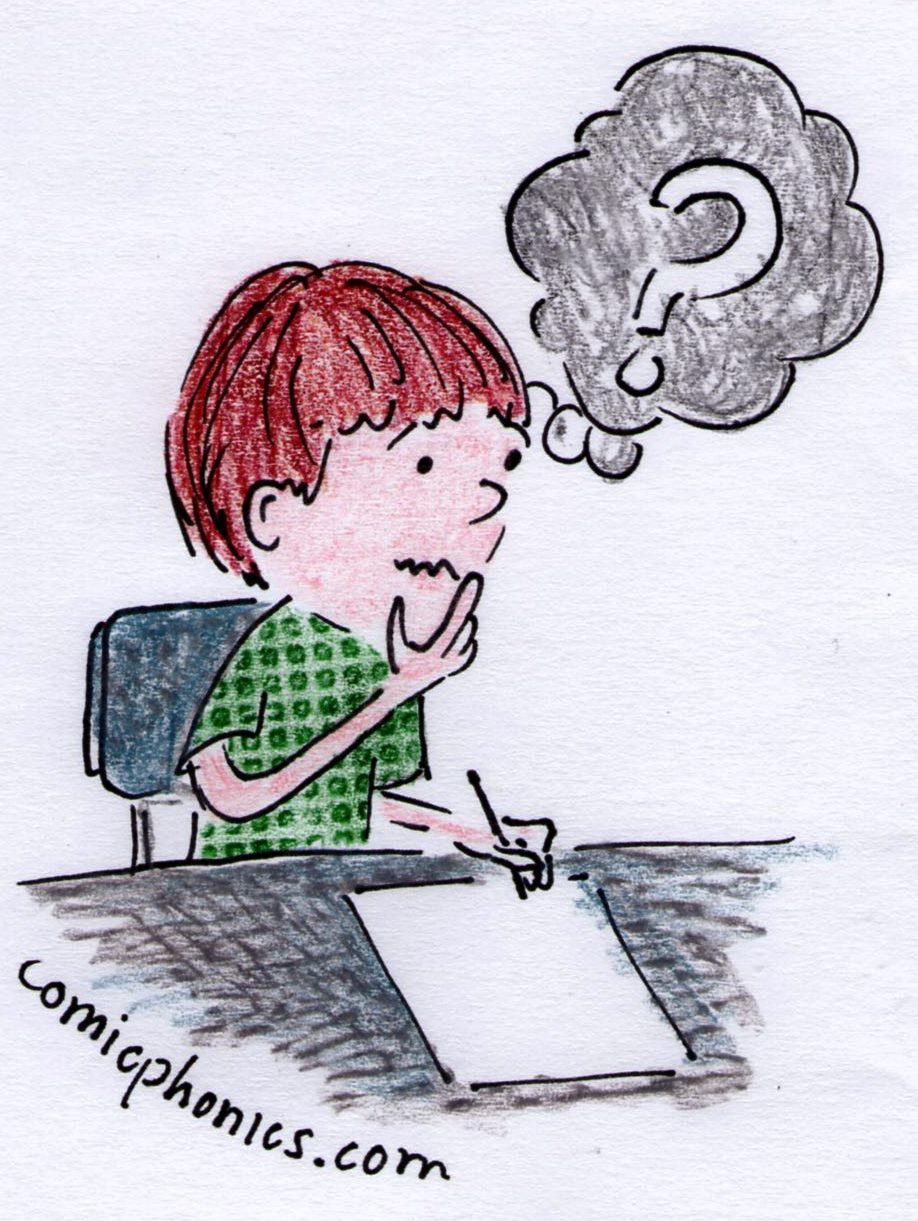
  • The Common Core State Standards (CCSS) ask kindergarteners to “use a combination of drawing, dictating, and writing to compose opinion pieces in which they tell a reader the topic or the name of the book they are writing about and state an opinion or preference about the topic or book; use a combination of drawing, dictating, and writing to compose informative/explanatory texts in which they name what they are writing about and supply some information about the topic; and use a combination of drawing, dictating, and writing to narrate a single event or several loosely linked events, tell about the events in the order in which they occurred, and provide a reaction to what happened.”
  • In first grade children’s writing ability varies widely, but teachers expect students to write in sentences by the end of the year. They might draw a picture at the top of a paper and then write one or more sentences under the picture telling what the picture means, and using many of the errors which kindergarteners use.  Many of the rules of writing and spelling are fluid for a first grader, but they are becoming formal than for kindergarteners.
  • The Common Core State Standards recommend that first graders “write opinion pieces in which they introduce the topic or name the book they are writing about, state an opinion, supply a reason for the opinion, and provide some sense of closure; write informative/explanatory texts in which they name a topic, supply some facts about the topic, and provide some sense of closure; and write narratives in which they recount two or more appropriately sequenced events, include some details regarding what happened, use temporal words to signal event order, and provide some sense of closure.”

As you can see, a wide gap exists between what many children can do and what the CCSS expect them to do.  For more on the Common Core State Standards, go to http://www.corestandards.org/ELA-Literacy/W/K/.

Should my child do reading and writing in the same lesson if the lesson is supposed to focus on writing?

EPSON MFP imageAs a tutor, this is an issue I have struggled with.  Most of the time, I combine reading and writing.  Here’s why:

  • A kindergartener or even a sixth grader has little personal experience to write about. They quickly exhaust “my dog” or “my family” as topics.  It makes sense for me to provide a topic to write about.  A quick and easy way to do that is to supply a picture book or a short essay.  But if I learn the student has taken an outing over the weekend, I switch gears and ask the student to write from his or her experience.  I might need to generate many questions about the outing to develop enough material to write about, but a personal experience trumps a reading experience, especially for young children.
  • Reading gives students a quick start. I might ask a young children to read part of a picture book (limiting the time spent reading to between five and ten minutes of an hour-long lesson).  For an older child, I might bring an essay or news story (again, limiting the time spent reading and discussing it.)  Our discussions focus on ideas related to writing, such as organization, characters, setting, suspense and conclusions.  Then we talk about the kind of writing I expect the student to write.
  • For students who don’t like to be told what to write, I might bring two reading selections, offering a choice. The child has a sense of control and I am happy with either choice.
  • Reading gives students various genres to analyze or to use as prompts. If the student is writing a persuasive essay, for example, reading one first offers ideas for organization and vocabulary.  I focus less on the content and more on the structure, details, figures of speech–the writing–during a writing lesson.
  • Reading offers excellent models for writing. If I am teaching how to write a formal essay with a thesis, obvious topic sentences and a good conclusion, reading such an essay first is a great way to begin the lesson.  We can talk about what makes the example good (or poor if it is poor) and how it could have been improved.

Everyone writes to be read, even if the reader is a later-day version of himself or herself.  We talk about this during our lessons, offering a solid reason to read before we begin and just as solid a reason to read the student’s work after it is complete.

Use a diagram to “see” the structure of the new SAT essay

When working with students learning how to write an essay for the new SAT exam, I draw diagrams of an essay pattern they can follow. The diagram acts as a prewriting organizer.  It shows students an overall perspective of what they must write.  Here is a diagram that is easy to follow yet leads to an effective SAT essay.

diagram-of-sat-essayThis diagram separates the persuasive techniques from the summary.  In the SAT workbooks, the best essay samples entwine the summary and the persuasive techniques, a more sophisticated pattern to follow.

What is important is to cover all three of the criteria which will be judged:  1) clearly showing that you understand what the essay prompt is all about (the summary), 2) recognizing and analyzing persuasive techniques, and 3) doing all this using excellent English (perfect  grammar, a variety of sentence patterns, advanced vocabulary and–most difficult of all–your own voice).

The new SAT writing essay is an improvement

Big changes have come to the SAT essay.

  • It’s optional, not required any more.
  • You have 50 minutes, not 25, to complete it.
  • It’s based on a reading passage, not an out-of-the-blue idea.
  • It will be judged on three criteria: your understanding of the reading passage, your ability to analyze the reading passage, and your writing skills.

It’s still not easy, but it’s certainly more like the writing students do in college.  Often college students need to read a book or a journal article and write a response to it.  Students need to show that they understand what the reading is about, that they can analyze the thinking that went into the passage, and that they can do so in clear, sophisticated English.  Rarely are college students ever offered a philosophical problem with no warning and no preparation, and rarely too are they asked to respond with an essay in one sitting.

The old, 25-minute limit was ridiculous.  Planning a response was reduced to three minutes; writing was limited to 20 minutes; and checking for errors lasted about two minutes, or more often, not at all.  When I work with students on writing anything we spend significant time on planning, developing details and ordering the paragraphs.  You can’t do that in three minutes.  And for most of the writing college students do they have overnight or longer to provide a response.  Good writers put their writing down, take a walk or a hot shower, and then return to the writing inspired.  At least with the new SAT there is breathing room.

Even though the reading selection might contain highfalutin vocabulary, you don’t need to understand every single word to get the gist of a reading selection and to analyze it.  The reading passage is long enough and contains enough persuasive arguments that the student can readily understand it with a strong high school vocabulary.

And the essay is optional.  For students who can write, this is their chance to prove it, adding another way to impress college admission officers.  For students who can’t write well, their lack of skill will show in the multiple choice section of the writing test.

Google the new SAT writing test to find websites offering greater perspective on the change.  See if you agree that the change has improved the test.

Use a prewriting organizer to write the first draft

After helping students create a good prewriting organizer, I sometimes see students begin their first drafts with no prewriting organizer in sight.  “Where is it?” I ask.  They dig through their writing binder and find it, hidden somewhere.

This is a graphic representation of a third grade student's handwritten mind web.

The best prewriting organizers for expository and persuasive essays are mind webs (click the graphic for more information).

This tells me that those students are not used to writing an essay with a prewriting organizer.  They don’t know how to use it.  I can’t assume that “If they write it, they will use it.”  They need to be taught how to use it.

I insist that the prewriting organizer be situated to the side of the notebook paper on which the student is writing his first draft.  To show me that he is using the prewriting organizer, I ask him to cross out lightly the ideas as he includes them in his essay.  By the time the essay is done, all the ideas on the prewriting organizer should be crossed out.

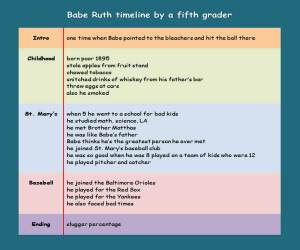
An example of a modified timeline organizer on Babe Ruth's life--childhood, school years, and baseball career.

Use a modified time line as a prewriting organizer for narratives (click the graphic for more information).

If a student is coming in cold after creating a prewriting organizer the day or the week before, I ask her to read the prewriting organizer to herself in the order in which she has numbered the subtopics.  This warms up her brain and reminds her of the details and the scope of her essay.

While she is writing the first draft, I usually allow the student space, looking over her shoulder occasionally.  If she is making progress, I leave her alone, but if she seems stuck, I intervene.  The most common problem is how to start body paragraphs.

Use a chart for comparison and contrast essays.

For comparison and contrast essays, use a chart or a Venn diagram as a prewriting organizer (Click on the graphic for more information).

We reread the information planned for the paragraph and see how it relates to the essay topic, and from this we write a topic sentence.  If a student has not written an essay before, I offer more help than I do for experienced writers.

Sometimes students recognize that they should change the order of their subtopics.  Before beginning the rough draft is a good time to do that.  Just cross out the numbers on the organizer and write new ones.  Sometimes students recognize that they have little to say about one subtopic, but they can think of another one with greater detail.  This is a good time to make that change.

Sometimes the student has lost interest in the topic of the essay completely and wants to change topics before he begins the first draft.  Usually I let him discard the completed organizer and start over.  You might think that creating that organizer was a waste of time, but no.  The student has practiced organizing an essay, an essential skill of a good writer.  Not every planned essay needs to be written.

In our next blog, we will talk about the conclusion, another difficult part of the essay for many students to write.