Category Archives: English Writing Instruction

Writing well takes study and practice.

11 Tips for Writing a Blog

Write short.

  • Short sentences.  Short paragraphs.  Short blogs.  Why?  Many times your readers are using phones to read your blog.  Long sentences and paragraphs discourage, especially if they appear in small typefaces.  But if an idea demands more text, go for it.

Include white space.

  • The space between sentences.  The space between paragraphs.  The space where a headline or subheading ends.  Why?  Your writing will look friendly, not intimidating.

Include bullets.

  • Why?  Bullets insert more white space.  They indicate a list without ordering the elements.  They shorten a line of type and make it easier to read.

Sound like you. 

  • When you write, pretend you are talking to a friend.  Let your voice come through. Why?  Blogs are personal.  If readers like your personality, they will keep coming back.

Use hyperlinks. 

  • If you mention something you’ve already written about, hyperlink it.  Why?  A hyperlink makes it easy for your reader to move from one item of interest to another.  And it gives you more page views which can raise your profile in search engines.

Use graphics.

  • Why?  Like white space, graphics break up your text and make it friendlier.  They can keep a reader reading and add additional information.

Respond to blog comments.

  • Why?  To encourage more comments.  To show you are a real person.  To connect with readers.

Post to social media.

  • Why?  To attract more readers.  To encourage readers to share your posts.  To develop a wider network.

Post when you have something worth saying.

  • Your blogging schedule need not be set in stone, but it should be fairly regular.  Your posts should be relevant, not time wasters.  Why?  You should respect both your own time and your readers’ time.

Write professionally.

  • Correct grammar errors.  Be concise.  Use topic sentences.  Why?  You want readers to respect your ideas, but if they are focusing on your errors, they will lose confidence in you and your ideas.

In your headlines, use numbers.

  • 12 ways to do this.  3 main points to avoid.  Why?  Numbers are hard facts.  They are specific.  They draw readers in.

Fun picture books for beginning readers, plus learning activities

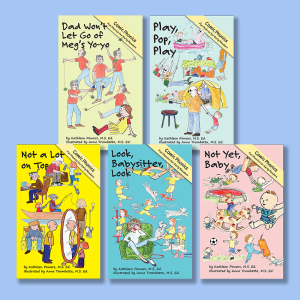
Are you looking for funny stories for your beginning reader? Silly stories using easy-to-read CVC and sight words?  With silly pictures to make kids laugh? And learning activities to reinforce the phonics?

We’ve made them!

Click on the image above for more information on these beginning readers.

Years ago, when my kids were learning to read, that’s what I wanted. But I couldn’t find them. So I started writing them. My sister, an art teacher, made them even funnier with her cartoon-like drawings. We tried them out on our kids and later my students, improved them, and now they are available for you to use with your beginning readers.

The story themes focus on little kids’ lives.

• A six-year-old receives a yo-yo for her birthday, but her father wants to play with it.

• A baby brother wants to do what his kindergarten-age brother does, but he’s too little.

• A wild child makes a mess while the babysitter gabs on the phone.

• A preschooler talks his grandfather into playing with his toys.

• A five-year-old devises ways to hide her father’s bald head.

After each story are several pages of game-like learning activities to reinforce the words and ideas of the stories.

My sister, Anne Trombetta, the illustrator, and I, the author, are teachers with masters’ degrees. We’ve applied educational research to devise story lines, words, activities and art to engage new readers.

Please check out our early reader picture books. We hope you’ll not only buy  them, but tell us how your little reader responded to the silly stories.

13 writing tips

The father of one of my students asked me if I could provide his son with a short guide his son could keep near his computer and use while writing.  Here it my suggestion.

Create a detailed prewriting organizer before you write.  Use it.

Make sure you follow directions if you are writing a response.  Cite?  Paraphrase?  Summarize?  Analyze?  Two instances?  Three?

Write the thesis sentence first before you write any other sentence if you are writing an essay.

Decide who your main character is and the problem he or she will face before you write your first sentence if you are writing a narrative.

Read your first draft aloud.  Does every sentence make sense?  Do you follow your organizer?  If something is missing, include it.  If something is irrelevant, delete it.

Make sure every body paragraph supports the thesis of your essay.

Make sure every action moves the main character closer to solving his or her problem in your narrative.

Identify weak or overused verbs and replace them with specific verbs.

Identify and vary sentence structures.  Especially include complicated simple sentences and complex sentences.

Show, don’t tell.  If you are concluding, you are telling.

Search for your typical grammar mistakes and fix them.

Add more precise details such as names, numbers, dates, locations, direct quotes, dialog, examples, thoughts, precise descriptions and sensory information.

Do revise.  First drafts are seldom good enough.

Add details

Students write in generalities rather than with precise detail.  Yet it is detail that enhances writing.

Take, for example, this general sentence:  The dog barked at the cat.  See how it changes when we add details.

Adding numbers:  The dog barked at the single cat.

Adding dates, days, seasons:  Just as the sun was setting, the dog barked at the single cat.

Adding proper nouns, names:  Just as the sun was setting, Fang barked at the Fluffy.

Adding places:  Just as the sun was setting in the back yard, Fang barked at the Fluffy.

Adding stories:  Just as the sun was setting in the back yard, Fang barked at  Fluffy, the cat almost hit by the garbage truck this morning.

Sensory information, figures of speech:  Just as the hazy sun was setting in the back yard, grey-muzzled Fang barked at puny, calico-coated Fluffy, the cat almost hit by the careening garbage truck this morning.

Specific verbs:  Just as the hazy sun was setting in the back yard, grey-muzzled Fang growled at puny, calico-coated Fluffy, the cat almost crushed by the careening garbage truck this morning.

What are details?

  • numbers, %, time
  • dates, days, seasons, eras
  • proper nouns
  • names
  • places
  • stories
  • direct quotes
  • thoughts
  • facts
  • for examples
  • sensory information
  • description
  • specific verbs
  • figures of speech

What does revising mean?

In working with a middle grades student recently, I mentioned that, based on my experience, many English teachers don’t teach revising of essays.  “Not mine,” said the student proudly, opening his computer and pulling up a page called “Revising” written by his teacher.  “Read it,” he said.  I did.  Here is the gist of it.

  1. Find instances of the verb “said” in all its forms, count them, and replace ¾ of them.
  2. Identify pronouns, count them, and replace half with nouns.
  3. Identify certain “boring” words (from a list given by the teacher) and change 99% of them to  more detailed vocabulary.
  4. Make sure your writing follows your organizer.

One of the problems with these instructions (aside from their usefulness) is what is missing about revising.  Little or none of the advice deals with developing a thesis or main idea, organizing it, developing and sequencing ideas, writing logically, creating tone and voice, writing with varied sentence structures, or writing introductions and conclusions.  Yet these are far more important areas of writing than identifying the verb “to say” or replacing pronouns with nouns.

Students today are poor writers for many reasons.  Lack of practice, poor modeling, and little teacher intervention until the writing is being graded are a few.  But so is poor or little advice on how to revise, and the kind of teacher training which largely ignores research.

I suspect the teacher who composed the above revising instructions, like most teachers, is well-intentioned.  But she is probably not an experienced writer.  If she were, she would know that the verb “said” should not be replaced with words like “reported,” spoke,” “advised,” or “shouted.” Those synonyms draw attention away from what was said to how it was said, diluting the message.  Pronouns should not routinely be replaced with nouns.  At first reference, a noun should be used, but in subsequent referrals in the same paragraph, a pronoun should be used. Yes,  “boring” words should be replaced, especially verbs, with more precise vocabulary.  And yes again, first drafts should follow an organizer.

Two out of four are good advice.  50%.  This is  reason why students today are poor writers.