Category Archives: direct quotes

Revisiting eight ideas to improve your writing

In my past blog, I suggested eight ideas to improve your writing.  In my next paragraph, I will ignore those suggestions and write poorly.  See if you can find eight examples of poor writing in this next paragraph.

A reader contacted this blogger a few days ago.  She informed me that there were good ideas in my most recent blog, and moreover, she suspected this blogger could utilize that blog to compose another blog that contradicts the advice of the first blog, and thereby set up a challenge to locate the poor writing and to attract a multitude of readers like her who are puzzle aficionados.  I listened to my reader’s admonition, and this paragraph is my response.

Spoiler alert:  The following paragraphs expose the poor writing.  Are you ready?

  • “This blogger” draws attention to the writer of the blog in a way that the word “I” does not. As the writer of the blog, I need to refer to myself in the paragraph.  But I should choose an inconspicuous way to do that.


  • “She informed me” draws attention to the way she spoke which is unimportant. “She informed” is better written as “she said.”  “Said” is an inconspicuous word.


  • “There were” puts the subject later in the sentence. “There were good ideas” could be better written as “my blog contained good ideas.”


  • “Moreover” and “thereby” are transition words that interrupt the flow of the sentence. “Moreover” is better said as “and.” “Thereby” is better said not at all in this paragraph. It is not needed.


  • “Admonition” is a four-syllable word and “aficionados” is a six-syllable word. Both draw attention to themselves because many readers might not know what the words mean.  It’s better to stick to simpler vocabulary (“advice” and “fans”) in a blog meant for children as well as ESL students and adults.


  • The second sentence in the three-sentence paragraph is 59 words long—far too many words for readers trying to understand the writer’s message. The sentence should be broken down into three or four simpler sentences.


  • “She informed me that” introduces and indirect quote. Use direct quotes whenever possible so readers can hear for themselves the vocabulary, the tone, the grammar and the inferences of the speaker.


  • And lastly, the paragraph is five lines long.  Is that too long?  Maybe, maybe not.  It is the longest paragraph of this blog, so it might look long–and intimidating–to some readers.  This is especially true because it extends the width of the blog.  Yet because the second sentence is so long, the paragraph is hard to subdivide.


All these ideas about good writing are based on the fundamental rule of good writing:  Clarity is the most important characteristic of good writing.  If a word or sentence or paragraph is not clear to readers, they will not keep reading.
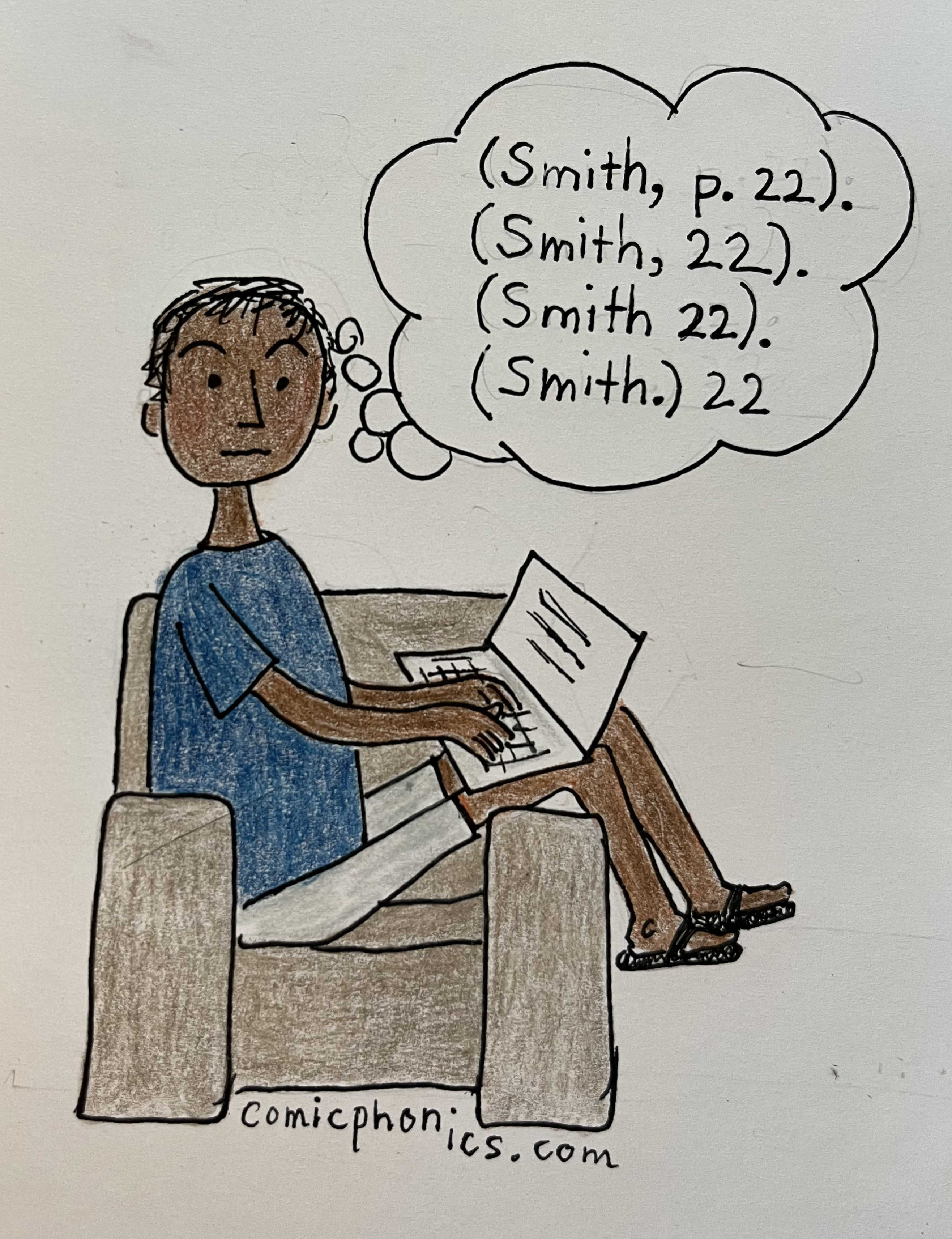


Two kinds of citation errors:  not citing paraphrases and summaries, and using the wrong punctuation

Students make several kinds of errors when using citations in their research papers.

One error is thinking that only direct quotations need to be cited.  Not so.  Direct quotations, paraphrases and summaries all need to be cited.

  • A direct quote is a reproduction of the precise words of a speaker or document. Shorter direct quotes of a phrase or a sentence are preferred to longer direct quotes of several sentences.  Direct quotes are used when the original words are iconic (Lincoln’s “of the people, by the people, and for the people”) and when the original words have a stronger impact than a paraphrase (Churchill’s “We shall never surrender.”)
  • A paraphrase is a “translation” of a direct quote into synonyms using different sentence structure from the original direct quotation. A paraphrase “translates” only a small portion of a speaker’s words or of a document.  Paraphrases are used to make difficult ideas easier to understand or to simplify long, complex thoughts.  Many teachers today prefer paraphrasing to quoting directly.
  • A summary is a straightforward repetition of the main ideas of a speaker or document. A summary presents longer amounts of information than a paraphrase and usually follows the same idea order as the original.

Direct quotations, paraphrases and summaries all need to be cited.  If the original source of  material you are using in your essay or research paper is not you, you need to give that source credit.  Not to do so is plagiarism, which I will discuss in a future blog.

Another error—the most common error—is to use improper punctuation in your essay or research paper.  In the United States, three commonly used documentation “styles” of citing information are the MLA, the APA, and the Chicago Manual (sometimes known as the Turabian).  If you are not familiar with “styles,” ask your teacher to explain the one you need to use.  You can find information online as well.  The MLA style is used in English courses and  in other language courses.  The APA style is used in the social sciences.  The Chicago style is used in history, social sciences and humanities courses.

Whole books are written on each of these styles, so I will not attempt to explain them here.  But let me take one example so you know what I am talking about.  Suppose you quote the author of a book in the text of your paper.  How do you show that citation?  For the MLA style, immediately after the quotation, you key an introductory parentheses, the author’s surname, the page number from which the quote came, an ending parentheses, and a period to end the sentence (Smith 368).  For the APA style, after the quotation you key an introductory parentheses, the author’s surname, a comma, then the year the quotation was made, an ending parentheses, and a period if you are ending a sentence (Smith, 2007).  For the Chicago style, a numeral 1 is placed after the quote, and a footnote is written in a footnotes section of the paper to identify complete information about the quote’s source.

You may think, you gotta be kidding!  No.  As you go through middle grades, high school and certainly college, you need to become familiar with various styles and to use them correctly.  Fortunately, online sources exist where you can input your source’s information and the website will order and punctuate the information correctly.  Swipe, copy, and paste into your paper.

More on how to incorporate quotations into text

In my last blog, I discussed how to incorporate a simple direct quotation into a student text, using a hamburger visual.

Let’s try a more difficult quotation.

Suppose you are writing about hurricanes.   You are trying to explain how wind sheer prevents a hurricane from growing stronger.  You have found a good quote to explain what wind sheer does to a hurricane.

Start with your text in your own words:  “Wind sheer prevents a hurricane from growing stronger.”

Next (the top bun), you introduce who said the direct quote and why it is worth quoting:  “Adam Sobel, an atmospheric scientist and director of the Initiative on Extreme Weather and Climate at Columbia University, explains wind sheer as. . .”

Now (the hamburger), you write the quote:  “different winds at different altitudes were keeping it from standing upright.”

Uh oh.  A problem—actually two problems.  Your text concerns hurricanes in general, but Sobel is describing Hurricane Henri in particular.  You need to remove the word “it” (meaning a particular hurricane) and replace it with the word “hurricanes” (meaning hurricanes in general.)  Since you are changing the quote slightly, you need to indicate that by putting your substitution in brackets.  The revised quote becomes, “different winds at different altitudes were keeping [hurricanes] from standing upright.”

But a second problem remains.  The past tense helping verb “were” refers to Hurricane Henri, but your text concerns hurricanes in general.  For proper grammar, you could change the verb “were keeping” into the gerund “keeping.”  The revised quote becomes “different winds at different altitudes. . .keeping [hurricanes] from standing upright.”  You need the ellipses because the helping verb is omitted.

Last (the bottom bun), you explain why you think this quote is relevant to your text in your own words.  “Sobel’s explanation creates a visual image of winds tilting a storm’s clouds, making them less organized than in an upright storm.”

Now put it all together:

Wind sheer prevents a hurricane from growing stronger.  As Adam Sobel, an atmospheric scientist and director of the Initiative on Extreme Weather and Climate at Columbia University, explains, wind sheer is “different winds at different altitudes. . .keeping [hurricanes] from standing upright.”  Sobel’s explanation creates a visual image of winds tilting a storm’s clouds, making them less organized than in an upright storm.

To recap:

  • To use a direct quotation, you must put it in context by identifying who made the direct quote and why it is relevant in the context you are using it.
  • The transition from your introductory information to the quotation must use correct grammar.
  • Sometimes words of the direct quote must be left out or changed slightly (for example, from singular to plural, from one verb tense to another, from one pronoun to another).
  • Any change in the direct quote must be shown either with ellipses or with brackets.
  • If several changes must be made, paraphrasing might be a better alternative.

How to incorporate direct quotations into text

Incorporating direct quotes into their own writing can be difficult for students.  They may not have read the kind of writing—academic, scientific—which routinely uses direct quotes, so they are unfamiliar with this type writing.  And they may not have been taught it explicitly—with lessons, examples, and practice.

If so, where should a teacher begin to teach how to incorporate quotations?

One way is with the image of a hamburger in a bun.  The hamburger stands for the direct quote, and the top and bottom buns stand for the “before” and “after” information that is also needed.

The top part of the bun is where you introduce the direct quote by explaining who the quote comes from and why the quote is worth quoting.  

For example, suppose you write about democracy, and you want to quote Abraham Lincoln’s definition.  You could introduce your quote by writing, “Abraham Lincoln defined democracy in his Gettysburg Address as. . .”

The hamburger part of the image is the direct quote itself: “government of the people, by the people and for the people.”  You don’t need to quote a whole sentence—just the part which meets your needs.  You might need to rewrite your introductory information to make it work grammatically with your quote.  You don’t introduce the quotation by saying, “It says,” or “Here it is,” or “The quote is.”

For example, you don’t say, “Abraham Lincoln defined democracy.  He said, ‘government of the people, by the people and for the people.’”  This example is not good because the writer does not transition into Lincoln’s quote.  A better way is, “Abraham Lincoln defined democracy.  He said democracy is ‘government of the people, by the people and for the people.’”  Even better is using the word “as” to replace “He said democracy is.”  One word instead of four.

The bottom part of the bun is your understanding of the quote and why you consider it relevant.  A good example is “This definition is deceptively simple yet eloquent.”

The finished quotation is “Abraham Lincoln defined democracy in his Gettysburg Address as ‘government of the people, by the people and for the people.’  This definition is deceptively simple yet eloquent.”

To recap:

  • To use a direct quotation, you must put it in context by identifying who made the direct quote and why it is relevant in the context you are using it.
  • The transition from your introductory information to the quotation must use correct grammar.
  • Sometimes words of the direct quote must be left out or changed slightly (for example, from singular to plural, from one verb tense to another, from one pronoun to another).
  • Any change in the direct quote must be shown either with ellipses or with brackets.
  • If several changes must be made, paraphrasing might be a better alternative.

Rules Hemingway wrote by

Did you watch the new PBS documentary on Ernest Hemingway which premiered on Monday?  If so, you heard Hemingway say “the best rules I ever learned for the business of writing” came from the Kansas City Star stylebook. He reported for the Star 1917 to 1918.

Detective with a magnifying glass inspecting a newspaper.Here are some of those rules:

  • Use short sentences.
  • Use short first paragraphs.
  • Use vigorous English.  [Use active verbs.]
  • Be positive, not negative.
  • Never use old slang.  Slang, to be enjoyable, must be fresh.
  • Watch your sequence of tenses.  [Be consistent.]
  • Don’t split verbs.  [Put adverbs before a verb phrase.]
  • Be careful of the word “also.”  “Also” modifies the word it follows, not the word it precedes.
  • Be careful of the word “only.”  “He only had $10” means that he alone had $10.  “He had only $10” means $10 was all the cash he had.
  • Don’t split infinitives.
  • Avoid using adjectives, especially extravagant ones.
  • Use “none is,” not “none are.”
  • Animals should be referred to with the neuter gender unless the animal is a pet with a name.
  • Break into a long direct quote early in the quote to identify the speaker.
  • Avoid expressions from a foreign language.
  • Collective nouns take singular verbs.