Category Archives: compound sentence

Encourage complex thinking in little kids’ writing

When children start to write sentences, teachers and workbooks encourage simple sentences (sentences with one complete subject and one complete predicate).  Such a sentence might be “I am seven years old” or “My dog had pups yesterday.”
As students progress, teachers encourage compound sentences (two simple sentences connected with a FANBOYS—for, and, nor, but, or, yet, so—conjunction).  Such sentences might be “I am seven years old but I can ride a bike” or “My dog had pups yesterday and I can name one.”

As students progress to a greater age, and in theory, to more complex thinking, teachers encourage complex sentences (two simple sentences connected in such a way that one sentence is clearly more important).  Such sentences could be “I am seven years old although I look older” or “My dog had pups yesterday while I slept.”

Teaching sentences this way presupposes that little children think in simple sentences, then gradually grow into thinking in compound sentences, and then as they mature more, think in complex sentences.

The problem is, this pairing of sentence types to maturity is a false correlation.  Have you ever listened to four- and five-year-olds speak?  “I want five candies because Johnny has five candies” (complex sentence).  “For Halloween, I want to be a princess with a long pink dress and a sparkly crown in my hair and maybe ballerina slippers” (simple sentence).  “She pushed me into the snow with a real hard push, the kind of push of a football player mad at the guy carrying the football.” (simple sentence)

These sentences in the previous paragraph contain complex thoughts (cause and effect, layered details, and a metaphor).  Yet only the first sentence is a complex sentence, and of the three, it is the least complex in thought.  The other two show far more complexity of thought, yet they are simple sentences.

The complexity of these sentences can be shown by boldfacing the simple subject and predicate, and by stacking the dependent ideas  above (if they are said first) and below (if they are said after the subject and predicate).  Notice how the two simple sentences show more layers (more complexity of thought) than the complex sentence.

I want five candies

because Johnny has five candies.


For Halloween

I want to be a princess

with a long pink dress

and a sparkly crown

in my hair

and maybe ballerina slippers


She pushed me

into the snow

with a real hard push

the kind of push

of a football player

mad

at the guy

carrying the football


My point:  Little children speak with complex ideas.  Encourage them to write with complex ideas too.
Imitate classic sentences to improve your writing

Do you want to improve the sentences you write?  One way to do that is to imitate classic sentences, according to Stanley Fish, author of How to Write a Sentence (2011).  A sentence form he recommends imitating is the additive (cumulative) sentence.  This form of writing seems spontaneous because it shifts back and forth, digresses, repeats, and loses itself in details—much like the speech of some people.

How do you recognize such a sentence?  Many are compound sentences, or if not compound, then containing compound subjects, predicates, and phrases.  They use coordinating conjunctions, especially “and,” “but” and “or.”  One word or idea is not more important than another.  They mostly use one- and two-syllable words.

Why would you want to use such sentences?

  • To show spontaneity, distractedness, and randomness of thought.
  • To write in a way which seems unplanned and lighthearted.
  • To create dialog which ambles from one thought to another.

Ernest Hemingway is one of the best known writers of additive sentences.  Here, for example, is one such sentence from A Farewell to Arms (1929):  “In the bed of the river there were pebbles and boulders, dry and white in the sun, and the water was clear and swiftly moving and blue in the channels.”

Where do you begin to imitate such a sentence?  One way is to identify its structural components.  It starts with 1) a prepositional phrase showing a general location; 2)that phrase is followed by  “there” plus the verb “to be” followed by two nouns acting as subjects; 3) they are followed by two adjectives connected by “and”; 4) they are followed by another prepositional phrase showing location; 5) “and” is followed by another noun acting as subject of the second clause; 6) then come three adjectives describing that noun; and 7) and another prepositional phrase related to the subject of the second clause ends the sentence.

Or and easier way is to substitute the words in Hemingway’s sentence with your own words.  That’s what I did to come up with the following three additive sentences:

  • Example 1: In the fur of the dog there are fleas and more fleas, jumping in the moonlight, and the dog scratches and twists and bleeds from the bites.
  • Example 2: In the driveway to the house there are drifts, blowing snow, cold and white in the storm, and the snow is thick and racing fast and scurrying over the driveway.
  • Example 3: On the test in Miss Mathers’ class, there are short answers and essays, some easy and some hard, and the students must think and decide quickly and write in their bluebooks.

If you practice creating enough sentences like these, using various additive forms, you will become good at it, and these kinds of sentences will occur naturally to you, expanding the sentence universe you can rely on.

(For a related topic, see a previous blog on Hemingway’s writing rules.)

What is FANBOYS?

FANBOYS is an acronym for the seven words recognized in English as coordinating conjunctions.  Those words are

  • For
  • And
  • Nor
  • But
  • Or
  • Yet
  • So.

Using these words is an acceptable way to join two or more nouns, verbs, and many other grammatical constructions, including independent clauses.  When independent clauses are joined they form a compound sentence.

The FANBOYS acronym is an easy way for children to remember which words can be used to form compound sentences.  If one of these coordinating conjunctions is used, then a comma must be used after the first clause unless the clause has only a few words.

Some people use “then” as if it were a coordinating conjunction, but it isn’t.  “Then” is an adverb and cannot join two clauses unless a coordinating conjunction is also used.

Another way to form a compound sentence is to use a semicolon.  When a semicolon is used, no coordinating conjunction is used.  Clauses joined by a semicolon must be related in content.

Other conjunctions, called subordinate conjunctions, are used to join one independent clause and one or more dependent / subordinate clauses.  Complex sentences join two clauses of unequal weight while compound sentences usually join two clauses of equal weight.

Beginning readers needn’t know about coordinating conjunctions.  By third grade students are learning rules of grammar.  That is when they usually encounter FANBOYS for the first time.

Beginning writers sometimes think that if they use a coordinating conjunction to join two little sentences, they are writing better.  Sometimes they are.  But sometimes they are just creating stringy sentences.

What percent of your sentences should be compound sentences?

I came across an intriguing statistic in a book* for teachers of writing.  A study of 20 well known writers, including Hemingway, Faulkner, and Steinbeck, showed they used compound sentences no more than nine percent of the time.

Or said another way, these classic American writers wrote simple and complex sentences more than 90 percent of the time.

Ever since, I have told my students to strive for a majority of complicated simple sentences.  An uncomplicated simple sentence is good from time to time, especially after a long, complicated simple sentence or a long complex sentence.  But too many uncomplicated simple sentences make writing seem childish.

What is an uncomplicated simple sentence?  All the sentences in this paragraph are.  What is a complicated simple sentence?  All the other sentences in this blog except for the second sentence are.

Often you can tell an uncomplicated simple sentence by its length.  It’s short, usually fewer than ten words.

*Notes Toward a New Rhetoric:  Six Essays for Teachers by Francis Christensen, 1967.

What parents want writing teachers / tutors to teach

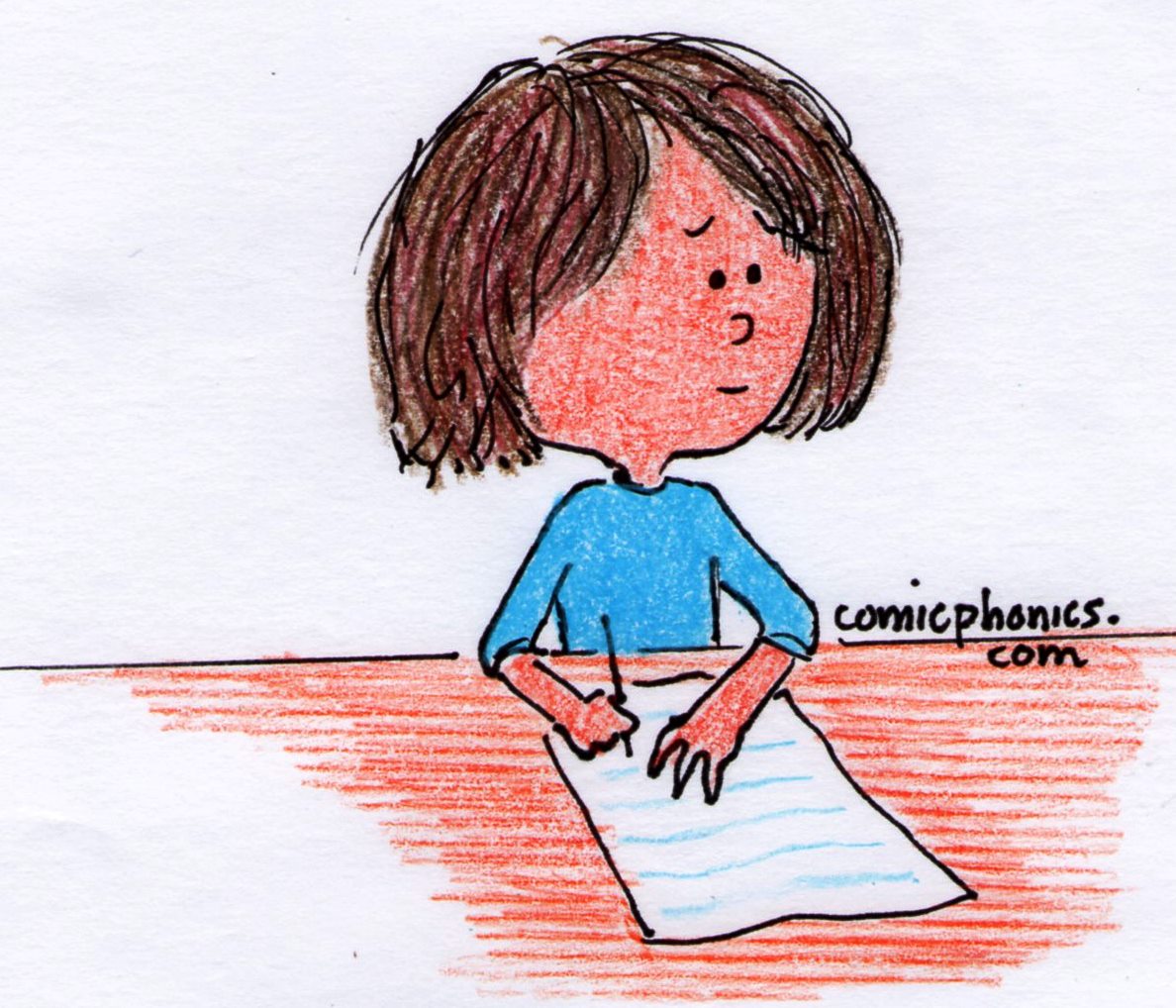
When parents ask for writing help for their children, what kind of help do they want?Child writing

  • Grammar?
  • Vocabulary?
  • Sentence structures?
  • Organizing?
  • Transitions?
  • Introductions and hooks?
  • Conclusions?
  • Spelling?
  • Cursive handwriting?
  • Details?
  • Revising?
  • Particular types of writing (paragraphs? essays? book reports? short answer responses? long answer responses? summaries?)
  • Narrative elements (character development? plot? setting? foreshadowing?  point of view? conflict? dialog? voice? suspense?)
  • Verb tenses?
  • Paraphrasing?
  • Clarity?
  • Dialog?
  • Figures of speech?

Most parents have no idea so many elements combine to create good writing.  When they see a list like this, they are taken aback.

That is why it is important for parents and teachers to agree on what students should learn at various ages.  If a parent thinks the student should be perfecting grammar, but the teacher instead focuses on organization of information, the parent will not be happy.  Or if a parent thinks a student should be using a great piece of rhetoric as a model, but the teacher wants the student to develop his own way of expression, again the parent will be dissatisfied.

Only when a parent is aware of all that a student is expected to learn can the parent and teacher have a meaningful conversation about how to improve a student’s writing.