Category Archives: clarity

Bloated words mean longer, boring writing

Utilize.  Three syllables.  Use.  One syllable.  Why not use “use”?

Price point.  Two words.  Price.  One word.  Why not use “price”?

Vaporous.  Three syllables.  Vapid.  Two syllables. Why not use “vapid”?

Inflating your writing with multi-syllabic or multi-phrasal words when simpler words work just as well makes your writing pompous, long and hard to understand.

So why do it?

  • To sound important. In college I worked as a telephone operator, but my brother suggested I introduce myself as “an international communications coordinator.”  Nobody knew what I was talking about, and when I explained I was a phone operator, they rolled their eyes.
  • To sound educated. Many SAT words are multi-syllablic:  capricious, ephemeral, and facilitated, for example.  But isn’t it easier to understand synonyms such as flighty, short-lived and made easy?  And why do we write?  To sound educated or to be understood?
  • To please an English teacher who confuses big words with deep thinking. In fact, big words obfuscate logic (clutter your meaning) and enshroud cogitation (hide poor thinking).

What can you do to rid your writing of clutter?

  • Look for empty words. If you look, you will find.  Many empty nouns end in “tion,” “ment” and “city.”  Turn them into verbs and then search for simpler synonyms.
  • Tell yourself that big words aren’t better.  They are just bigger.
  • Look up synonyms for long words. Many English words with the most punch are ancient Anglo-Saxon words of one or two syllables.
  • Read the poetry of Robert Frost. Frost rarely used even two-syllable words, and that is no fluke.  He said good writing should be understood on a literal level the first time it is read.

Write short.

How many names are too many names?

When you start to write a novel or a short story, how many characters should you introduce in the first scene?

I picked up the novel of a new-to-me but best-selling author tonight and started reading.  On the first page (really a half page), five characters were introduced along with their relationships to each other.  On the second page, four more people were named and their relationships.  On the third page, one more.  Ten names and a web of who knows how many relationships in two and a half pages of text.  None of them were developed enough to know more than “he’s a detective,” “she’s an au pair,” “she’s giving the party” and “he’s got a crush on the au pair.”

A bit into the second page I was flipping back to the first page to remind myself  who was who.  Then, befuddled, I pulled out a piece of paper and drew family tree-like relationships to keep characters straight.

Should this be necessary?  How many names are too many names?

I have never read any guidance on this topic.  Yet a maximum number of names is an important criterion for me to use to determine if I will keep reading.  If I find myself needing to draw family trees, I ask myself, “Is this worth reading?”  “No,” I almost always decide.  If an author can’t figure out how to introduce characters without confusing me, then the author can’t be that good.  I put the book back on the shelf and move on.

In college I needed to read Anna Karenina in English 101.  At the front of my translation was a list of characters which at first intimidated me.  But I rarely  consulted it.  Tolstoy had a way of introducing characters without overloading my short-term memory.  For the heck of it, I just now checked to count how many characters Tolstoy introduced by name in that novel’s first scene (about two pages).  The answer–three:  Stiva, his wife, Dolly, and one man named as part of a silly dream, a man whose name we realize immediately is not important.  Other people’s roles are mentioned—a French governess, an English governess, a housekeeper, a cook, a kitchen-maid, a coachman, the children—but they are not named.  A reader needs to keep track of only two.  And one of those two we are learning about intimately since those pages are told from his point of view.

How many names are too many names?  I don’t know.  But when I am confused by the third page, that is too many names.

Savoring great sentences

Good writers try to make their sentence structure invisible so that we readers are 100% engrossed in the meaning of the writing without being distracted by the grammar.  But when I read really good writing, I go back to analyze why it seems so effortless, so perfect.

Detective with a magnifying glass inspecting a newspaper.Sometimes I find incredible sentences.  Here is one of my favorite cumulative sentences, jotted down many years ago, its source now unknown to me.

“He stood at the top of the stairs and watched me, I waiting for him to call me up, he hesitating to come down, his lips nervous with the suggestion of a smile, mine asking whether the smile meant come, or go away.”

Isn’t that a great sentence?  It contains 43 words.  Usually 43-word sentences are hard to follow unless they are a list.  But this simple sentence is easy to follow.  Why?

It starts with an independent clause using all single-syllable words:  a subject (he) and two verbs (stood and watched).  Next are two phrases with parallel ideas about the two people (I and he) expressed in parallel grammar (I waiting, he hesitating).  The last two lines are also parallel ideas expressed in similar ways.  The first starts with “his lips,” and the second starts with the pronoun, “mine,” referring to her lips.

Adding to the clarity of this long sentence are the organic transitions.  The first line introduces the two people, “he” and “me”; the second line uses “I,” “him” and “me”; the third uses “he”; the fourth uses “his”; and the fifth uses “mine.”

Also adding to the sentence’s goodness is the use of “up” and “down” to create a visual image of the situation.  In the independent clause we learn a male is at the top of the stairs; in the next phrase we learn that another person is waiting to be called up by him; in the next line the word “down” is used.

Another organic transition is his “lips” and his “smile”; in the last line the word “smile” is repeated.

And finally, there are the last three words.  “Or go away” comes as a surprise.  Wait!  Did I understand this right? the reader asks, going back and re-evaluating what the sentence might really mean.  You have been bewitched by a master writer.

Are you a sentence saver?  If so, you must be a writer.

What parents want writing teachers / tutors to teach

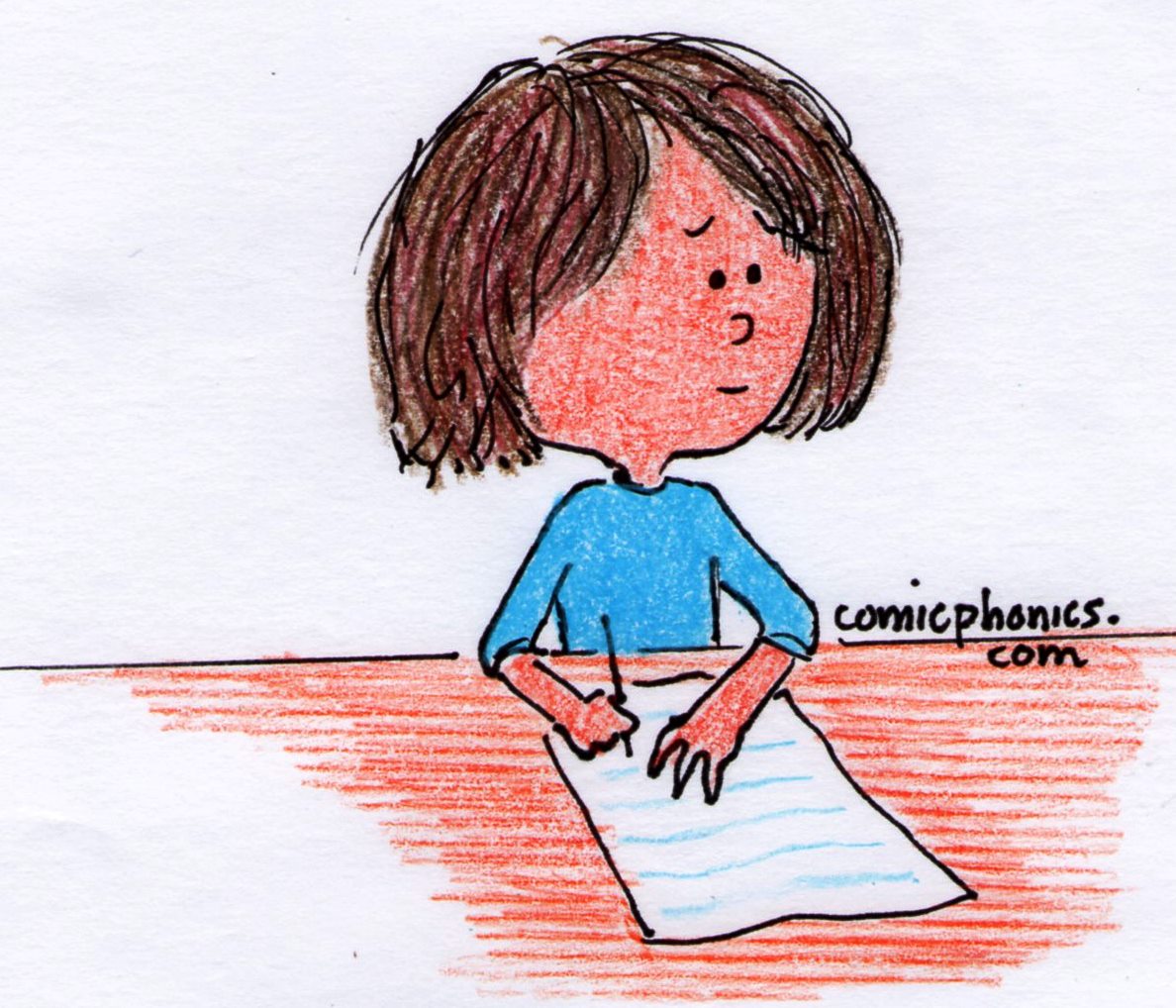
When parents ask for writing help for their children, what kind of help do they want?Child writing

  • Grammar?
  • Vocabulary?
  • Sentence structures?
  • Organizing?
  • Transitions?
  • Introductions and hooks?
  • Conclusions?
  • Spelling?
  • Cursive handwriting?
  • Details?
  • Revising?
  • Particular types of writing (paragraphs? essays? book reports? short answer responses? long answer responses? summaries?)
  • Narrative elements (character development? plot? setting? foreshadowing?  point of view? conflict? dialog? voice? suspense?)
  • Verb tenses?
  • Paraphrasing?
  • Clarity?
  • Dialog?
  • Figures of speech?

Most parents have no idea so many elements combine to create good writing.  When they see a list like this, they are taken aback.

That is why it is important for parents and teachers to agree on what students should learn at various ages.  If a parent thinks the student should be perfecting grammar, but the teacher instead focuses on organization of information, the parent will not be happy.  Or if a parent thinks a student should be using a great piece of rhetoric as a model, but the teacher wants the student to develop his own way of expression, again the parent will be dissatisfied.

Only when a parent is aware of all that a student is expected to learn can the parent and teacher have a meaningful conversation about how to improve a student’s writing.

Use adult vocabulary for academic words

I was working with a high school freshman writing an essay.  He was baffled by his teacher’s directions to write a chicken foot and buckets.  So was I.  There was a drawing of a horizontal line with three diagonal “toes” going out from the end of the horizontal line.  This was the chicken foot.  There was another drawing of four cans with a space for a label at the top of each one.  These were the buckets.  But there was no identification of what these terms or diagrams meant.

Emails back and forth solved the problem.  The chicken foot was the thesis.  The horizontal line was the opinion and the three toes were the supporting ideas backing up the thesis.  The buckets were the details for each of the chicken’s toes, with an extra one  in case.

The more I thought about these terms, though, the more annoyed I became.  Why not use the terminology that the student will need to use in other high school English classes and in college classes?  Why not call a thesis a thesis and its supporting topic sentences supporting topic sentences?  Why not call evidence “evidence” or “citations”?

What my student’s teacher is doing is what so many parents do for babies learning to talk.  The parents say “night-night” instead of “sleep” or “bye-bye” instead of “we’re leaving.” But eventually the children need to learn the proper names for “sleep” and “leaving.”  Why introduce “baby” versions of the words?  Isn’t “sleep” just as easy to understand as “night-night”?

I know the teacher is well meaning.  And I know she explained “chicken foot” and “buckets” during class.  But my student didn’t understand, and looking up those words on the teacher handout didn’t help.  If the teacher had used the word “thesis,” he could have looked that word up and found plenty of explanation.  If she had used the words “topic sentences” or “supporting topic sentences,” he could have found those words and their meanings online.  If she had used the words “evidence” or “citations,” my student could have figured out what they meant and what he was expected to do.

Children eventually need to learn proper vocabulary for ideas, whether it is “identify” or “cite.”  Babying their vocabulary does no service to children; rather it confuses them and stalls their acquisition of adult vocabulary.