Read John Truby’s “The Anatomy of Story” if you are a fiction writer

If you are an aspiring novelist or fiction writer, may I recommend a good how-to book?  It’s not new, but it’s new to me.
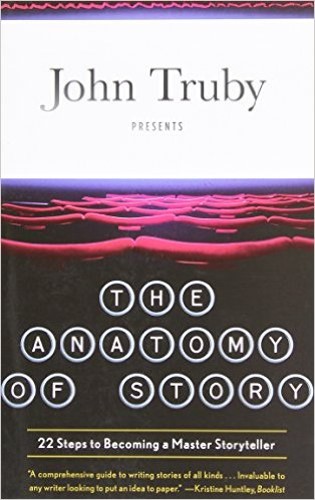
Cover of John Truby's The Anatomy Of StoryJohn Truby’s The Anatomy of Story; 22 steps to becoming a master storyteller has been around since 2007.  I’ve seen it recommended in other how-to writing books, but the “22 steps” part of the title put me off.  And after reading the book and rereading parts, the “22 steps” still seem like a juggernaut to an aspiring novelist.

Yet the book is a masterpiece.  Several points ring true.

  • Every story must have a single pathway to its climax and end. Even stories with as many side steps as Homer’s Odyssey must lead the main character and reader toward a single goal.
  • Every compelling story has one main character (hero) fighting along that pathway toward his or her goal.
  • If the hero’s enemy is an abstraction (a company, a war or evil) the reader will engage more if that enemy can be embodied into a single human enemy such as Darth Vader or Voldemort.
  • The main character must have a flaw to overcome by the end of the story. How he overcomes his flaw is the real story.  Harry Potter must defeat Voldemort.  But Harry is a meek eleven-year-old at his story’s start.  How he overcomes his fears and grows into a man brave enough to defeat Voldemort is the real story.
  • If the main character makes difficult moral choices (not just action choices) on his pathway, the story gains depth and the possibility of greatness.

One inclusion I particularly like is the many novels and movies which the author analyzes when he makes his various points.  I have long known that I like The Godfather, Shane, Chinatown and Casablanca, but now I know why.  It’s because these stories contain so many of the elements which Truby says are essential in great stories.

As for the 22 steps?  Because so much else rings true in The Anatomy of Story, I accept that the 22 steps are necessary for a great novel.  Nobody said writing a novel is easy, and Truby says writing a great novel is rare.  But he has created a formula.  If you are writing fiction, check it out.

Citing evidence is an important writing skill

Citing evidence used to be a skill learned in high school, but with the Common Core State Standards, it has moved to middle grades.  This is because of the Common Core’s emphasis on problem solving.  But it is also because reading critically is an important life skill.

commoncoreenglishlanguagestantards

Click on the above graphic to open the pictured web page.

  • Here is the standard for ninth, tenth, eleventh and twelfth grade literature reading: ELA-Literacy.RL.9-10.1
    “Cite strong and thorough textual evidence to support analysis of what the text says explicitly as well as inferences drawn from the text.”

“Cite several pieces of textual evidence to support analysis of what the text says explicitly as well as inferences drawn from the text.”  (The only difference between high school and middle school standards is the degree of reporting textual evidence.)

  • Here is the standard for sixth, seventh and eighth grade social studies: ELA-Literacy.RH.6-8.1  “Cite specific textual evidence to support analysis of primary and secondary sources.”

Middle school students I tutor need to be able to read a selection and answer a question based on the reading.  The students are expected to cite two or more lines of evidence from the reading when they answer the question.

With practice, most are able to do it.  But some students encounter problems, namely

  • Using in their answers information they know is true but which is not given in the reading passage.
  • Taking two sides of an argument when they are expected to choose only one.
  • Citing not enough evidence to thoroughly support their answer.
  • Citing evidence okay but not showing how the evidence supports the answer.
  • Talking about the text in general without actually citing evidence.
  • Writing evidence as direct quotes, without adapting it to the student’s sentence structure. This can include copying pronouns without identifying what they mean.
  • Not paraphrasing.

How to overcome these problems?

  • Emphasize the difference between a guess or hunch and evidence.
  • Model the difference between strong and weak evidence.
  • Make sure students can explain why evidence they choose supports their answer.
  • Practice paraphrasing.
  • Practice using nouns when pronouns are not clear.
  • Practice, practice, practice.

How to motivate reluctant child writers

If the problem is physical—holding a pencil or pen, having illegible handwriting, or sitting still long enough to write—you can help if you

  • EPSON MFP imageAsk the child to dictate the story to you. You write down exactly what he says.  Coax the child to help with revision.
  • Ask the child to write on a keyboard, phone or tablet. Sometimes technology entices.
  • If the child is willing to hand write, you type and print his work.

If the problem is perfectionism—erasing every mistake, insisting that she start over again and again—you can help if you

  • Reward the child for every line or paragraph written without starting over.
  • Offer to type the writing once it is done so the child can have a clean version.

If the problem is inexperience—too young or too sheltered to have a large mental “data” base—you can help if you supply the story structure.

  • Read a picture book together, discuss how the author began, what the author included, and how the book ended, and then ask the child to rewrite the book, using only the pictures for reference.
  • Find wordless picture books and ask the child to write the story.
  • Find a cartoon strip, cut out the words, and ask the child to write the story. Later you type and print the child’s words and paste them into the cartoon.
  • Introduce the child to storyboards and ask the child to draw her story’s main parts. Later she can add words to her drawings.
  • Encourage the child to find models of the kinds of writing she wants to do, and to follow those models.

If the child is a poor speller,

  • Encourage her to use technology with embedded spelling checkers when she writes.
  • Let her write a first draft by hand without interruptions. Later, underline the misspelled words and together work on fixing them.

If the child has no idea how to begin a story, or how to sequence it, or if she forgets what she wants to happen next,

  • Teach the child to create a mind web before she writes. Using color coding and numbering, help her to sequence the information.  Remind her to check her mind web as she writes.
  • You compile a list of ways to begin a paragraph or essay and review that list with her before she begins. Together come up with several possible ways to begin her particular piece of writing.  You say three or four possible beginnings and discuss the advantages of each.  Then let her choose.

If the child’s vocabulary is limited

  • Create a word bank the child can use and leave it next to her as she writes. Add to it as she describes what she has in mind.
  • Ask her to underline words that she thinks could be said better. Offer suggestions.  Teach her how to use a thesaurus.

If the child has failed at writing before, and fears failing again,

  • Find examples of the child’s past writing and analyze it for why it was done poorly. Many times the reasons are lack of detail, limited vocabulary, and run-ons.
  • If the reason is lack of detail, practice drills of extending sentences. Take a sentence the child wrote, write it on a new piece of paper, and then take turns adding details.  Do this with a whole paragraph and then read the newly written paragraph.
  • If the reason is run-ons, practice finding run-ons. Use the child’s own writing when possible.

Practice, practice, practice.  Writing is a skill, like playing the piano or swimming fast.  Research shows that to write better, a person must practice, practice, practice.

Teaching children when to write “and” and “but”

Learning new vocabulary words in elementary school is important for reading comprehension.  But vocabulary instruction needs to include a deeper understanding of words students write and speak all the time, words they haven’t paid much attention to, such as the conjunctions “and” and “but.”

boy reading

Children know what “and” and “but” mean.  But do they realize they use “and” to connect two words or ideas which are both positive or both negative?  And do they realize they use “but” to join one word or idea they favor and another word or idea they don’t favor?

Helping students learn to write means pointing out the relationships which conjunctions create.  Here’s how.

  • Start with the word “and.” Write a sentence such as “I like ice cream and cookies.”  Point out to the student that you used “and” to join two ideas you feel the same way about.  Ask her if there are any other ways she could say “I like ice cream and cookies” without using “and.”  If she is stumped, suggest, “I like ice cream.  Additionally, I like cookies.”  Or, “I like ice cream as well as cookies.”  Or, “I like ice cream.  Also, I like cookies.”  Point out that “and,” “additionally,” “as well as” and “also” all are used to connect ideas which we feel the same way about, either positively or negatively.

Other words which mean the same as “and” include consequently, because,  moreover, and furthermore.  A semicolon between two sentences usually indicates that the idea in the first sentence continues in the second sentence.

  • Now write a sentence such as “I like ice cream but not anchovies.”    Ask her if there is any other way to say that idea.  She might say, “I like ice cream.  However, I don’t like anchovies.”  Or, “I like ice cream although I don’t like anchovies.”  Or, “I like ice cream even though I don’t like anchovies.”  Point out that “but,” “however,” “although” and “even though” all are used to connect ideas we don’t feel the same way about.  One idea we like and one idea we don’t like.  One idea usually uses a form of “not” or a prefix that means “not” such as un, im, ir, or dis.

Words which mean the same as “but” show contrast.  Some other words are though, despite and yet.

  • To reinforce the difference between “and” and “but” and their synonyms, suggest two ideas, such as summer and winter. Ask the student to say or write a sentence saying how they feel about those two times of year.  Now ask the student to change the word or words they used to connect summer and winter to a word or phrase which means the same thing.  Now do it again to another phrase or word which means the same thing.  Try another relationship, such as snakes and dogs.  Again, ask for synonyms for the connecting words.

Being aware how “and” and “but” and their synonyms create different relationships between ideas is important in writing.  If a child is reading and comes to the word “however,” she knows the thought has just changed to an opposite kind of thought.  If she comes to the word “moreover,” she knows more of the same kind of thought is coming.

Another way of teaching these ideas is to suggest that “and” is something like a plus sign, but “but” is something like a subtraction sign.  Or “and” is something like walking straight ahead while “but” is something like taking a U-turn.

Writing metaphors

Metaphors are powerful figures of speech.  For example, take Robert Frost’s poem “Stopping by Woods on a Snowy Evening.”  Of the last two identical lines, the first is literal but the second is metaphorical.  The first “And miles to go before I sleep” means just that, a long way to travel before the horse and buggy driver can drop into bed.   But the second “And miles to go before I sleep” means–perhaps–not a literal sleep but the “sleep” of death.  Frost could have ended his poem with, “And miles to go before I sleep, and miles to go before I die,” but how much more eloquent is his repetition of the word “sleep,” a metaphor for death.

EPSON MFP imageReading metaphors requires more of  readers than does reading literal words or even similes.  Readers must make a connection which is inferred but not stated directly.  Yet for their work, readers are rewarded, gaining satisfaction from discovering the meaning of the metaphor.

Metaphors are rarely written by adults and especially not by children.  They need to be taught, and need to be practiced.

Where to begin?  Here are three ways.

  • Suppose a child is writing a story with two or three characters. The child could use ordinary names for his characters, or he could use names as metaphors, the way J. K. Rowling does in her Harry Potter books.  (Malfoy means bad faith; Snape sounds like snake; the “mort” of Voldemort means death.)  A child could create a metaphorical name to reveal something about a character’s nature.  You and the student could brainstorm about a name which indicates bossiness, for example.  It could be a word which means boss (Lord, Lady, King, Rex, Regis, Mayor, Bishop, Majors) or a word which sounds like a word which means boss, even if it is made up (Empor, Captin, Sarge, Leder).
  • Suppose a character is doing something, such as running fast, and the child writes a simile, such as “runs like a cheetah.” Show the child that he could also write that the character “runs on cheetah legs.”  Many similes are easily turned into metaphors.  “as fast as lightning” could be “lightning fast” or “races with lightning steps.”  “Runs as fast as a rocket” could be “blasts on rocket feet.”
  • Ask the child to picture someone’s hands not as hands, but as something else:  scissors, pencils, chopsticks, or hooks.  Now turn that image into a metaphor.  He ate with chopstick fingers.  She arranged her hair with finger combs.  Mom smoothed her dress with finger irons.