What writing skills are expected of fourth and fifth graders?

  • In fourth grade simple stories or essays are expected from most children. A topic sentence becomes the introduction, lots of facts become one or more body paragraphs, and a summing-it-all-up sentence becomes the conclusion.  Many students need help with the introductions, not knowing how to begin.  Almost all students need help with the conclusions.  They are expected to use transitions.  Students need to learn to plan their writing so that sequencing information isn’t a problem.
  • The Common Core State Standards (CCSS) asks fourth grade students to “write opinion pieces on topics or texts, supporting a point of view with reasons and information; introduce a topic or text clearly, state an opinion, and create an organizational structure in which related ideas are grouped to support the writer’s purpose; provide reasons that are supported by facts and details; link opinion and reasons using words and phrases (e.g., for instance, in order to, in addition);and provide a concluding statement or section related to the opinion presented.
  • The CCSS also asks fourth graders to “write informative/explanatory texts to examine a topic and convey ideas and information clearly;
    introduce a topic clearly and group related information in paragraphs and sections; include formatting (e.g., headings), illustrations, and multimedia when useful to aiding comprehension;
     develop the topic with facts, definitions, concrete details, quotations, or other information and examples related to the topic; link ideas within categories of information using words and phrases (e.g., another, for example, also, because); use precise language and domain-specific vocabulary to inform about or explain the topic; and provide a concluding statement or section related to the information or explanation presented.”
  • As for narrative writing, the CCSS asks fourth graders to ” write narratives to develop real or imagined experiences or events using effective technique, descriptive details, and clear event sequences;
    orient the reader by establishing a situation and introducing a narrator and/or characters; organize an event sequence that unfolds naturally; use dialogue and description to develop experiences and events or show the responses of characters to situations; use a variety of transitional words and phrases to manage the sequence of events; use concrete words and phrases and sensory details to convey experiences and events precisely; and provide a conclusion that follows from the narrated experiences or events.
  • girl with pony tail on floor writingBy fifth grade, if the students have had enough practice, they should be able to write simple expository (informational) and persuasive essays and short narratives. They should write an introductory paragraph, two or three body paragraphs, and a conclusion paragraph.


What kind of writing should second and third graders do?

Here are what the Common Core State Standards (CCSS) expect student writers  to achieve in second and third grade.

  • The CCSS expects second graders to “write opinion pieces in which they introduce the topic or book they are writing about, state an opinion, supply reasons that support the opinion, use linking words (e.g., because, and, also) to connect opinion and reasons, and provide a concluding statement or section; write informative/explanatory texts in which they introduce a topic, use facts and definitions to develop points, and provide a concluding statement or section; write narratives in which they recount a well-elaborated event or short sequence of events, include details to describe actions, thoughts, and feelings, use temporal words to signal event order, and provide a sense of closure.
  • In my experience, by second grade, students learn the concept of paragraphing, or as the children understand it, collecting sentences about the same thing in a single paragraph. They learn to indent.  But most still write everything as one long paragraph and need to be reminded about paragraphing, punctuation, spelling, and upper and lower case use.
  • In my experience, by third grade students learn to write topic sentences for paragraphs, usually by asking a question (Do you want to know about my dog?) or by making a statement about the obvious (I’m going to tell you about my dog). They need help imagining other ways to start paragraphs.  Some students still need help separating a group of sentences into paragraphs although a few students might be writing longer and somewhat sophisticated passages.  They learn about different kinds of writing–informative, persuasive and narrative–and try their hands at each kind with varying success.”
  • For persuasive writing, the CCSS recommends that third graders should “write opinion pieces on topics or texts, supporting a point of view with reasons;introduce the topic or text they are writing about, state an opinion, and create an organizational structure that lists reasons;provide reasons that support the opinion; use linking words and phrases (e.g., because, therefore, since, for example) to connect opinion and reasons; and provide a concluding statement or section.
  • For informative/explanatory writing, the CCSS recommends that third graders should write informative/explanatory texts to examine a topic and convey ideas and information clearly; introduce a topic and group related information together; include illustrations when useful to aiding comprehension; develop the topic with facts, definitions, and details; and use linking words and phrases (e.g., also, another, and, more, but) to connect ideas within categories of information; provide a concluding statement or section.”
  • For narratives the CCSS recommends that third graders “develop real or imagined experiences or events using effective technique, descriptive details, and clear event sequences; establish a situation and introduce a narrator and/or characters; organize an event sequence that unfolds naturally; use dialogue and descriptions of actions, thoughts, and feelings to develop experiences and events or show the response of characters to situations; use temporal words and phrases to signal event order; and provide a sense of closure.

In second and third grade, the CCSS also expects students  to begin to use electronic equipment.

For more information, go to http://www.corestandards.org/ELA-Literacy/W/3/.

What kind of writing should kindergarteners and first graders be able to do?

The ability to write well comes gradually and in stages.  This skill is a synthesis of many writing skills, each building on one another.  Here is what I see in practice and what the Common Core State Standards recommends for kindergarten and first graders.

  • In kindergarten children learn to write letters and words, and some advanced students may write sentences.  They might write with phonetic or invented spelling, backward letters, missing punctuation and haphazard  capitalization.  They use a combination of upper case and lower case letters.  They like to draw a picture of what they are describing.
  • The Common Core State Standards (CCSS) ask kindergarteners to “use a combination of drawing, dictating, and writing to compose opinion pieces in which they tell a reader the topic or the name of the book they are writing about and state an opinion or preference about the topic or book; use a combination of drawing, dictating, and writing to compose informative/explanatory texts in which they name what they are writing about and supply some information about the topic; and use a combination of drawing, dictating, and writing to narrate a single event or several loosely linked events, tell about the events in the order in which they occurred, and provide a reaction to what happened.”
  • In first grade children’s writing ability varies widely, but teachers expect students to write in sentences by the end of the year. They might draw a picture at the top of a paper and then write one or more sentences under the picture telling what the picture means, and using many of the errors which kindergarteners use.  Many of the rules of writing and spelling are fluid for a first grader, but they are becoming formal than for kindergarteners.
  • The Common Core State Standards recommend that first graders “write opinion pieces in which they introduce the topic or name the book they are writing about, state an opinion, supply a reason for the opinion, and provide some sense of closure; write informative/explanatory texts in which they name a topic, supply some facts about the topic, and provide some sense of closure; and write narratives in which they recount two or more appropriately sequenced events, include some details regarding what happened, use temporal words to signal event order, and provide some sense of closure.”

As you can see, a wide gap exists between what many children can do and what the CCSS expect them to do.  For more on the Common Core State Standards, go to http://www.corestandards.org/ELA-Literacy/W/K/.

To comma, or not to comma? That is the question.

Which way would you write this phrase:  “red, white, and blue” or “red, white and blue”?

In Maine, a court case involving around $10 million in back overtime pay came down to just this:  Is the comma before the word “and” needed in a series?

If you are thinking, “You gotta be kidding,” no I’m not.  The case of O’Connor v. Oakhurst Dairy, settled this month in a US Appeals Court in Maine, focused on whether some drivers deserved overtime.  That decision—yes, they do deserve overtime– came down to the lack of a comma in one of Maine’s overtime laws.

Here is the Maine law stating which workers don’t deserve overtime pay:

The canning, processing, preserving,
freezing, drying, marketing, storing,
packing for shipment or distribution of:
(1) Agricultural produce;
(2) Meat and fish products; and
(3) Perishable foods.

The problem is the lack of a comma after the word shipment.  Is the phrase “packing for shipment or distribution of” to be taken as a whole?  Or are the shipment and distribution two separate categories, neither of which deserves overtime?  If the law had a comma after the word shipment, distribution would not require overtime pay.

The court ruled that the lack of a comma after “shipment” made the law ambiguous even though it follows the written guidelines in the Maine Legislative Drafting Manual.  The court sided with the drivers distributing milk, saying they were entitled to overtime.

The AP Stylebook, which most reporters consult for grammar issues, says the final comma before “and” is not needed in most cases any more than is a comma needed for a two item series (bread and butter; not bread, and butter).  However, the style manuals used in colleges and universities do require the comma, and public schools where I live, in Georgia, teach that the comma is required.

There is a name for the comma before the word “and.”  It is called the Oxford comma.  I haven’t heard of a word for the lack of a comma, but for this discussion we might call it the AP comma rule.

Which practice do you use?  The Oxford comma?  The AP comma rule?  Usually I use the AP comma rule unless doing so leads to confusion.  Sometimes the AP comma rule can lead to what seems like an appositive rather than a continuation of a series, such as in “I want to thank my two political science teachers, President Obama and Hillary Clinton.”  If omitting the comma could lead to confusion, I include the comma.

The tendency in US writing is to leave out commas when the sentence is clear without punctuation.  For example, years ago I was taught that introductory adverbs like “now,” “later” and “then” need to be followed by a comma.  Yet the comma in “Then, I went home” seems silly.  I was also taught that compound sentences should use a comma after the first clause, but in the short sentence, “I fell and I hurt my leg,” a comma after “fell” seems ridiculous.

The first rule in writing anything is “Be clear.”  If leaving out a comma leads to ambiguity, use a comma. Otherwise, unless you are following a particular style book, the choice is yours.

By the way, when Shakespeare wrote “To be, or not to be,” in Act 3, Scene 1 of Hamlet, he used the Oxford comma.

Dysgraphia needs to be accommodated like other learning disabilities

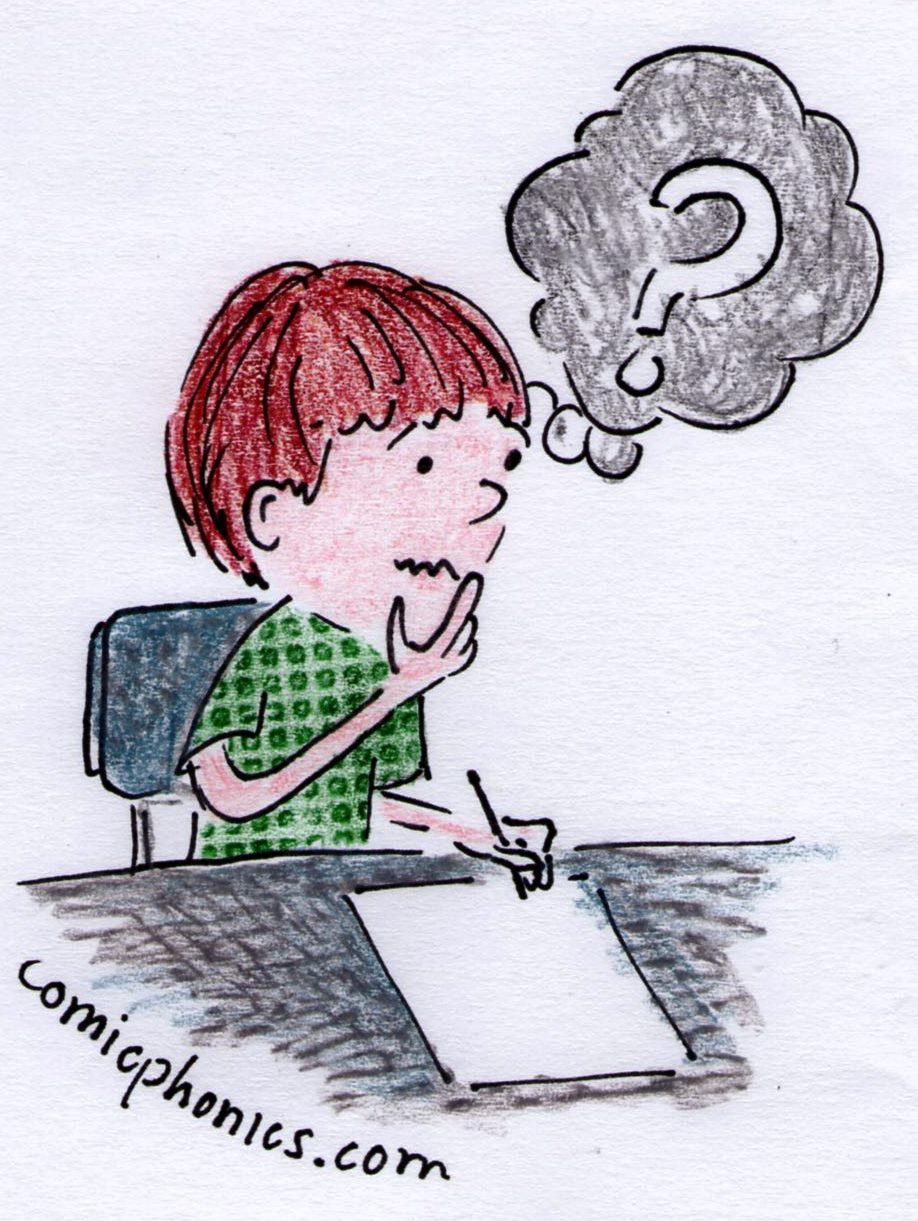
Dysgraphia is a learning disorder in which a child does not want to write.  In other ways the child is normal, but he flat out doesn’t want to hold a pencil and write.  If he is forced to write, his letter formation, the spacing between letters and words, and the various sizes of letters indicate something’s wrong.

EPSON MFP imageAll children have times when they balk at writing—when they’re tired, for example.  But dysgraphia shows as a day-in, day-out struggle to get a child to write–and not just in a writing lesson but in math and social studies too.  You might think the child is having a temper tantrum, but actually he is balking at a way of learning which makes no sense to him.  Children with dysgraphia spend so much energy thinking about how to hold the pencil, and how to form the letters, and where the spaces go, that whatever they are supposed to learn by writing—whether it is addition facts or how fossils form—is lost.

Something is wrong, and that something is how the brain works.  (More on that in future blogs.)

So what can you, as the parent or teacher of such a child, do to end tears and tantrums?

  • As much as possible, for that student eliminate writing as a way of learning and testing. Some students are asked to write each new spelling or vocabulary word five times.  Don’t assign this kind of work to a child with dysgraphia.  Let the child use flashcards rather than worksheets to learn math facts.
  • Allow the child to do her work out loud. Let the child tell an adult what she knows.  Allow the child to speak her answers directly to you or into an audio recording machine.
EPSON MFP image

EPSON MFP image

  • If the child must write a story or an essay, or answer a question in a sentence or two, give the child time to organize her thoughts. Then let her dictate her response to you.  When it’s time to revise, let the child dictate the revisions.
  • Make learning the use of a keyboard a part of this student’s studies.
  • Allow the student to “write” on an iPad or other electronic device.
  • Try various kinds of writing tools. Sometimes smooth-flowing markers can seem not as bad as pencils or pens. Sometimes thicker or thinner tools can feel better.  The smooth surface of a dry erase board can entice a student.
  • If the child has sensory integration issues, schedule writing after recess or after a back rub.

You might be thinking: But at a certain point, doesn’t the child need to conform?

Maybe that’s the wrong question.  Maybe we should be asking how we can make learning math, languages, science and social studies possible without needing to write.  We do it in other fields.  Do you need to write to learn how to play a piano?  Create a collage?  Act in a play?

Writing is one way to learn, but it is not the only way.  For children with other learning problems, we make accommodations.  Do blind children read with their eyes?  Do deaf children speak with their mouths?

In this time of differentiated learning, children with dysgraphia need to be recognized as living with a brain impairment.  They need to be accommodated so that they can learn in a way which makes sense to them.