Category Archives: English Writing Instruction

Writing well takes study and practice.

College writing is moving into high school

I am working with a high school sophomore who is writing an argumentative research paper, the kind of research paper I was required to write in college.

His teacher identified the type of information required for each paragraph in a handout.  It includes a hook leading into an introduction leading into a thesis, using a funnel effect to taper to the thesis.  The thesis must have several elements, all of which must be backed with data in the body.

The body must have at least three sections of data supporting the thesis, plus a counter argument which must be debunked.  The conclusion should not merely repeat the thesis but in some other way support the ideas of the essay.

This essay is due not for an A.P. course but for a regular sophomore English class.

With another high school sophomore, I worked on a Toulmin essay.  This kind of essay has a rigid structure for each body paragraph.  First comes a position statement or thesis; second, a claim or example supporting the position; third, data cited to support the claim; fourth, a warrant or a clarification of the connection between the claim and the data; fifth, a counterclaim which rebuts the thesis; and last, a rebuttal with data to destroy the counterclaim.

With another high school freshman I worked on a response to a news article using the SAOQ method:  summarize the article in a few sentences; analyze the main idea or some aspect of the article; offer your opinion on the ideas in the article, using logical arguments to back your opinion; and offer three discussion questions of a probing nature to show you have pondered the article.

These assignments call on higher level thinking skills:  analyzing information; researching, using and citing appropriate data; recognizing truth from stereotypes or “fake news”; recognizing valid counterclaims; evaluating ideas; and synthesizing information into new literary forms.

In short, these writing assignments require critical thinking, the kind of thinking the Common Core Standards advocate.  No matter what you may think of the Common Core Standards, they are putting pressure on schools to develop students who can think.  In the three schools where my three students study, the schools and the students are meeting the challenge.

Finding the right word

When you are reading a rough draft, and you come to a word which seems not quite right to you, or you know there must be a better word but you don’t know what it is, what should you do?

Draw a box around any word which offers an opportunity for improvement and keep reading, says John McPhee, author of Draft No. 4: On the Writing Process.  Later, go back, and one by one, think about each of those words.  He suggests you use a good dictionary, the kind which will not only offer synonyms but which will explain shades of meaning among those synonyms.

McPhee recommends not heading directly to a thesaurus because generally thesauruses list synonyms but do not identify shades of meaning, and it is that nuance that you are probably looking for.  However, he says that if you like using a thesaurus, do that, but then look up your chosen word or phrase in a dictionary too.  He calls thesauruses “rest stops” on the way to the dictionary.

McPhee also warns against choosing a multisyllabic word when a simple word will do.

McPhee is author of close to three dozen nonfiction books and is a former writer for Time and The New Yorker.  He offers advice in Draft No. 4 based on his experience writing for more than 50 years, including how to interview in a way which makes people open up, and how to structure nonfiction so that the structure helps the writer but is invisible to the reader.

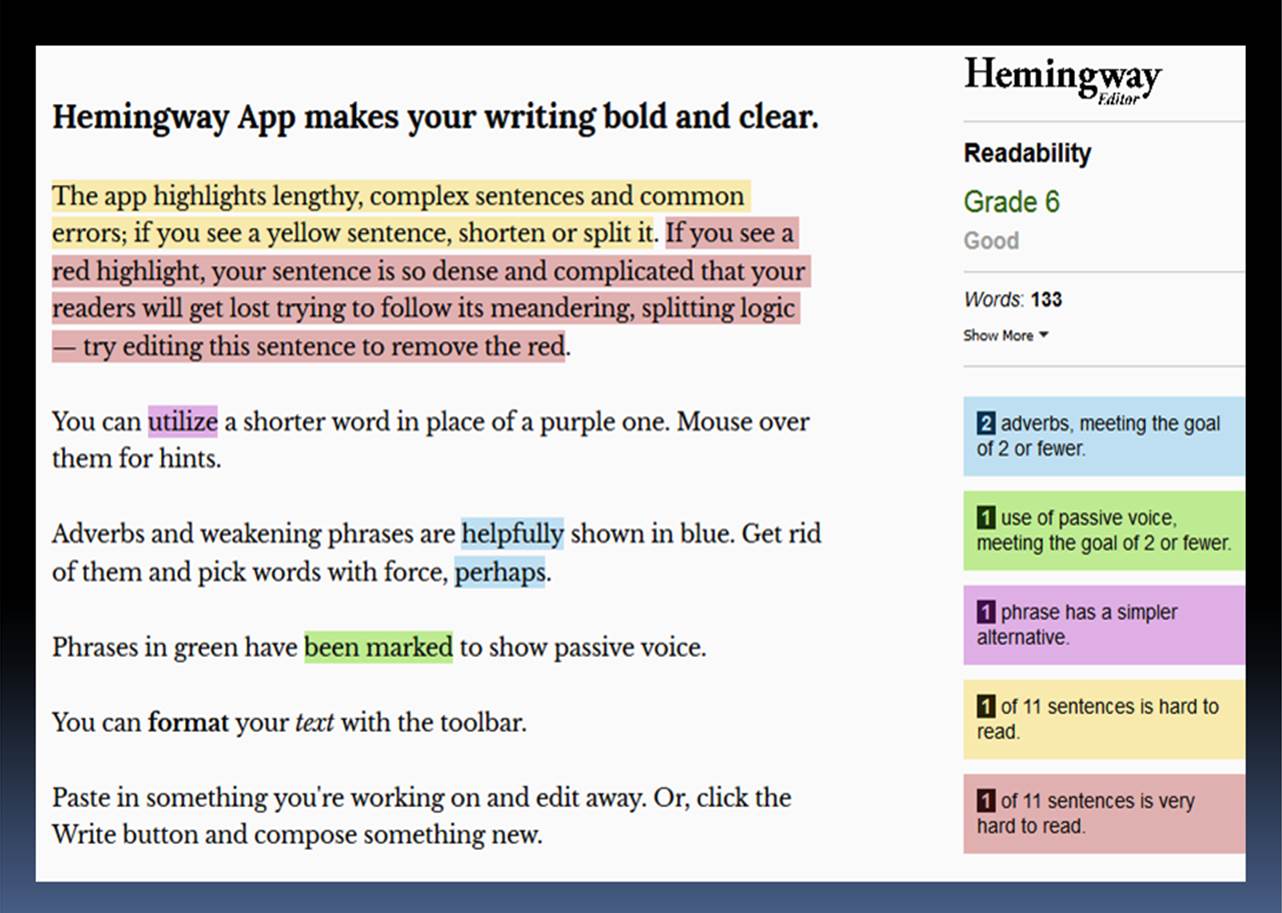
Want to write like Hemingway? There’s an app for that

Do you want to write like Ernest Hemingway, using active voice verbs; short, simple sentences; short, one-syllable words; and few adverbs?  There is a free web app to help you.  Here’s how the app works.

Type a passage which you want to be more Hemingway-like. Swipe and copy it.  Go to Hemingwayapp.com.  Click the “H1,” “H2,” or “H3” button at the top of the app screen to allow you to paste your passage.  Or click the “write” button in the top right corner to compose on the site.


Highlighted in yellow will be sentences which are long or complex or which have common errors. The app identifies them, but it’s up to you to figure out how to fix them.

Highlighted in red will be sentences which are dense, that is, too full of information. Again, it’s up to you to figure out how to fix them.

Highlighted in purple will be words for which a shorter synonym is possible. Synonyms will be suggested by the app.

Highlighted in blue will be adverbs—a sign that your verbs aren’t strong enough to stand alone. The app won’t suggest stronger verbs, but it will identify adverbs, most of which should probably go.

Highlighted in green will be passive voice verbs. You need to figure out how to rewrite the sentence to make the verb active.

In the right margin will be a readability score, that is, the reading grade level of your passage.

The Hemingway app will make your writing more Hemingway-like, but that doesn’t mean your writing will be of high literary merit.  Your writing will be streamlined and easier to read, but that is not the same as “good.”

Still, if your revising skills are poor, or if you are pinched for time, this app can offer suggestions on how to make your writing more readable.  The cost to download a desktop version (3.0) is $19.99, available for both PC’s and Mac’s.


Problems students encounter with questions demanding a written response

Most third graders now need to write paragraph responses to questions on ELA, math, science and social studies tests. This is one of the upgrades in skills brought by the Common Core curriculum. Previously, third graders might have been tested using only multiple choice questions or questions requiring a word or a phrase for an answer. But a whole paragraph written in grammatically correct sentences and with evidence from the text? This is new.

And it’s not easy. I’ve worked with a few students on these short answer responses requiring the inclusion of evidence. Here’s what happens.

• Students write an answer but they forget to include the evidence.
• Students quote the evidence, sometimes word for word, but fail to connect it to the question asked or to the main idea.
• Students provide only one example of evidence when the question calls for two or three.
• Students make up evidence, not realizing they must stick to the evidence in the text.
• Students provide irrelevant evidence.
• Students respond with un-asked-for information. If the directions ask the student to conclude, she might summarize. If the directions ask the student to describe, she might identify.
• Students do not stick to the point; they go off on tangents.
• Students write what they know even though that has not been asked for.
• Students write using incomplete or illogical thoughts.
• Students might talk around a topic without ever responding directly to the question asked.
• Students leave out information which is clear to them even though it might not be clear to a reader.
• Students tire or become distracted before they are done. They might forget to finish or give up.

Are there solutions? Yes, and we’ll talk about them in coming blogs.

10 picture books with simple illustrations

Picture books with simple illustrations and bland backgrounds—the kinds which appeal to toddlers and children with sensory integration problems—can be hard to find if you search online or on shelf.  Even harder to find are such books which tell a story.

But they are great boks for reading aloud to sensitive children.  And they are equally valuable for suggesting story ideas for children to write.

Here are ten such books from all over the world which your child might enjoy.  Many have won awards.


Why Mosquitos Buzz in People’s Ears by Verna Aardema

The Enormous Crocodile by Roald Dahl (the version illustrated by Quentin Blake)

The Snowman by Raymond Briggs

Puss Jekyll Cat Hyde by Joyce Dunbar

The Farmer and the Clown by Marla Frazee (wordless)

Flora and the Penguin by Molly Idle (wordless)

The Great Paper Caper by Oliver Jeffers

The Snowy Day by Ezra Jack Keats

Snow White and the Fox by Niroot Puttapipat

Lon Po Po:  A Red Riding Hood Story from China by Ed Young