Category Archives: Common Core Standards

What kind of writing should second and third graders do?

Here are what the Common Core State Standards (CCSS) expect student writers  to achieve in second and third grade.
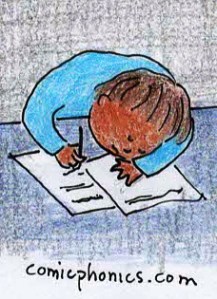
  • The CCSS expects second graders to “write opinion pieces in which they introduce the topic or book they are writing about, state an opinion, supply reasons that support the opinion, use linking words (e.g., because, and, also) to connect opinion and reasons, and provide a concluding statement or section; write informative/explanatory texts in which they introduce a topic, use facts and definitions to develop points, and provide a concluding statement or section; write narratives in which they recount a well-elaborated event or short sequence of events, include details to describe actions, thoughts, and feelings, use temporal words to signal event order, and provide a sense of closure.
  • In my experience, by second grade, students learn the concept of paragraphing, or as the children understand it, collecting sentences about the same thing in a single paragraph. They learn to indent.  But most still write everything as one long paragraph and need to be reminded about paragraphing, punctuation, spelling, and upper and lower case use.
  • In my experience, by third grade students learn to write topic sentences for paragraphs, usually by asking a question (Do you want to know about my dog?) or by making a statement about the obvious (I’m going to tell you about my dog). They need help imagining other ways to start paragraphs.  Some students still need help separating a group of sentences into paragraphs although a few students might be writing longer and somewhat sophisticated passages.  They learn about different kinds of writing–informative, persuasive and narrative–and try their hands at each kind with varying success.”
  • For persuasive writing, the CCSS recommends that third graders should “write opinion pieces on topics or texts, supporting a point of view with reasons;introduce the topic or text they are writing about, state an opinion, and create an organizational structure that lists reasons;provide reasons that support the opinion; use linking words and phrases (e.g., because, therefore, since, for example) to connect opinion and reasons; and provide a concluding statement or section.
  • For informative/explanatory writing, the CCSS recommends that third graders should write informative/explanatory texts to examine a topic and convey ideas and information clearly; introduce a topic and group related information together; include illustrations when useful to aiding comprehension; develop the topic with facts, definitions, and details; and use linking words and phrases (e.g., also, another, and, more, but) to connect ideas within categories of information; provide a concluding statement or section.”
  • For narratives the CCSS recommends that third graders “develop real or imagined experiences or events using effective technique, descriptive details, and clear event sequences; establish a situation and introduce a narrator and/or characters; organize an event sequence that unfolds naturally; use dialogue and descriptions of actions, thoughts, and feelings to develop experiences and events or show the response of characters to situations; use temporal words and phrases to signal event order; and provide a sense of closure.

In second and third grade, the CCSS also expects students  to begin to use electronic equipment.

For more information, go to http://www.corestandards.org/ELA-Literacy/W/3/.
What kind of writing should kindergarteners and first graders be able to do?

The ability to write well comes gradually and in stages.  This skill is a synthesis of many writing skills, each building on one another.  Here is what I see in practice and what the Common Core State Standards recommends for kindergarten and first graders.

  • In kindergarten children learn to write letters and words, and some advanced students may write sentences.  They might write with phonetic or invented spelling, backward letters, missing punctuation and haphazard  capitalization.  They use a combination of upper case and lower case letters.  They like to draw a picture of what they are describing.
  • The Common Core State Standards (CCSS) ask kindergarteners to “use a combination of drawing, dictating, and writing to compose opinion pieces in which they tell a reader the topic or the name of the book they are writing about and state an opinion or preference about the topic or book; use a combination of drawing, dictating, and writing to compose informative/explanatory texts in which they name what they are writing about and supply some information about the topic; and use a combination of drawing, dictating, and writing to narrate a single event or several loosely linked events, tell about the events in the order in which they occurred, and provide a reaction to what happened.”
  • In first grade children’s writing ability varies widely, but teachers expect students to write in sentences by the end of the year. They might draw a picture at the top of a paper and then write one or more sentences under the picture telling what the picture means, and using many of the errors which kindergarteners use.  Many of the rules of writing and spelling are fluid for a first grader, but they are becoming formal than for kindergarteners.
  • The Common Core State Standards recommend that first graders “write opinion pieces in which they introduce the topic or name the book they are writing about, state an opinion, supply a reason for the opinion, and provide some sense of closure; write informative/explanatory texts in which they name a topic, supply some facts about the topic, and provide some sense of closure; and write narratives in which they recount two or more appropriately sequenced events, include some details regarding what happened, use temporal words to signal event order, and provide some sense of closure.”

As you can see, a wide gap exists between what many children can do and what the CCSS expect them to do.  For more on the Common Core State Standards, go to http://www.corestandards.org/ELA-Literacy/W/K/.

Citing evidence is an important writing skill

Citing evidence used to be a skill learned in high school, but with the Common Core State Standards, it has moved to middle grades.  This is because of the Common Core’s emphasis on problem solving.  But it is also because reading critically is an important life skill.

commoncoreenglishlanguagestantards

Click on the above graphic to open the pictured web page.

  • Here is the standard for ninth, tenth, eleventh and twelfth grade literature reading: ELA-Literacy.RL.9-10.1
    “Cite strong and thorough textual evidence to support analysis of what the text says explicitly as well as inferences drawn from the text.”

“Cite several pieces of textual evidence to support analysis of what the text says explicitly as well as inferences drawn from the text.”  (The only difference between high school and middle school standards is the degree of reporting textual evidence.)

  • Here is the standard for sixth, seventh and eighth grade social studies: ELA-Literacy.RH.6-8.1  “Cite specific textual evidence to support analysis of primary and secondary sources.”

Middle school students I tutor need to be able to read a selection and answer a question based on the reading.  The students are expected to cite two or more lines of evidence from the reading when they answer the question.

With practice, most are able to do it.  But some students encounter problems, namely

  • Using in their answers information they know is true but which is not given in the reading passage.
  • Taking two sides of an argument when they are expected to choose only one.
  • Citing not enough evidence to thoroughly support their answer.
  • Citing evidence okay but not showing how the evidence supports the answer.
  • Talking about the text in general without actually citing evidence.
  • Writing evidence as direct quotes, without adapting it to the student’s sentence structure. This can include copying pronouns without identifying what they mean.
  • Not paraphrasing.

How to overcome these problems?

  • Emphasize the difference between a guess or hunch and evidence.
  • Model the difference between strong and weak evidence.
  • Make sure students can explain why evidence they choose supports their answer.
  • Practice paraphrasing.
  • Practice using nouns when pronouns are not clear.
  • Practice, practice, practice.

Did the Common Core eliminate cursive handwriting as something kids need to learn? I can’t believe it!

The Common Core requires legible manuscript (printing) in kindergarten and first grade, but after that there are no standards relating to handwriting.  Learning cursive writing is not required.

In fourth grade, the Common Core requires students to be able to keyboard or type a full page at one sitting.

However, the Common Core developers have encouraged individual states and school districts to modify the standards as is appropriate for their populations.  Some states have included handwriting.  In California, kids need to learn printing in second grade and cursive in third and fourth grade.  Massachusetts requires legible handwriting of any kind in fourth grade.

Does your state require children to practice handwriting?  You can find out by going to your state’s department of education and searching for the state-required curriculum.  You may find that your state has adopted the Common Core as a whole, in which case handwriting will not be taught after first grade.

But that does not mean you can’t augment your child’s learning.  Teacher supply stores sell booklets on how to write in cursive.  Or you can go online to find such materials.

One good reason for children to be able to read and write cursive is to be able to read documents from the past.  The original Declaration of Independence and US Constitution were first written in cursive as were all documents before the 1860’s when the typewriter started being used.

Another reason is that teachers in higher grades and college often write notes, worksheets and sometimes tests in cursive.  A seventh grader told me that when her science teacher wrote some notes on the white board, few students in the class could read them.  The same teacher wrote a thank you note to members of a team she coaches, and the students needed to ask their parents to read the note to them.

Until word processing became popular in the 1980’s, most private correspondence, diaries, journals and manuscripts were written in cursive.  How awful not to be able to read great-grandpa’s post cards home from WWII or great-grandma’s recipes in her hand.

Written responses to test questions can be made faster with cursive than with printing.  This might not seem important when children are little, but writing a complete essay in 25 minutes for the SAT is another matter.  Sometimes students will have electronic notepads to take notes, but when they don’t, they will appreciate the ease of note-taking in cursive.

A few minutes a day practicing one letter at a time is all it takes to learn cursive.  Yet that knowledge opens another world to children, as does reading music, Braille, sign language or numbers.

How to teach writing—what the research says

After analyzing 250 important research studies on how to teach writing, researchers found three constants:

  • The more time students write, the better writers they will be.
  • Writing on a computer, rather than by hand, leads to better writing.
  • Teaching grammar doesn’t help.

student thinking about what to write

Let’s look at each of these correlations with good writing.

Spending more time writing improves student writing. It’s common sense that the more time you spend honing a skill, the better you become at it. Yet research shows that after third grade, students spend little time in class writing. Why?

The more students write, the more teachers need to read, to respond to and possibly to grade. The paperwork becomes overwhelming. Teachers are unwilling to spend hours every night reading student writing.

Also, many English teachers love literature and want to teach it. But they are not writers. They had little instruction in how to write when they were in school, and their teacher training didn’t focus on it. They can’t teach what they don’t know.

Composing on a computer leads to better student writing. Once a student becomes familiar with the keyboard and functions, writing on a computer goes much faster than writing by hand. You can move phrases, sentences, and even paragraphs around by swiping, cutting and pasting. Spell check indicates spelling errors, and software alerts you to grammar errors as well. A dictionary is a click away. Want to check on idioms or figures of speech? Another click away.

All this work is called revising, and as every professional writer knows, it is the key to good writing. When it becomes easy for students, they are willing to do it.

Yet most schools still ask students to write using pencil and paper. Why?

Maybe teachers believe students “cheat” when they let software provide correct spelling and grammar. How can teachers check for plagiarism if students can download someone’s writing? Or maybe teachers think that because computer technology is not available to all students, to level the playing field they should ask students to use a technology that is available, pencils and paper.

Learning grammar by diagramming sentences or by listening to distinct lessons on how to use apostrophes does not improve writing, according to the research. But teaching certain kinds of grammar, such as usage, does help. The old-fashioned kinds of grammar lessons most children have in school do not improve students’ writing.

Why? Perhaps children do not see the connection between grammar activities and writing. Correcting worksheets by adding commas or coordinating conjunctions is not the same as writing. Maybe if the students’ own writing were used to demonstrate grammar errors and solutions, the students would recognize the connection between grammar and their own writing. But that is not the way grammar is taught.

Researchers at Arizona State University and Arcadia University led by Steve Graham, who conducted this research, found few rigorous studies on the teaching of writing compared to thousands of studies on the teaching of reading. However, with the greater emphasis on writing brought on by the Common Core Standards, more research on student writing is sure to come.