Yearly Archives: 2017

Finding the right word

When you are reading a rough draft, and you come to a word which seems not quite right to you, or you know there must be a better word but you don’t know what it is, what should you do?

Draw a box around any word which offers an opportunity for improvement and keep reading, says John McPhee, author of Draft No. 4: On the Writing Process.  Later, go back, and one by one, think about each of those words.  He suggests you use a good dictionary, the kind which will not only offer synonyms but which will explain shades of meaning among those synonyms.

McPhee recommends not heading directly to a thesaurus because generally thesauruses list synonyms but do not identify shades of meaning, and it is that nuance that you are probably looking for.  However, he says that if you like using a thesaurus, do that, but then look up your chosen word or phrase in a dictionary too.  He calls thesauruses “rest stops” on the way to the dictionary.

McPhee also warns against choosing a multisyllabic word when a simple word will do.

McPhee is author of close to three dozen nonfiction books and is a former writer for Time and The New Yorker.  He offers advice in Draft No. 4 based on his experience writing for more than 50 years, including how to interview in a way which makes people open up, and how to structure nonfiction so that the structure helps the writer but is invisible to the reader.
Want to write like Hemingway? There’s an app for that

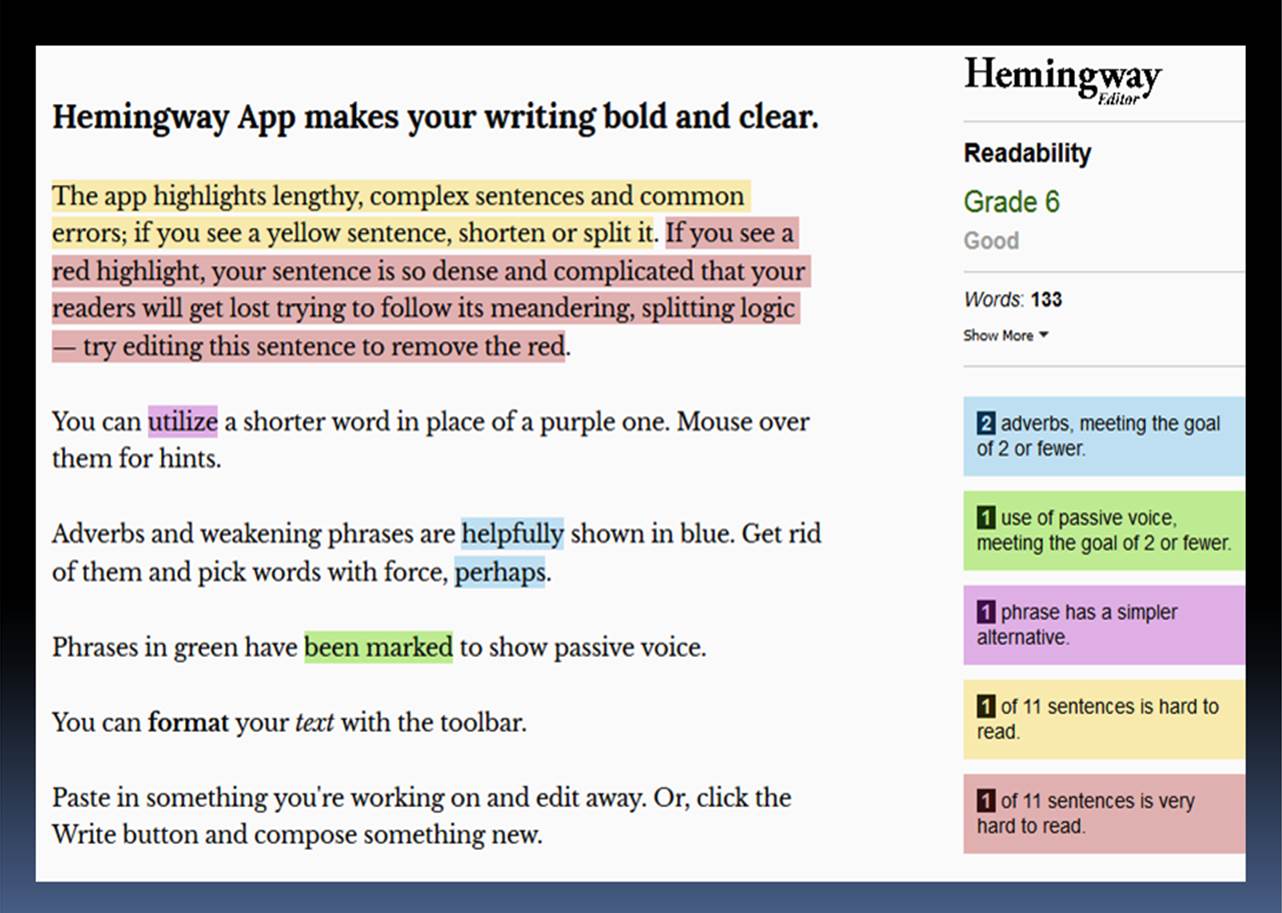
Do you want to write like Ernest Hemingway, using active voice verbs; short, simple sentences; short, one-syllable words; and few adverbs?  There is a free web app to help you.  Here’s how the app works.

Type a passage which you want to be more Hemingway-like. Swipe and copy it.  Go to Hemingwayapp.com.  Click the “H1,” “H2,” or “H3” button at the top of the app screen to allow you to paste your passage.  Or click the “write” button in the top right corner to compose on the site.


Highlighted in yellow will be sentences which are long or complex or which have common errors. The app identifies them, but it’s up to you to figure out how to fix them.

Highlighted in red will be sentences which are dense, that is, too full of information. Again, it’s up to you to figure out how to fix them.

Highlighted in purple will be words for which a shorter synonym is possible. Synonyms will be suggested by the app.

Highlighted in blue will be adverbs—a sign that your verbs aren’t strong enough to stand alone. The app won’t suggest stronger verbs, but it will identify adverbs, most of which should probably go.

Highlighted in green will be passive voice verbs. You need to figure out how to rewrite the sentence to make the verb active.

In the right margin will be a readability score, that is, the reading grade level of your passage.

The Hemingway app will make your writing more Hemingway-like, but that doesn’t mean your writing will be of high literary merit.  Your writing will be streamlined and easier to read, but that is not the same as “good.”

Still, if your revising skills are poor, or if you are pinched for time, this app can offer suggestions on how to make your writing more readable.  The cost to download a desktop version (3.0) is $19.99, available for both PC’s and Mac’s.


How to end a scene with a page-turner


Have you ever gone to bed with a novel, planning to read for 20 minutes or so, and found yourself still engrossed an hour later?

How do good writers keep readers captivated ?

Good writers use cliff hangers to end a scene. Cliff hangers can be major events like who shot J.R. Ewing.  In the TV show ”Dallas” in the 1980s, viewers wondered all post-season who shot the villainous J.R. They tuned in in record numbers for the season opener in the fall.  The screen writer of that show wrote a huge cliff hanger.  But cliff hangers can also be small.  Who sent Mom a single rose when it wasn’t even her birthday?  And why did they do it?  Turn the page to find out.

Good writers foreshadow coming events to end a scene. When a grinning Rhett Butler watches Scarlett O’Hara ascend the stairs of the Wilkes mansion, Scarlet feels uncomfortable.  Later when Scarlett discovers that Rhett has overheard her baring her soul to Ashley Wilkes, Scarlet is mortified.  Her early discomfort foreshadows her later embarrassment.

Good writers end a scene with a change of action.  Shakespeare did this all the time in his plays.  A love scene is followed by a murder is followed by comic relief.  Police mysteries show a detective reaching a dead end  when the medical examiner phones to say he has discovered something.  We keep reading.

Good writers shift the point of view (POV) to end a scene.  Leo Toystoy starts Anna Karenina from the point of view of cavalier Stephen Oblonsky as he blames his affair with his children’s governess on his silly smile and his vibrant personality. Then the scene shirts to the head of his distraught wife, pregnant with her seventh child, who can see no option but to leave him.

Good writers use monologue or dialog to end a scene, and they write last words or last thoughts that are significant.  One character might admonish another to heed advice.  One character might rue the day he agreed to a blind date as he pushes a doorbell.  We turn the page to find out if he is right.

Good writers use surprise to end a scene. What if the guy ringing the doorbell is met by a huge dog, or a wise-cracking little sister, or his drop-dead beautiful date. . .and her big brother chaperone?

What all of these scene endings have in common is a question.  We, the readers or viewers, want to know something.  And so we keep reading.

What is a weak thesis?

Many students don’t know the difference between a weak thesis and a strong thesis.  Here are some clues that show that an essay’s thesis is weak:

A thesis is weak if it is already known to be true, so there is nothing new to be explored.  For example,

  • Smoking is bad for human health.
  • Benjamin Franklin was an 18th century inventor.
  • The New England Patriots are a great football team.

A thesis is weak if it is a personal belief, not something to be investigated.  For example,

  • Summer is the best season.
  • Middle school is harder than elementary school.
  • Abraham Lincoln ranks number one among US Presidents.

The thesis is weak if it is too broad to be thoroughly investigated.

  • Hurricanes are dangerous storms.
  • Nancy drew books appeal to girls.
  • Romeo and Juliet is a tragedy.

The thesis is weak if it does not make a claim needing to be proven.  For example,

  • Dr. Seuss wrote popular children’s books.
  • Being a police officer is both good and bad.
  • In chess, each piece moves in particular ways.

The thesis is weak if it is not controversial, not a statement over which people can disagree.

  • Barak Obama was the 44th President of the US.
  • No human being has lived for 130 years.
  • Alex Fleming’s discovery of penicillin mold was one the greatest medical discoveries of the 20th century.

He? She? They?


A person from a nearby university was in the news lately.  This person’s name was given, but it is an androgynous name like Chris or Morgan which masks a person’s gender.  Later in the article this person was referred to as “they.” At first I thought “they” referred to several people, and I went back to reread the article’s beginning, thinking I had missed something.  But I hadn’t.  As I continued to read, I discovered that “they” is the pronoun this person preferred to be called.

Using “they” to refer to a known individual confuses me.  Using “they” to refer to a corporation, team or committee does not, although it seems grammatically wrong.  “The IRS sent me a letter.  They said I owe more taxes.”  When I work with students, I explain that the IRS is one government agency, so it should be referred to as “it” even though in informal speech many people refer to it as “they.”

What do you think about this?  Would you write about a particular individual and refer to that individual as “they”?

I have not faced this situation, yet it is only a matter of time since more and more people identify as gender neutral.  And then there are people who were born one gender but change their gender, like Bruce Jenner / Caitlyn Jenner.  What are our options if we want to be respectful yet accurate?

  • Refer to a person as “he” or “she” unless that person specifically asks us to use a different pronoun?
  • Guess which pronoun to use?
  • Ask an androgynous-looking or -sounding person which pronoun to use? Or is it up to the person to ask us to use a particular pronoun?
  • Call the person by a full name instead of using a pronoun?

Perhaps with time using “they” to refer to a specific individual (not an unknown person) will sound normal.  But at present it sounds wrong to my ear.  I would probably repeat the person’s name instead of replacing it with a pronoun as long as that was practicable.  But that might lead to some convoluted sentence structures.  In that case, I would probably use the pronoun the person prefers, explaining that to the reader.

A 21st century dilemma for sure.