He? She? They?


A person from a nearby university was in the news lately.  This person’s name was given, but it is an androgynous name like Chris or Morgan which masks a person’s gender.  Later in the article this person was referred to as “they.” At first I thought “they” referred to several people, and I went back to reread the article’s beginning, thinking I had missed something.  But I hadn’t.  As I continued to read, I discovered that “they” is the pronoun this person preferred to be called.
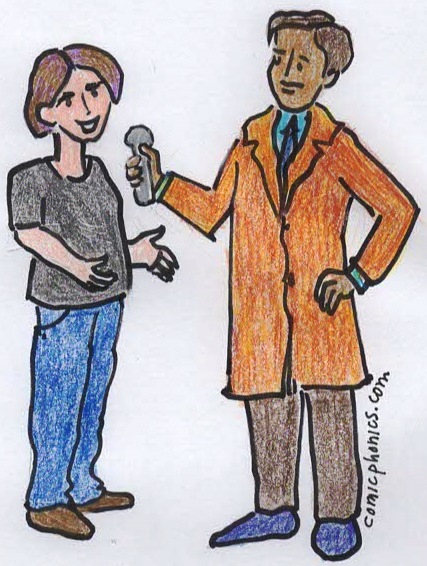
Using “they” to refer to a known individual confuses me.  Using “they” to refer to a corporation, team or committee does not, although it seems grammatically wrong.  “The IRS sent me a letter.  They said I owe more taxes.”  When I work with students, I explain that the IRS is one government agency, so it should be referred to as “it” even though in informal speech many people refer to it as “they.”

What do you think about this?  Would you write about a particular individual and refer to that individual as “they”?

I have not faced this situation, yet it is only a matter of time since more and more people identify as gender neutral.  And then there are people who were born one gender but change their gender, like Bruce Jenner / Caitlyn Jenner.  What are our options if we want to be respectful yet accurate?

  • Refer to a person as “he” or “she” unless that person specifically asks us to use a different pronoun?
  • Guess which pronoun to use?
  • Ask an androgynous-looking or -sounding person which pronoun to use? Or is it up to the person to ask us to use a particular pronoun?
  • Call the person by a full name instead of using a pronoun?

Perhaps with time using “they” to refer to a specific individual (not an unknown person) will sound normal.  But at present it sounds wrong to my ear.  I would probably repeat the person’s name instead of replacing it with a pronoun as long as that was practicable.  But that might lead to some convoluted sentence structures.  In that case, I would probably use the pronoun the person prefers, explaining that to the reader.

A 21st century dilemma for sure.


Diagrams help students read and write

“Scaffolding” is an educator term to describe teacher actions to help students  learn something new.  Scaffolding could be a series of questions meant to prepare students for what they are to read.  Scaffolding could be a timeline of a topic—say American history—to show where a subtopic—say the Civil War—fits into the big picture.

Scaffolding can also be simple diagrams to help visual learners understand what they are about to read or write.  These diagrams help students “see” the organization of a reading passage, or they help students “see” the structure of a paragraph or essay they are about to write, providing clarity.

For example, suppose a student needs to write a biography of Coretta Scott King.  Maybe the student has written a list of ideas related to Mrs. King’s life, from her education to working with her husband on Civil Rights matters to promoting his legacy.  But this brainstormed list seems to be without order.  The student doesn’t know what goes with what or how to begin.  How could a diagram help?  Take a look.

This diagram is a simple visual pattern following Mrs. King’s life, more or less in chronological order.  With a little help, the student might see that Mrs. King’s life was private until she married; then her life became public as she worked with her husband on civil rights matters; then her life became even more public after his death as she led efforts to honor him and she spoke and wrote about ongoing civil rights matters.  These insights could provide transition ideas from one paragraph to another.

If each box of the diagram is outlined in a color which corresponds to a portion of Mrs. King’s life or activities, the overall organization of the essay becomes clear.

A student can make a diagram like this after he creates a prewriting organizer such as a mind web or a brainstormed list.  Or this diagram can take the place of that prewriting organizer.  Color-coding the information is important because it helps visual learners “see” how the essay breaks down into smaller chunks.

A similar diagram can be made by a teacher to preview what students are about to read.  Whether it is Junie B. Jones’ fear of school buses or why polar bears face a bleak future, a diagram showing students what they will read before they read it allows them to see the big picture and each subtopic in the order in which they will read about it.  For children with reading comprehension problems, a diagram can help them understand and remember what they read.

Should children write in a composition notebook or on notebook paper?

The parents of most children I tutor supply them with a brand new composition notebook, the kind whose pages are sewn together.  They do this with good intentions, a way to keep all the children’s writing together.

But is this a good idea?  Much better is to supply children with loose, lined notebook paper.

When students create prewriting organizers (mind webs, charts, Venn diagrams or a series of drawings), those organizers need to be referred to in order to be useful.  I ask students to set the organizers to the left or right of the page on which they write their first draft.  That way, students can refer to the organizer while writing.  If the organizer is in a composition notebook, students need to flip pages back and forth to use the organizer, an annoying process.

When students finish the first page of their rough draft, with a composition notebook usually they turn the page to write the next page.  That way they can’t see what they have just written.  Good writers reread what they have written as they move along.  If the first page of a rough draft is on loose notebook paper, the student can push that page up on the desk and lay the next page beneath it, creating visual continuity.

What if students are writing on computers?  Some of my students create prewriting organizers by hand on notebook paper and put the organizer next to their keyboards when they write.  Some create organizers on their computers and split their screens so they can see the organizer while they compose.  Since pages scroll down, the paragraph or two just written is always on screen, allowing for continuity.

Computers have other advantages because they fix the spelling and alert the writer to grammar mistakes as the writing goes along.  They allow the writer to erase or to re-position words with a swipe and a click of a mouse.  Composing on computer is ideal, but some children are too young to know where the letters are on the keyboard, and waste time hunting for a letter, forgetting what they were going to write.  For keyboard savvy students, though, I recommend composing on computer.  With practice, this is the most efficient way to write.

It seems like a small thing, choosing to use a notebook or loose notebook paper on which to write.  But the loose paper or a computer screen leads to better results.

The five-paragraph essay is an obstacle to learning

The five-paragraph essay is a form of convergent thought.  It encourages the writer to fit information into a formula:  an introduction stating a main idea and sometimes naming three supporting points; three body  paragraphs, one for each point; and a conclusion renaming the main idea and three points.

The five-paragraph essay discourages writers from exploring new ideas.  Instead, it encourages writers to stick with what they already know.

For example, a student writer might choose for an essay topic an uncontroversial idea, such as that smoking is bad for health.  The writer might choose as the three points 1) smoking destroys lungs, 2) smoking leads to diseases like lung cancer, and 3) smoking leads to facial wrinkles.  But what if the writer thinks, wait a minute, wrinkles aren’t a health problem.  The writer ponders, searching for a third reason why smoking is bad for health, and can’t think of one.  So the writer changes his topic completely to fit the five-paragraph format.

What if the writer had instead researched wrinkles to see if there is any connection to smoking and health?    The writer might have learned that wrinkles are a health concern.  He might have learned about research connecting wrinkles and smoking and health.  He might have learned some open-ended questions which scientists are striving to answer.  He might have learned.

The problem with the five-paragraph essay is that it encourages closed-minded thinking, not learning.  It encourages simplistic, not complex, thinking.  It encourages safety, not exploration of ideas.  It encourages fill-in-the-blanks, not critical thinking.

Limit indirect quotes and increase direct quotes to improve writing

What is an indirect quote?  Here are some examples.

  • Sia said that she was really tired.
  • Riley asked me for a pencil.
  • April told the dog to get off the couch.
  • Donald Trump urged Alabama voters to choose Luther Strange.3rd grader writing an essay.

What is a direct quote?

  • Sia said, “I’m tired.”
  • “Hey, how about forking over a pencil, Dude?” asked Riley.
  • “Jump down this second, you naughty pooch!” April yelled at her dog.
  • “Big day in Alabama. Vote for Luther Strange, he will be great!” tweeted Donald Trump.

Why are direct quotes usually better?

  • The middle man is removed. The reader can decide for himself what the speaker or writer actually said and meant.
  • The personality of the speaker often shows through the use of formal or informal vocabulary and sentence structure.
  • The vocabulary is sometimes more precise or colorful.
  • The reader experiences the immediacy of an event.

Are indirect quotes ever okay?  Yes, of course.  Sometimes indirect quotes are even preferred, such as

  • If a speaker / reporter needs to be brief. Sometimes a paragraph of direct quotes can be reduced to a handful of words.
  • If the writer thinks she might be accused of a misquote, an indirect quote can eliminate this problem.
  • If the writer wants to hide the actual words used because the speaker used foul language, grammatical errors or anything which might show the speaker in a bad light, paraphrasing can eliminate these problems.
  • If the identity of the speaker needs to be hidden, but could be learned from the way he speaks, then paraphrasing provides cover.
  • If the writer doesn’t remember the exact words or wants to summarize them, then indirect quotes work well.

Bottom line:  Use direct quotes when you can.  If you  write with direct quotes, your writing is likely to sparkle.