11 ways to discourage student use of AI in writing assignments

As teachers prepare to return to school, many wonder how to incorporate AI into their curriculum.  For teachers of writing, the opposite might be true:  how to encourage original thinking by students who might be tempted to use AI to do their assignments.  For those teachers, here are eleven suggestions:
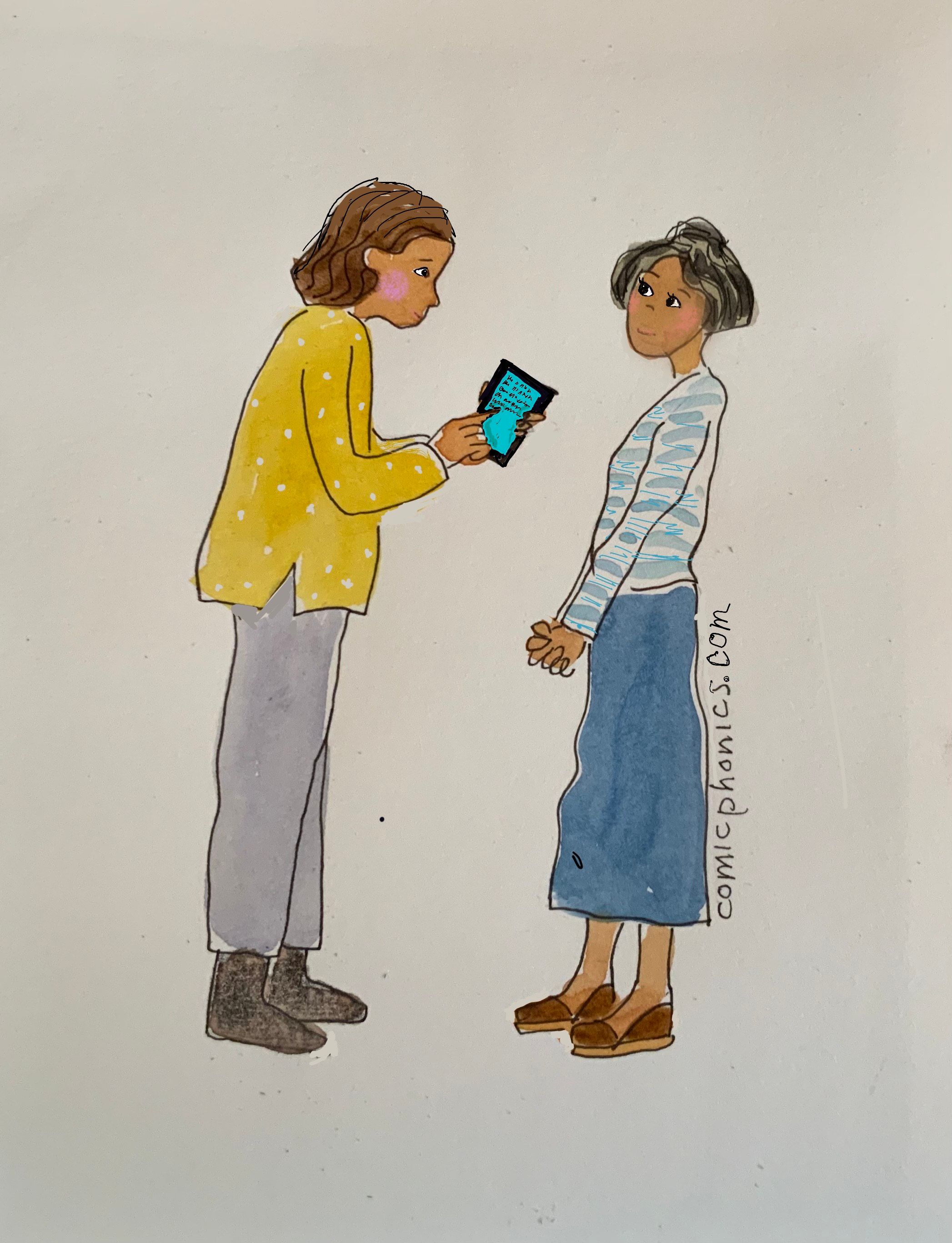
At the beginning of the school year, ask students to handwrite in class a paragraph on what they studied in ELA last year, what they liked, what they didn’t, and why. Hold onto that writing.  If you suspect a student is using AI to write, compare the writing style of the early document to the later one.  If they are not similar, ask the student to redo the assignment.

Require that students go through all the steps of writing, including writing an organizer, writing a main idea sentence, writing a first draft, and revising. Grade each of these steps in the writing process, not just the finished product.  Once you have approved the organizer, require students to continue organizing their writing the way they originally planned it.

Require all but the final draft to be done in class in handwriting on notebook paper. Provide the paper, marked a particular way for each class section you teach to discourage first period students from sharing with third period students.  If possible, require different essay topics from different class sections.  Collect work done in class at the end of class, and check to be sure each student has submitted his or her work.

Require that specific information of your choice—information that AI is not likely to have in its huge data base—be included in the student writing.  That information could be from a student’s personal experience, such as comparing a novel’s character to a teacher in the school or writing a new beginning to Huck Finn as if the student is Huck.

Provide citations which students must use in their writing.

Don’t assign tasks easily done by AI such as summaries. Assign tasks that require critical thinking such as analyzing, synthesizing and evaluating.
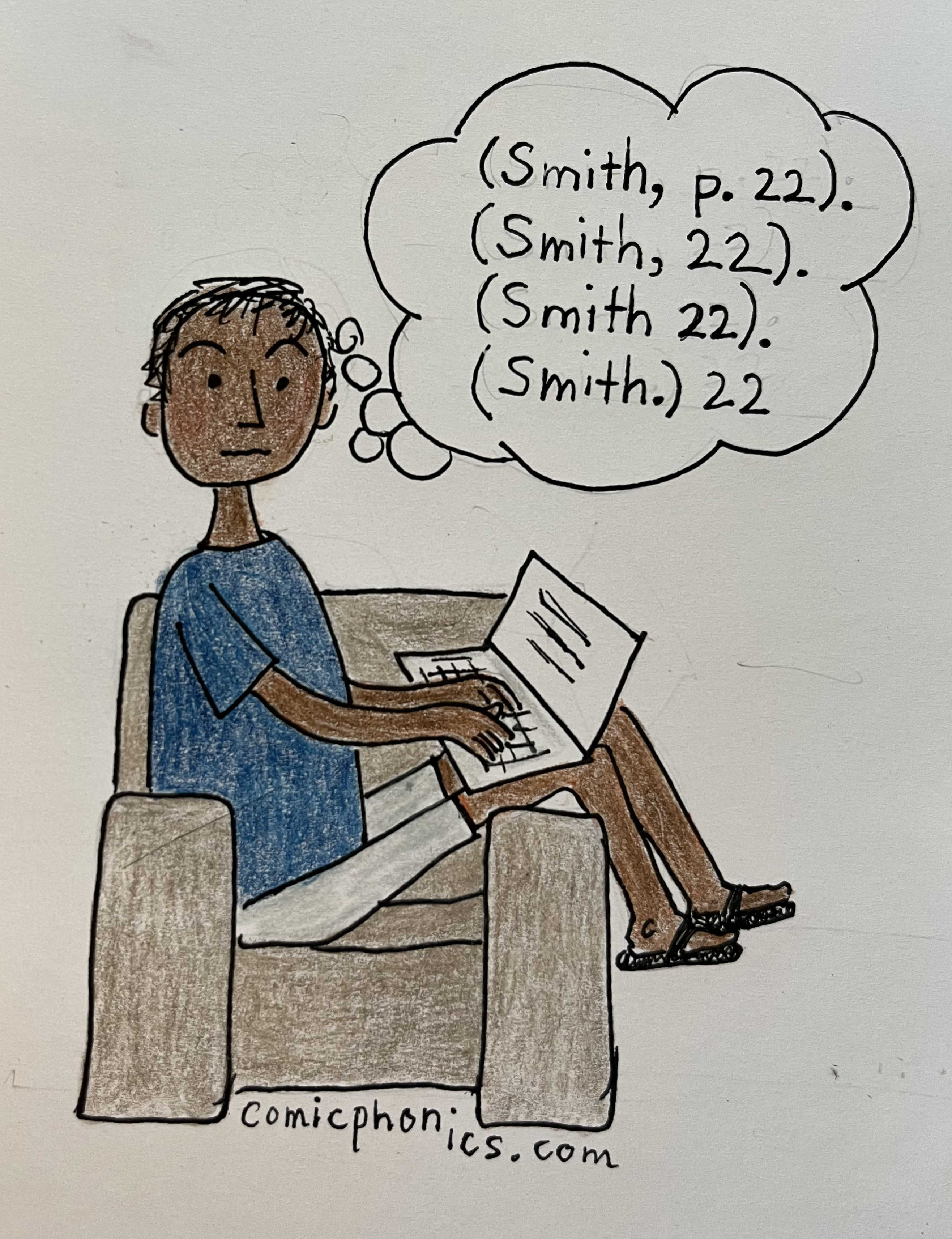
Require students to reflect in writing about the writing assignment: what they liked about it and what they found hard.  This can be done at any stage of a writing assignment.  The information might suggest a mini-lesson to help students overcome a writing problem.

If students are writing about a book, quiz them on details in the book. Make them prove they have read the book before they write about it.

As you read student work, notice vocabulary that seems too advanced for a particular student. Ask the student what that word means.  Also, notice if that same word is used in more than one student’s writing.  That could be a sign of AI involvement.

Assign more short assignments and fewer long assignments so students spend more time writing.

Remind students that you will use Turnitin, GPTzero, and Copyleaks if you suspect a student used AI in an assignment.
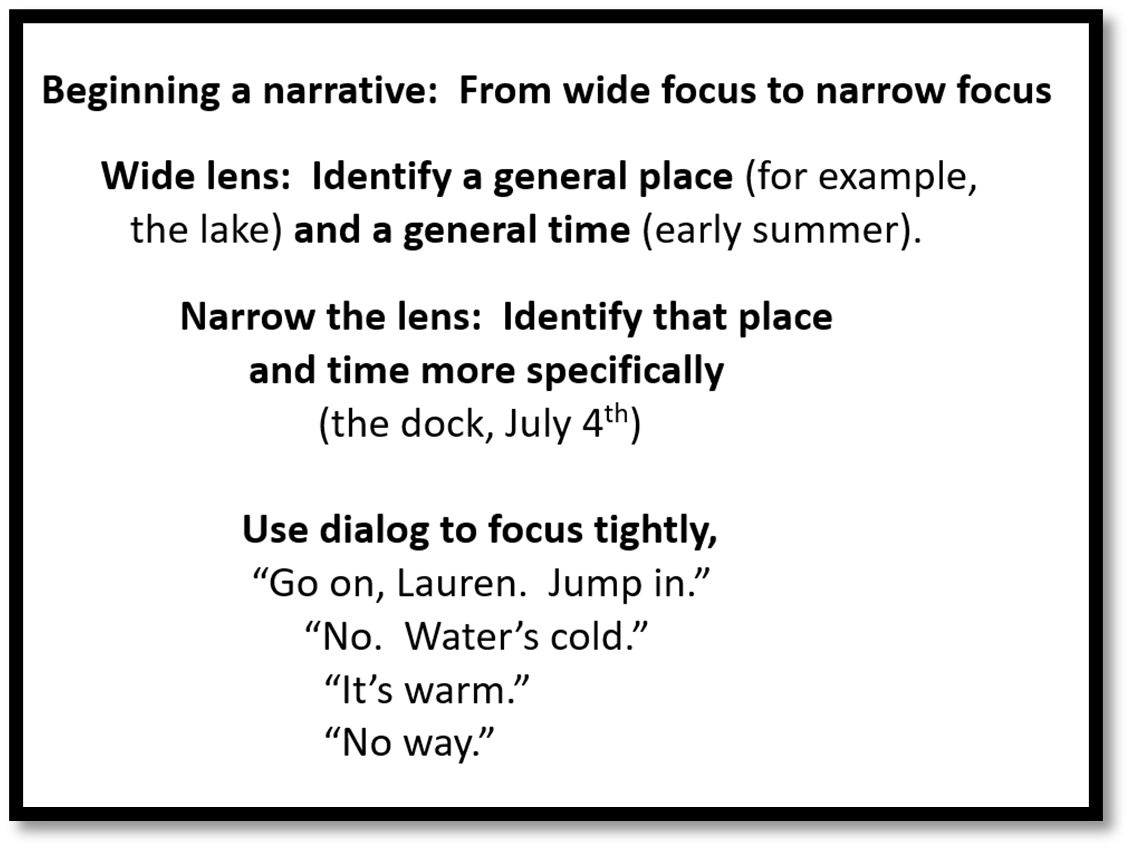
A proven way to start a narrative

Lots of good approaches begin narratives.  “Once upon a time,” and “One day,” are two for inexperienced writers.  What’s a good approach for more sophisticated writing?

Start* with a wide view lens, farther back in time, such as

  • “I graduated from New Haven in 1915, just a quarter century after my father, and a little later I participated in that delayed Teutonic migration known at the Great War.”  From this beginning, we learn the narrator is a young man (Yale was a men-only university in 1915), a WWI vet (a participant in WWI) , and from a moneyed family (Most Americans could not afford college, yet alone Yale University in the early 20th century).

Now change that wide-angle lens to a normal lens, narrowing in on place and time.

  • “I came back restless. . . .so I decided to go east and learn the bond business. . . .in the spring of twenty-two. (Uncertain about his future, the young man settles on selling bonds on the East Coast.)

Lastly zoom in, using conversation to learn about a character or setting.

  • “What you doing, Nick?”  (We know his name.)
  • “I’m a bond man.”  (He has secured a job selling bonds.)
  • “Who with?”
  • I told him. (The name of the firm is not important to us.)
  • “Never heard of them.”  (The firm is little known or the speaker disparages that line of work)
  • This annoyed me.  (Nick feels put down.)*

This type opening–starting with a wide angle lens, telescoping in to a regular lens, and then focusing on specific dialog–gives you a pattern to follow, a pattern with a proven record of success.  Look for this pattern, likely spread out over several paragraphs.

*From The Great Gatsby by F. Scott Fitzgerald


Once upon a time. . .

Starting a work of fiction with “Once upon a time” has advantages, especially for children:

  • It gets them going, and getting going can be hard.
  • It decides the verb tense—the past tense—saving them time.
  • It decides the point of view—third person omniscient almost always—again, saving time.
  • Either it tells readers that knowing the exact time isn’t important or it gives writers time to consider the setting while they write.
  • It tells readers that the story which follows is a fairy tale, so expect  magic.

But usually—maybe always—“Once upon a time” isn’t needed.  When my students revise, I tell them to eliminate “Once upon a time” and start with what follows, like this:  “Once upon a time, a girl named Cindy dreamed to open her own bakery.”  I explain that “Once upon a time” is a crutch, and since they have moved along in their story, or perhaps even finished it, they don’t need the crutch any more. Deleting “Once upon a time” is usually the right thing to do.

“Once upon a time” has been used to start European fairy tales and folk tales for at least six hundred years.* At first it was used orally by story tellers.  Later it was kept by Hans Christian Andersen, the Brothers Grimm and other writers when they wrote down the stories.

A similar opening crutch is “One day.”  “One day” tells us the exact day isn’t important, or at least not important at the beginning of the story.  That day might turn out to be important later on, but for the characters in the story and for us, the readers, that day was like any other when it started.

Is it wrong for student writers to rely on crutches like “Once upon a time” or “One day”?  Of course not.  These crutches get them writing that first sentence, often the hardest sentence of all.  Just remind them that later on they should delete that phrase unless what they write is truly a fairy tale.  Even then, ask if they want their readers to know from the start that they are reading a fairy tale.  If surprising readers is important, delete “Once upon a time.”  The story will be just as good—probably better.

*According to AI Overview in my Google search engine.


F. Scott Fitzgerald’s ideas on how to write

The American novelist and short story writer, F. Scott Fitzgerald, did not write a book about how to write.  But he did share his ideas through letters to his daughter, his publisher, and other writers.  Here are some of his suggestions and insights.*

“I could tell you plenty [of] books in which the main episode, around which swings the entire drama, is over and accomplished in four or five sentences.”

In Gatsby. . .I started “from the small focal point that impressed me–my own meeting with Arnold Rothstein.”  [Rothstein, 1882-1928, was a gambler and racketeer who was murdered.  The character of Meyer Wolfsheim is based on Rothstein.]

“All fine prose is based on the verbs carrying the sentences.”

“I am a professional thief, hot after the best methods of every writer in my generation.”

“The chief fault in your style is its lack of distinction. . . .And the only thing that will help you is poetry which is the most concentrated form of style.”

“I don’t think anyone can write succinct prose unless they have at least tried and failed to write a good iambic pentameter.”

“It takes half a dozen people to make a synthesis strong enough to create a fiction character.”

“When you tell an anecdote, tell it so your listeners can actually see the people you are talking about.”

“There comes a time when a writer writes only for certain people and where the opinions of others is of little less than no importance at all.”

“A novel either “is something entirely new and fresh and profoundly felt. . .or else it is a tour de force by a man of exceptional talent. . . .A great book is both.”

The Great Gatsby had against it its length and its purely masculine interest.”

“If The Great Gatsby fails commercially it will be for one of two reasons or both.  First, the title is only fair, rather bad than good.  Second and most important the book contains no important women character, and women control the fiction market at present.  I don’t think the unhappy end matters particularly.”

“Writing is a sheer paring away of oneself leaving always something thinner, barer, more meager.”

*These quotes come from F. Scott Fitzgerald on Writing, edited by Larry W. Phillips.  NY:  Scribner, 1985.

How to summarize a work of fiction

First, read the short story, novel, play, poem or other form completely, from beginning to end.  If you don’t understand parts, get help.

Longer works of fiction are usually divided into chapters or acts.  To Kill a Mockingbird, for example, is divided into 31 chapters.  To summarize the whole book, summarize important actions in each chapter.  For example, in chapter 1 of Mockingbird, the narrator, Scout Finch, introduces readers to the setting:  her hometown, Macomb, Alabama, during the early 1930s.  She introduces her father, Atticus, an attorney; her older brother, Jem; and their friend, Dill.  She also introduces the children’s obsession with teasing their reclusive neighbor, Boo Radley.

Some chapters are more important than others, and those chapters should take up more space in a summary.  Less important chapter contents can be either omitted or lumped together with other chapters.  For example, many chapters in Mockingbird concern various ways the children tease Boo.  You don’t need to write a chapter summary of each prank.

A summary should be written in the same order as the book is written (usually in chronological order).  If the book is not strictly chronological, you can say that in a flashback, a particular action happens.  A summary should use words like exposition, inciting event, rising action, climax, falling action, and resolution to label parts of the story.  A summary should name the important characters and identify the way the main character changes.  If certain themes or moods are important (for example, racism or suspense), those should be identified as they appear.

A summary is not a conclusion.  You want to identify what happens to whom, and who grows or changes throughout the novel.  If the ending is a cliffhanger, you can say that, telling what the reader is left wondering.  Or if the ending leaves the reader wondering about a moral decision a character has made, you can say that.  But you can’t say that the ending is good or bad.

How long should a summary be?  For a book of 300 pages, it is possible to write a terse, two or three-sentence summary.  Take, for example, Romeo and Juliet.  “After Romeo and Juliet fall in love and secretly marry, violence breaks out in Verona, and Romeo is forced to flee; distraught, Juliet takes a potion leading to a deep sleep.  Romeo thinks she is dead, and kills himself.  Juliet awakens, finds Romeo dead, and kills herself.”  Most summaries are not this short, but summary means a short version with unimportant details and characters left out.  If you are writing for a school assignment, your teacher will tell you how long your summary should be.

A play can be summarized by summarizing each act or each scene.  For example, Act One of Romeo and Juliet can be summarized as “Romeo and Juliet meet and immediately fall in love.” If each of the five acts were summarized this way, the whole play could be summarized in one paragraph.  Or each scene can be summarized, leading to a more complete summary.  The first of the five scenes in Act One could be summarized as “In Verona, Italy, in the 1500s, two wealthy families and their servants continue an age-old feud.  They are threatened with death by the authorities if they continue.  Romeo, the son of one family, has just broken up with his girlfriend, and he is depressed.  His cousin, Benvolio, encourages him to date other girls.”  With 24 scenes, a summary of each scene might lead to a two-page summary.

A short story summary summarizes each scene, or if the story is really short, each paragraph.  In fiction, something happens to someone causing that someone to change.  What happens to whom and how that person changes should be the heart of any summary.