Category Archives: teaching writing

Webb’s Depth of Knowledge—Writing examples

Using Bloom’s Taxonomy (1956) is one way in which teachers can develop deeper thinking skills in students.  Bloom’s six cognitive skills start with easier thinking skills and move to more difficult, “higher order” thinking skills.

Bloom’s Level objective
knowing remembering facts
understanding showing understanding of facts
applying apply knowledge to new situations
analyzing examining information for component parts
synthesizing* creating something new from diverse elements
evaluating making judgments based on evidence or criteria

*Synthesizing is now called “creating,” and it has become the sixth, not fifth, level.

About 40 years after Bloom’s Taxonomy became known, a refinement of Bloom’s taxonomy called Webb’s Depth of Knowledge was developed (1997).  It has four levels.

DOK Level title of Level
1 recall and reproduction
2 skills and concepts
3 short-term strategic thinking
4 extended thinking


For teachers wanting to demand deeper thinking of their students, both Bloom’s Taxonomy and Webb’s DOK Levels can be used to design lesson plans.  Below are some writing assignments based on Webb’s Levels.


Literature


Level 1  Identify a list of important characters from the first Harry Potter novel.  Explain their relationship to Harry.

Level 2  Compare Harry’s, Ron’s and Hermione’s personalities.

Level 3  Explain how the opening scene in the first Harry Potter book lures readers into that book.

Level 4  Show how the authors of the first Harry Potter book and the first Percy Jackson book used a similar plot sequence to begin those books.


Social Studies


Level 1  Match famous quotes with 20th century American leaders.

Level 2  Create a set of ten cards with a quote by a famous 20th century leader on one side and the leader’s name on the other side.

Level 3  Using the set of cards created for Level 2, create a set of three clues for each quote, one easy, one difficult and one in between.

Level 4  Describe how specific references such as Stone Mountain and MLK, Jr.’s little children can be understood as metaphors for other concepts in MLK, Jr.’s “I Have a Dream” speech.


Math


Level 1  Define given vocabulary words relating to circles (radius, diameter, circumference, ray, arc, pi, center point).

Level 2   Explain why pi is approximately and not exactly 3.14.

Level 3  Describe three real life situations in which understanding pi can be useful to solve problems.

Level 4  Write an essay on the history of pi, citing sources.


Science


Level 1  Define a fossil.

Level 2  Identify the sequence of events in the forming of a fossil.

Level 3  Explain why a fossil from an earlier time is found in a lower layer of rock than a fossil from a later time.

Level 4  From the school library take three books about fossils appropriate for a certain grade level.  Critique each book, explaining its strengths and weaknesses for that grade level.
When you are writing the sentences of an essay, where do you begin?

  1.  with the hook?
  2. with the introduction?
  3. with the thesis or essay topic sentence?
  4. with the supporting topic sentences?
  5. with the conclusion?

The answer is with the thesis /  essay topic sentence.

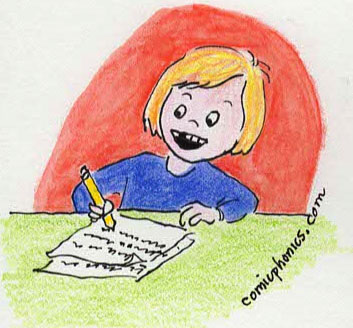
3rd grader writing an essay.But too many students don’t start there.  They start with a topic—say Harry Potter books—and then focus on writing a hook to get someone to read their essay about Harry Potter books.  When they are writing their hook they have no idea about the precise topic of their essay, just that it has something to do with Harry Potter books.  Wrong approach!

To impress upon my students how primary the thesis is to an essay, I have them write it on their planner before they plan in detail.  Then when they begin to write sentences, I have them skip five or six lines on notebook paper (or on a computer) and write their thesis there, partway down the paper, leaving room to add an introduction later.

The thesis is the anchor of the whole paper.  I have students box that sentence in color for easy referral.

Next, I have the student write the body paragraph topic sentences. This time I ask students to skip ten or more spaces after each body paragraph.  Later they can come back and fill in those spaces with details.

We read over those topic sentences and check out each one against the thesis.  Does the topic sentence support the thesis?  If yes, keep it.  If no, toss it and write another topic sentence which does.

Next, students write the body paragraph sentences with all the details which back up the paragraph’s topic sentence and the thesis.

Now that they know what their essay is about they can go back and write the introduction and the conclusion.

Think of an essay as a wedding ceremony.  What is most important in the ceremony?  Is it the music as the bride walks down the aisle?  Is it the flowers?   Is it the witnesses?  The kiss?  Of course not.  It’s the vows.  The vows are just a few words.  “I take you, Harry, to be my husband.”  “I take you, Meghan, to be my wife.”  Those vows are followed by supporting details like “for better or for worse,” and “in sickness and in health.”

The vows are like the thesis.  “In good times and in bad” and the other details are like the body of the essay.  The music is like the introduction and conclusion.  And the bride’s beautiful dress is the hook.  You can have a wedding without the dress and the music, but you cannot have one without the vows.  The vows are where you begin, just as the thesis is where you begin an essay.

An essay is a planned, organized piece of writing with one overarching idea expressed in a topic sentence / thesis.  Until you know what that thesis is, it makes no sense to write any other sentences because every other sentence must support the thesis.

Use adult vocabulary for academic words

I was working with a high school freshman writing an essay.  He was baffled by his teacher’s directions to write a chicken foot and buckets.  So was I.  There was a drawing of a horizontal line with three diagonal “toes” going out from the end of the horizontal line.  This was the chicken foot.  There was another drawing of four cans with a space for a label at the top of each one.  These were the buckets.  But there was no identification of what these terms or diagrams meant.

Emails back and forth solved the problem.  The chicken foot was the thesis.  The horizontal line was the opinion and the three toes were the supporting ideas backing up the thesis.  The buckets were the details for each of the chicken’s toes, with an extra one  in case.

The more I thought about these terms, though, the more annoyed I became.  Why not use the terminology that the student will need to use in other high school English classes and in college classes?  Why not call a thesis a thesis and its supporting topic sentences supporting topic sentences?  Why not call evidence “evidence” or “citations”?

What my student’s teacher is doing is what so many parents do for babies learning to talk.  The parents say “night-night” instead of “sleep” or “bye-bye” instead of “we’re leaving.” But eventually the children need to learn the proper names for “sleep” and “leaving.”  Why introduce “baby” versions of the words?  Isn’t “sleep” just as easy to understand as “night-night”?

I know the teacher is well meaning.  And I know she explained “chicken foot” and “buckets” during class.  But my student didn’t understand, and looking up those words on the teacher handout didn’t help.  If the teacher had used the word “thesis,” he could have looked that word up and found plenty of explanation.  If she had used the words “topic sentences” or “supporting topic sentences,” he could have found those words and their meanings online.  If she had used the words “evidence” or “citations,” my student could have figured out what they meant and what he was expected to do.

Children eventually need to learn proper vocabulary for ideas, whether it is “identify” or “cite.”  Babying their vocabulary does no service to children; rather it confuses them and stalls their acquisition of adult vocabulary.

Evaluating student writing

When I work with student writers, I ask them to evaluate their own writing.  The process I use is simple and works no matter what type writing the students do.

After the student has revised a piece of writing, I draw a large “T” which creates two columns.  I label the first “Did well” and the second “Needs improvement.”  I ask the student to identify what was done well and what needs work.

We start with the “Did well” column.  If the student is stumped, I ask questions about things which the student obviously did well.  “Did you have a beginning, middle and end?”  If he says yes, I ask him to write “B-M-E” under “Did well.” “Did you spell correctly?”  He writes “spelling” under “Did well.”

I try to list at least three things the student did well, no matter how basic his writing is.  Handwriting, starting sentences with capitals, writing periods and commas that look like periods and commas—I search for positives.  The more the better.

Then we move to the “Needs improvement” column.  Usually the student will mention errors we have just corrected during revision.  He might say “run-ons” and using a word like “so” or “just” over and over.  With practice he will identify the conceptual errors, such as organization problems or not writing a topic sentence.  I  bring up one of these larger issues and go back to the paper to show an example of that problem.

I limit “Needs improvement” to three so the student doesn’t get discouraged and so he can keep those three in mind the next time he writes.

After we do this many times, the student realizes he is making the same kinds of mistakes over and over.  When this happens and a student is about to write a  new draft, I ask him what mistake he is likely to make.  He says, “run-ons” or “a hook that doesn’t hook.”  This helps him focus on how to improve his writing while he is writing, long before we evaluate it.

Transferring what the writer knows into the mind of the reader

One of the hardest skills to teach child writers is to give enough information to make the reader know what the writer knows.  Young children expect their readers to know what they mean.  “Well, everybody knows he’s my brother.  I don’t need to say that.”

I was having a conversation with a fifth grader who was writing a first draft about golf clubs and was considering what to say about loft.

“Don’t the woods have more loft?” I asked.  “They hit the ball the farthest.”

“No, shorter clubs have more loft because the face tips back.  The more it tips back, the more loft it has.”

“Maybe you should explain that.”

“Why? All golfers know that.”

“Yes, but I’m not a golfer and I’m going to be reading your essay.”

Some parents think students should write their essays alone, and that I should become involved later, during revising, not while students are writing a first draft.

But sometimes the most important work I can do as a writing tutor, is to make the student consider what his audience knows and doesn’t know, to put the student in the shoes of the reader.  I told the student above that if I were Rory McIlroy reading his essay, he wouldn’t need to explain loft because Rory McIlroy knows all about loft.  (He was impressed that I knew who Rory McIlroy was.)  But since I have played only miniature golf, I told my student, I don’t know about loft.

Because of this “gap” between what the student knows and what the student writes, I find it useful to sit next to a student when he or she writes the first draft.  I let the student write a few sentences, and then we discuss them—sometimes for grammar or tone, but often for knowledge the student is not sharing but which the reader needs to know to understand the essay.

Discussing the “gap” while the student is writing allows the student to fix it in the early stages of writing, rather than finishing a draft and then needing to make big changes later on.  Clarifying information during the composing process saves time and effort later.

As the old proverb says, “A stitch in time saves nine.”