Category Archives: narrative writing

Peer evaluation of writing

Is it worth taking time to let students evaluate others’ writing?

Recently I asked second graders to write stories based on the picture book, Flora and the Penguin by Molly Idle.  Since the book is wordless, the students were forced to write their own versions of the story relying not on the author’s words but rather on the illustrations for guidance.

Later, I selected portions of two students’ stories for comparison.  I typed and printed them side by side, so students could compare how the two students wrote the same parts of the story.

Here are some of the comments students (second through eighth grade) made:

  • I like Student One’s opening because it tells when the story happens.
  • I like Student Two’s opening because it names the girl.
  • I like the word “poked” by Student One because it shows exactly how the penguin acted.
  • I like all the ways Student Two shows what Flora and the penguin did. They skated, danced, jumped, twirled and slid.  You can see it happening.
  • I like the dialog that Student Two uses when Flora asks, “What are you doing?”
  • I like Student One’s word, “outraged.”  That is a strong word.
  • I like Student Two’s word, word “disgusted” because it shows how Flora felt.
  • I like Student One’s writing where it says that Flora feels sorry because it shows that Flora cares.
  • I like when Student Two says “just like a fishing net.” I can see it.
  • I like when Student Two says “they tugged and tugged,” but maybe there are too many “tugs.”
  • I like Student One’s ending because it says Flora and the Penguin are happy.

After their blow-by-blow analyses, I asked my students what they learned from evaluating other students’ writing.  They said:

  • Use details, lots of details.
  • Use dialog or thoughts.
  • Use names.
  • Show emotions of the characters.
  • Verbs are really important to show action.
  • Use good vocabulary words.

One second grader, who rushes through her writing, compared her  plain version with the two shown here and said, “I’m starting over.”

A seventh grader who read the two versions, said, “Second graders?  Really?  I didn’t think I could learn good ideas about how to write from second graders.”

Is peer evaluation of writing a good idea?  You decide.

How to end a narrative essay

One way to end a narrative is to look to the future.  When J.K. Rolling ended her final Harry Potter book, she skipped forward 20 years to show a new generation of students—Harry’s, Ron’s and Hermione’s kids—heading off to Hogwarts School.  This ending of the series reminds readers of the beginning of the series when Harry, Ron and Hermione first headed to Hogwarts.  The author takes us full circle, back to the beginning, but not the same beginning.

boy writing on a window benchEven if your story is only a few pages long, you could look to the future.  The character could wake up hours after your story seems to end and think back—with fright?  with happiness?—at what happened earlier in your story.  Or if a dramatic rescue happens near the end of the story, you could jump forward an hour or two to let the characters describe how they feel, or to show them sleeping safely.

Another way to end a narrative is to stay in the present time of the stories but have a final scenes which leave the reader with an important emotion.  That emotion could come from a single image, the last image of the story.  Maybe your babysitter has worked really hard to care for a cranky toddler.  The babysitter leaves, exhausted and thinking she will never return.  But as she looks back, she sees the toddler looking out the window, smiling and waving.

Still another way to end is with action, as if, on to the next adventure.  Superman stories often end this way, with Superman solving a problem, and then flying off.  We assume he is off to solve another problem, but his real reason for leaving is that the story is done, and the writer needs to find a way to end it.

I have had some students end their stories with cliff-hangers,  scenes where something awful  happens, and we, the readers, of course want to know how the disaster is resolved.  But all we read is “To be continued.”  This is really not an ending but a way of pausing when a student is tired or out of ideas.  Don’t use this kind of ending or your audience will be disappointed.

If you have used dialog in your narrative, then ending with dialog (or the thoughts of a character) makes sense.  But the dialog should not be preachy or try to tie up loose ends.  Instead, use dialog to create a mood.  That mood becomes the lasting impression which the reader has.

Do you need to explain everything at the end?  No.  If the details are not important, let the reader guess at them.  That’s part of the fun for the reader.

Think about what mood or question you want your audience to dwell on as they finish your narrative.   Then figure out a good way to convey that idea.  If you do, your ending will be satisfying.

What writing skills are expected of fourth and fifth graders?

  • In fourth grade simple stories or essays are expected from most children. A topic sentence becomes the introduction, lots of facts become one or more body paragraphs, and a summing-it-all-up sentence becomes the conclusion.  Many students need help with the introductions, not knowing how to begin.  Almost all students need help with the conclusions.  They are expected to use transitions.  Students need to learn to plan their writing so that sequencing information isn’t a problem.
  • The Common Core State Standards (CCSS) asks fourth grade students to “write opinion pieces on topics or texts, supporting a point of view with reasons and information; introduce a topic or text clearly, state an opinion, and create an organizational structure in which related ideas are grouped to support the writer’s purpose; provide reasons that are supported by facts and details; link opinion and reasons using words and phrases (e.g., for instance, in order to, in addition);and provide a concluding statement or section related to the opinion presented.
  • The CCSS also asks fourth graders to “write informative/explanatory texts to examine a topic and convey ideas and information clearly;
    introduce a topic clearly and group related information in paragraphs and sections; include formatting (e.g., headings), illustrations, and multimedia when useful to aiding comprehension;
     develop the topic with facts, definitions, concrete details, quotations, or other information and examples related to the topic; link ideas within categories of information using words and phrases (e.g., another, for example, also, because); use precise language and domain-specific vocabulary to inform about or explain the topic; and provide a concluding statement or section related to the information or explanation presented.”
  • As for narrative writing, the CCSS asks fourth graders to ” write narratives to develop real or imagined experiences or events using effective technique, descriptive details, and clear event sequences;
    orient the reader by establishing a situation and introducing a narrator and/or characters; organize an event sequence that unfolds naturally; use dialogue and description to develop experiences and events or show the responses of characters to situations; use a variety of transitional words and phrases to manage the sequence of events; use concrete words and phrases and sensory details to convey experiences and events precisely; and provide a conclusion that follows from the narrated experiences or events.
  • girl with pony tail on floor writingBy fifth grade, if the students have had enough practice, they should be able to write simple expository (informational) and persuasive essays and short narratives. They should write an introductory paragraph, two or three body paragraphs, and a conclusion paragraph.


Read John Truby’s “The Anatomy of Story” if you are a fiction writer

If you are an aspiring novelist or fiction writer, may I recommend a good how-to book?  It’s not new, but it’s new to me.

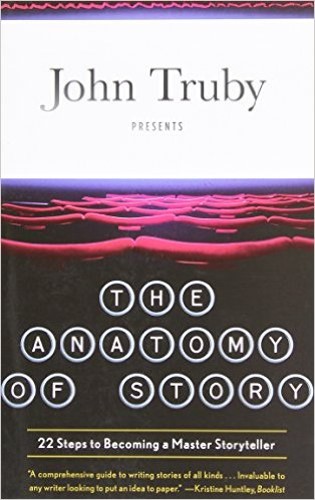
Cover of John Truby's The Anatomy Of StoryJohn Truby’s The Anatomy of Story; 22 steps to becoming a master storyteller has been around since 2007.  I’ve seen it recommended in other how-to writing books, but the “22 steps” part of the title put me off.  And after reading the book and rereading parts, the “22 steps” still seem like a juggernaut to an aspiring novelist.

Yet the book is a masterpiece.  Several points ring true.

  • Every story must have a single pathway to its climax and end. Even stories with as many side steps as Homer’s Odyssey must lead the main character and reader toward a single goal.
  • Every compelling story has one main character (hero) fighting along that pathway toward his or her goal.
  • If the hero’s enemy is an abstraction (a company, a war or evil) the reader will engage more if that enemy can be embodied into a single human enemy such as Darth Vader or Voldemort.
  • The main character must have a flaw to overcome by the end of the story. How he overcomes his flaw is the real story.  Harry Potter must defeat Voldemort.  But Harry is a meek eleven-year-old at his story’s start.  How he overcomes his fears and grows into a man brave enough to defeat Voldemort is the real story.
  • If the main character makes difficult moral choices (not just action choices) on his pathway, the story gains depth and the possibility of greatness.

One inclusion I particularly like is the many novels and movies which the author analyzes when he makes his various points.  I have long known that I like The Godfather, Shane, Chinatown and Casablanca, but now I know why.  It’s because these stories contain so many of the elements which Truby says are essential in great stories.

As for the 22 steps?  Because so much else rings true in The Anatomy of Story, I accept that the 22 steps are necessary for a great novel.  Nobody said writing a novel is easy, and Truby says writing a great novel is rare.  But he has created a formula.  If you are writing fiction, check it out.

Share your writing with students to improve yours and theirs

A couple of months ago I shared the first scene from a story I am writing with two of my students, an eighth grade brother and a sixth grade sister.

Teacher typing on a laptop seated between a young boy and a young girl.

Their feedback was insightful:  how I started off in the middle of a tense situation, how my short sentences made that tense situation even tenser, how they liked the tenderness of the main character, how shocked they were by something that happened just like the main character must have been, and how real the dialog of the children sounded.

I had previously taught them that writers today are encouraged not to provide back story at the beginning of a narrative, but rather to jump right into the action and weave the backstory in here and there.

“Oh, now I see what you mean,” said the brother.  “You have the mother trying to stop the car, and the 18-wheeler zooming up behind her, and the pickup ahead of her zig-zagging and trapping her.”

“Yeah, and only then you learn there are children in the back seat who are yelling because they’re scared,” said the sister.

“But you don’t tell anything about them except their names.”

“Yeah, but you still care about them because they’re kids and they’re scared.”

From this short exchange, I was reminded how useful it is for the writing teacher / tutor / parent to share her own writing with a student.

  • Sharing your writing proves that you know how to write, so your praise and criticism are respected by your students.
  • Sharing your writing makes the lesson more collaborative. The students give feedback, ask questions and suggest areas that could be improved, adopting the role usually reserved for the teacher.  The teacher, meanwhile, learns how to improve her writing.
  • Demonstrating the kind of behavior you hope your students will show, such as listening carefully to what they say, adding more information when they say that an idea is vague, and drawing arrows to move ideas around for better sequencing, will lead to the same good writing behaviors in your students.
  • Taking the students’ suggestions seriously models life-long learning, a lifestyle we hope they will adopt.
  • And perhaps most importantly, showing that you do what you are asking them to do builds their respect for you as their teacher.