Category Archives: Introductions

How to start a narrative

How to start a good story today is much like how to start a good essay, though it’s different too.  Many good stories today begin without any background information.  They begin in the middle of the action and weave in whatever background information is necessary later.  For example,

“Duck, you fool.  They’ll see us.”  This beginning starts in the middle of action.  Better yet, it starts with dialog.  Do you want to know who the speaker and his companion are?  Do you want to know why they are hiding?  Do you want to know who is hunting them?  Will you continue reading?

The three-year-old waited under the dirty laundry in the closet just as Mom and he had practiced.  The noise had stopped, but he didn’t trust the silence either.  “Wait for me,” Mom had said.  So he waited.  Is this a game of hide and seek?  Or has something sinister happened to Mom?  Why did Mom have the child practice hiding?  Why did she tell him to wait for her?  Will you keep reading?

Compare those beginnings with this kind.

It was early morning when she boarded the school bus.  She took her assigned seat and looked around.  Yes, it was Monday, all right.  Everyone was sleeping or trying to.  This beginning lacks the energy of the previous two beginnings.  Do you want to know why she boarded the school bus?  Probably not because you already know.  She’s going to school.   Do you want to know why everyone is sleeping?  Probably not because it’s Monday and that’s the way it is on Mondays.  Will you keep reading?

Mrs. Miller put on her hat and spring coat and waited for the taxi.  It came on time.  She nodded to the driver.  “Twelve Maiden Lane.” She sat back, alone in the passenger section, and thought what she always thought, that this is the way Queen Elizabeth was pampered wherever she went.  Do we know why Mrs. Miller is taking a taxi?  Do we care?  How about her thought, comparing herself to Queen Elizabeth?  That’s a little more interesting.  Why does she think that?  Will you keep reading?

Should you start a narrative with a question?  Lots of students do, but such a beginning rarely draws in readers, especially if the reader knows the answer.  But sometimes it can work.

Oh, please, doctor, please tell me what it is?  Is it pneumonia?  Meningitis?  Is my baby going to be okay?  Why are you just standing there, doctor?  Please tell me.  This opening has several questions, each one more emotionally charged than the previous one.  It works because the thoughts are a form of action.  Why is the child sick?  Why is the parent so frantic?  Why is the doctor mute?  We don’t know what happened before.  We arrive in the crisis moment.  Will you keep reading?

In the past, writers began stories with exposition, that is, with background information.  Today that approach is out of style.  We want to jump right into the action.

If you tend to start narratives by giving background information, try this to start with action.  Move along until you find the inciting moment—the moment when the action begins.  Delete everything that comes before the inciting moment.  If it is necessary information, weave it in through dialog or thoughts—but not flashbacks.  Flashbacks interrupt the forward flow of your story.  Your narratives will be more dramatic and better read.


Use a template to write an essay introduction

Starting essays—writing introductions—is one of the hardest writing challenges for many students.  They look at white space on their notebook paper or on their laptop and wonder, “How do I begin?”

What if they had a template that worked?  Here’s one I have developed for students who need to write an essay about some feature of a novel, film or play.

  • First sentence: name the novel, name the author and identify the location of story and when the story takes place.


  • Second, write a two-sentence summary of the story.


  • Third, write a transition sentence to connect the summary to the main idea.


  • Fourth, write the main idea (thesis).

Let’s try it out.  Suppose a fourth-grader is writing about what a silly little brother Fudge is in Tales of a Fourth Grade Nothing.  How would that introduction begin?

  • Tales of a Fourth Grade Nothing by Judy Blume takes place in New York City in modern times.


  • A big brother, Peter, is bothered by his little brother, Fudge.  Some people who don’t know Fudge think Fudge is cute.


  • But even Fudge’s mother and father get mad at him.


  • In the book, Fudge does some really dangerous things like fall off a rock, lose his shoe on a subway, and eat a turtle.

Now, suppose an eighth grader needs to write about a theme in To Kill a Mockingbird. How might that introduction begin?

  • To Kill a Mockingbird by Harper Lee takes place in Alabama during the 1930s.


  • Two children, Scout and her big brother, Jem, are fascinated by a neighbor, Beau, whom they have never seen.  They think he must be a monster because he never goes outside.


  • But a few times Beau does come out without Scout and Jem knowing it.


  • Beau comes outside to show friendship when he places trinkets in a hole in a tree, when he puts a blanket on Scout, and when he saves Jem’s life.

How about one more.  A high school student needs to write about sonnets in Romeo and Juliet.  How would that introduction go?

  • Romeo and Juliet is a five-act play by William Shakespeare which occurs in Verona, Italy, around the year 1600 or a little earlier.


  • In the play, two star-crossed lovers meet, fall in love at first sight, and marry.  They are forced to separate, and their efforts to reunite fail.


  • Shakespeare tells this love story using puns, words with double meanings, and figures of speech.


  • But some of the play’s most clever lines are in sonnet form, and an example of this is the prologue of the play.

Each of these examples is five lines long, the length many teachers require.  Each names the title and author and summarizes the plot.  The fourth line connects the summary to the main idea which is the last sentence of the introduction.  Yet each essay is different because the summaries, transition sentence and thesis are different.

This template follows a pattern that students can use over and over to begin an essay about a novel, film or play.  This template works in most situations where a novel, play, or fictional film is the starting point of an essay.

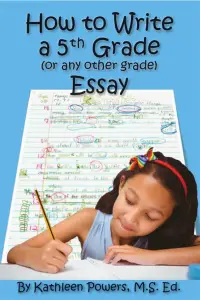
For more ideas on how to write, read my book How to Write a 5th Grade (or any other grade) Essay.  Or contact me for tutoring lessons.  I am now scheduling summer and fall classes.

Hi. My name is ___.

“Hi.  My name is Jane.  Do you want to hear about my vacation?”

This kind of opening—“Hi.  My name is ___” followed by a question—is the way almost all elementary school students whom I tutor begin their writing.  By the time they reach middle grades, they drop the “Hi.  My name is ___” and instead start with the question.  “Do you want to hear about my vacation?”

Just like primary grade students print their letters from the bottom up—the part closest to their bodies first—so do they write content from themselves out.  Since I see it so often in new students I work with, I suspect starting that way comforts students and instills confidence.

But of course, the primary effect of this kind of writing is to show the immaturity of the writer.  I suspect teachers cure students of “Hi.  My name is ___” by suggesting they start with the question first.

But with the kind of question the child asks—“Do you want to hear about my vacation?” the child still talks to the reader, and asks acceptance from the reader, as if the reader smiles and nods her head.  “Yes, of course, honey, I want to hear all about your vacation.”

The real problem with these kinds of openings is that they show a lack of imagination and an inability to engage the reader.  What if the reader thinks, “No, I don’t want to hear about your vacation.”  Oh. Okay.  Sorry.

The student should ask himself why a reader might want to hear about his vacation.  What was exciting or strange about the vacation?  Did your baby sister toddle into the woods and inspire a search party to find her?  Did you visit the Atlanta Aquarium and see a shark as long as a school bus?  Did you fly in a plane with masks on?

Teachers need to wheedle interesting responses from children by asking question after question until an engaging topic emerges.  How?

One way is to write a first sentence as a class.  Pick an event everyone has participated in—a test, recess, lunch in the cafeteria, a fire drill.  Ask for student volunteers to suggest something that happened.  When you hear a good idea, ask for details.  What did kids see or smell or taste?  What did kids think?  What did you hear someone say?  Write down clues on the board in the form of a mind web.  Pick something that students think will interest readers.

Then write the first sentences as a whole class.  Ask students to throw out suggestions.  Write them on the board.  Ask for student input.  Which sentence makes you want to keep reading?  Discuss why various sentences are good, better and best.

Don’t ask students to write the essay.  Instead, start over with a different event everyone has participated in.  Repeat the process.  Then repeat it again until most students are comfortable with this approach.  Ask students who are comfortable to work in pairs or small groups on how to write the opening sentences for another topic.  Meanwhile, you work in a small group with students who are not ready.

What if a student persists with “Hi.  My name is Frank.”  Remind the student about how the class brainstormed for good ideas to write about.  Help Frank on-to-one.

Read aloud good openings written by students.  Ask the class to describe why they are good.  I find sharing student writing is a sure way to inspire students to write better.

Masters of introductions

Are you looking for good ways to start novels?  If so, here are some great models.

If you want to foreshadow:

A crisis in a marriage caused by a man’s casual affair is how Leo Tolstoy begins Anna Karenina, a novel whose introduction is considered by many to be the best ever written.  Ultimately, the  couple reconcile, with their affair acting as a comparison to Anna’s affair later in the novel.  Because the comparison is not a direct, and because it involves Anna’s brother, it is all the more compelling.

If you want to highlight a first person point of view:

Start with a character who reveals his personality with a bang, such as Holden Caufield in The Catcher in the Rye by J. D. Salinger. “If you really want to hear about it, the first thing you’ll probably want to know is where I was born, and what my lousy childhood was like, and how my parents were occupied and all before they had me, and all that David Copperfield kind of crap, but I don’t feel like going into it, if you want to know the truth.”  From this first sentence we know this is a kid with an attitude, and we are hooked.

Or how about Huck Finn’s opening comment in Mark Twain’s The Adventures of Huckleberry Finn? “You don’t know about me without you have read a book by the name of The Adventures of Tom Sawyer; but that ain’t no matter.”  The poor English hints at Huck’s lack of education and perhaps backwoods roots.  So much is revealed about the protagonist in one sentence.

If you want to capture tone:

If the tone is satirical, start with a satirical statement, such as Jane Austen does in Pride and Prejudice. “It is a truth universally acknowledged, that a single man in possession of a large fortune, must be in want of a wife.”  Must be?  Acknowledged by whom?  We can expect wit, comic characters and a happy ending–a marriage.  This introduction is considered a classic.

If the tone reveals the misery of life, layer it on as does Frank McCourt in the third paragraph of Angela’s Ashes. “People everywhere brag and whimper about the woes of their early years, but nothing can compare with the Irish version:  the poverty; the shiftless loquacious alcoholic father; the pious defeated mother moaning by the fire; pompous priests; bullying schoolmasters; the English and the terrible things they did to us for eight hundred long years.”

If the tone is mystery, Edith Wharton in Ethan Frome nails it.  “I had the story, bit by bit, from various people, and, as generally happens in such cases, each time it was a different story.”  Not until the second last word of the sentence do we realize where the author is going, and we are hooked.

If you want to focus on an important symbol or motif:

Ray Bradbury’s Fahrenheit 451 immediately talks about fire, but with a twist.  “It was a pleasure to burn.”  This seems like a contradiction.  Is the narrator an  arsonist?

If you want to describe a character:

Joseph Conrad, in Lord Jim, starts with a powerful character sketch. “He was an inch, perhaps two, under six feet, powerfully built, and he advanced straight at you with a slight stoop of the shoulders, head forward, and a fixed from-under stare which made you think of a charging bull.”

If you want to rattle the reader:

See how L. P. Hartley does it in The Go-Between. “The past is a foreign country; they do things differently there.”  Comparing the past with a foreign country provokes thoughtfulness, but then the writer compounds the mystery with the second clause.

Or see how Charles Johnson does it in Middle Passage. “Of all the things that drive men to sea, the most common disaster, I’ve come to learn, is women.”  A woman is a disaster?  Even if you disagree, you want to find out why the narrator believes this is so.

What does teaching revising mean?

What could teachers do to help students revise?

When the essays are complete, teachers could reproduce a few sample student essays (with the students’ permission) and ask the class to analyze them. Teachers could ask:  Is there a thesis?  Do the topic sentences in the body support that thesis?  Is the thesis repeated in the topic sentences?  Is the thesis well supported in the body or is more information needed?  Does the information in each paragraph support the topic sentence of that paragraph?  If not, what should the writer do with that off-topic information?  Is the information presented logically?  Does the information in the introduction lead into the thesis?  Does the conclusion return to the ideas presented in the introduction?

Teachers could write and show their own response to the  prompt to offer an example of a well written response for the students to model.

Teachers could give students more time to improve their essays after they have analyzed other essays.

Teachers could have students read their essays to a partner for feedback before turning in their essays.

Before grading the essays, narratives, summaries, etc., teachers could return the writing marked with one idea for improvement.   Yes, the teacher would need to read each essay more than once.  But for the initial read, the teacher would need only to identify one glaring error which the student could then fix before receiving a grade.  Or if there is no glaring error, the teacher could suggest one idea for improvement (“How about turning this section into dialog?” Or “How about turning some compound sentences into complicated simple sentences?”)

The time to teach writing is not after the writing is graded but before and during the writing process while there is still time for the student to learn.  This is the time when students are most receptive to ideas which will help them become better writers.