Category Archives: how to teach writing

For kids with sensory integration issues, choose picture books with pared down shapes, colors, focus

If your child resists using certain picture books to retell a story, it could be the pictures themselves that discourage writing.
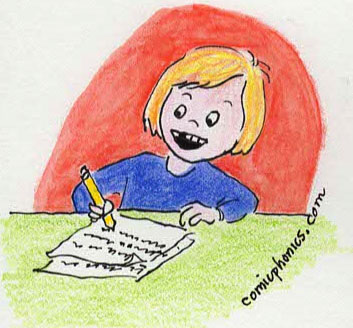
3rd grader writing an essay.

Choose picture books with plain or no background, solid colors, one or two characters and a single, focused idea in each drawing

Picture books with detailed backgrounds or with copious patterns can turn off children with sensory integration issues.  Such children have difficulty focusing if there is too much pattern, noise, motion, or texture in any experience.  They prefer plain painted walls and plain bedspreads, not papered walls and patterned bedding; low, instrumental music by a single instrument, not loud music or music with lyrics; sitting or standing still, not rocking or dancing; and loose knit clothing, not clothes with tags or clothes that are tight-fitting.

When you choose books for children who show sensory integration issues, search for picture books with these characteristics:

  • Pictures with no backgrounds, or just the hint of background—a wash of green to represent grass and trees, for example, or one or two birds in the sky, not a whole flock.
  • Characters dressed in solid colors without shading or patterns in their clothes. If you have seen Pippa the Pig books or cartoons, with their simplistic images, that is the kind you want to show your child.
  • Pictures using flat shapes and limited colors, the kind that children themselves produce. (Think of the way Peanuts cartoon characters are presented—Charlie Brown with his round head and Lucy with her dress of a single color.)
  • Pictures focusing on one or two characters, not groups. Look for pared down, minimalist images which have removed everything but the essential elements.

When you look for picture books for children with sensory integration issues to write about, search for picture books with the features just mentioned.  Some wordless picture books offer these kinds of pictures, but not all do.

Finding such books in your library or book store is not easy.  A section labeled “simplistic art” doesn’t exist.  I have had to scour shelves to find what I am looking for.  But the search is worth it to entice a reluctant child writer.

Next blog:  A list of books with the kind of art which appeals to children with sensory integration issues.
Show writers how important first sentences are

The first sentence of a story can lure readers in, like a wiggly worm on a fishing hook.  Or the first sentence can cause readers to pound the snooze button.

How can you show students how important first sentences are?

Here’s one way:

  • Show students a single drawing or photo in which some kind of human or animal action is going on. It could be the first page of a picture book (if so, cover up the words), a sports photo from a magazine, or something you’ve downloaded.  Try to find a picture which is clearly focused on one or two characters and without a lot of distracting background.Some creative sentence options.
  • Ask the students to write the first sentence of a story about the events in the picture. (No, you are not going to write the whole story.  No, I can’t offer any help.)  Let students muddle through how to approach the writing.  If they make a tentative suggestion, wanting your approval, affirm their suggestion, however good or bad you think it is.
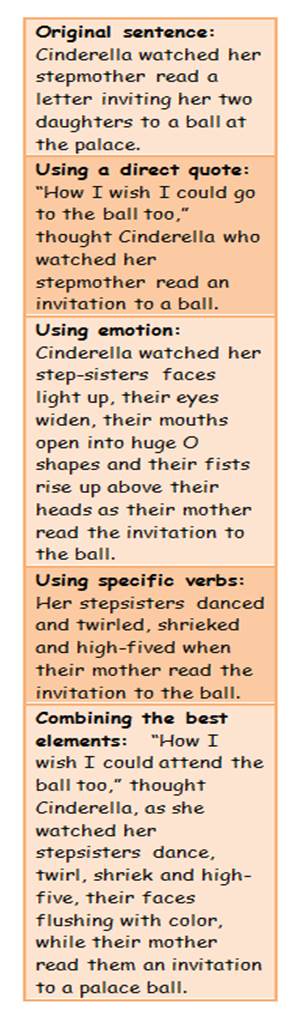
  • Next, tell them to write another first sentence for the same picture, but this time they are to start the sentence with a direct quote. It could be someone speaking aloud or someone musing.
  • Next, tell them to write another first sentence for the same picture, this time focusing on descriptive detail. The weather, clothing, posture, the look on someone’s face—any details which seem noteworthy are okay to write about.
  • Now tell them to write still another first sentence, focusing on the emotions of a person or animal in the picture.
  • Now write a sentence focusing on using specific vocabulary, especially specific verbs.

That gives you and the students several sentences to evaluate.

  • Ask the students to read aloud each of their sentences.
  • Ask which one seems the weakest or least alluring. If there are two somewhat bad sentences, that is fine.  Ask the students to identify why those sentences seem not as good as the others.
  • Ask which sentence seems the best. If the students think one, two or three are superior, ask why.
  • Go slowly, offering the students plenty of time to consider and reconsider their choices and reasons. Evaluating takes time.  Accept all responses.
  • Now, ask the students to take the best elements of the good sentences and combine them into one final sentence.
  • Ask them to read that sentence aloud, and to explain why they chose particular elements to include.

Lastly, ask the students what they have learned about writing from this exercise.

Peer evaluation of writing

Is it worth taking time to let students evaluate others’ writing?

Recently I asked second graders to write stories based on the picture book, Flora and the Penguin by Molly Idle.  Since the book is wordless, the students were forced to write their own versions of the story relying not on the author’s words but rather on the illustrations for guidance.

Later, I selected portions of two students’ stories for comparison.  I typed and printed them side by side, so students could compare how the two students wrote the same parts of the story.

Here are some of the comments students (second through eighth grade) made:

  • I like Student One’s opening because it tells when the story happens.
  • I like Student Two’s opening because it names the girl.
  • I like the word “poked” by Student One because it shows exactly how the penguin acted.
  • I like all the ways Student Two shows what Flora and the penguin did. They skated, danced, jumped, twirled and slid.  You can see it happening.
  • I like the dialog that Student Two uses when Flora asks, “What are you doing?”
  • I like Student One’s word, “outraged.”  That is a strong word.
  • I like Student Two’s word, word “disgusted” because it shows how Flora felt.
  • I like Student One’s writing where it says that Flora feels sorry because it shows that Flora cares.
  • I like when Student Two says “just like a fishing net.” I can see it.
  • I like when Student Two says “they tugged and tugged,” but maybe there are too many “tugs.”
  • I like Student One’s ending because it says Flora and the Penguin are happy.

After their blow-by-blow analyses, I asked my students what they learned from evaluating other students’ writing.  They said:

  • Use details, lots of details.
  • Use dialog or thoughts.
  • Use names.
  • Show emotions of the characters.
  • Verbs are really important to show action.
  • Use good vocabulary words.

One second grader, who rushes through her writing, compared her  plain version with the two shown here and said, “I’m starting over.”

A seventh grader who read the two versions, said, “Second graders?  Really?  I didn’t think I could learn good ideas about how to write from second graders.”

Is peer evaluation of writing a good idea?  You decide.

Connect back to the thesis in persuasive essays

Click on the chart for a larger version.

Suppose you need to write a persuasive or argumentative essay, as do many seventh graders whose states are following the Common Core curriculum.  Suppose you need to take a position on the following statement:  Santa Claus is real.

You decide to take the position that yes, Santa is real.  For your evidence, you use the following points:

  • The Weather Channel and many other news media track Santa’s whereabouts all over the world on Christmas Eve.
  • Santa’s image is used in advertising by Coca Cola and retailers during the Christmas season.
  •  Many movies have been made featuring Santa, including Miracle on 34th Street, The Polar Express, The Santa Claus I, II and III and A Christmas Story.

For your first body paragraph topic sentence, you write, “Many television and radio stations track Santa’s sleigh and reindeer around the world on Christmas Eve.”  If you add, “thus proving Santa is real,” you have a perfect topic sentence.  Then to back up your topic sentence, you list  TV and radio stations which do this.

So far so good.

You start your second body paragraph with, “Second, Coca Cola and other retailers use Santa’s image to sell items.”  The problem here is, “second” what?  You need to say something like, “A second reason to prove that Santa is real is that Coco Cola and other retailers. . .”

Every sentence in every body paragraph should support the topic sentence of that paragraph.  Just as importantly, every topic sentence should support the essay’s thesis.  Some students think, well of course, if I say “second,” the reader knows that what I mean is that this is the second reason why Santa is real.  Not so.  You need to say that.

You always need to state the connections between the evidence and your topic sentences, and between your topic sentences and your thesis.

In working with students writing persuasive essays, I see this lack of connections all the time.  To show the flow of connections, I draw arrows on students’ essays.  One group of arrows goes from the data in a body paragraph to the topic sentence of that body paragraph.  Another arrow goes from that topic sentence to the thesis or topic sentence of the whole essay found in the first paragraph.  If the connections is not stated, I draw the arrows with dashes rather than with solid lines to show that the connection is not explicit.

Make your connections obvious.

Should my child do reading and writing in the same lesson if the lesson is supposed to focus on writing?

EPSON MFP imageAs a tutor, this is an issue I have struggled with.  Most of the time, I combine reading and writing.  Here’s why:

  • A kindergartener or even a sixth grader has little personal experience to write about. They quickly exhaust “my dog” or “my family” as topics.  It makes sense for me to provide a topic to write about.  A quick and easy way to do that is to supply a picture book or a short essay.  But if I learn the student has taken an outing over the weekend, I switch gears and ask the student to write from his or her experience.  I might need to generate many questions about the outing to develop enough material to write about, but a personal experience trumps a reading experience, especially for young children.
  • Reading gives students a quick start. I might ask a young children to read part of a picture book (limiting the time spent reading to between five and ten minutes of an hour-long lesson).  For an older child, I might bring an essay or news story (again, limiting the time spent reading and discussing it.)  Our discussions focus on ideas related to writing, such as organization, characters, setting, suspense and conclusions.  Then we talk about the kind of writing I expect the student to write.
  • For students who don’t like to be told what to write, I might bring two reading selections, offering a choice. The child has a sense of control and I am happy with either choice.
  • Reading gives students various genres to analyze or to use as prompts. If the student is writing a persuasive essay, for example, reading one first offers ideas for organization and vocabulary.  I focus less on the content and more on the structure, details, figures of speech–the writing–during a writing lesson.
  • Reading offers excellent models for writing. If I am teaching how to write a formal essay with a thesis, obvious topic sentences and a good conclusion, reading such an essay first is a great way to begin the lesson.  We can talk about what makes the example good (or poor if it is poor) and how it could have been improved.

Everyone writes to be read, even if the reader is a later-day version of himself or herself.  We talk about this during our lessons, offering a solid reason to read before we begin and just as solid a reason to read the student’s work after it is complete.