Category Archives: English Writing Instruction

Writing well takes study and practice.

15 tips for writing a good blog

That headline is one example of how to write a good blog.  Make your headline eye-catching and intriguing, so readers will check it out.  Starting with numbers attracts too.  Here are some more tips:

  • Use bullets when you list. Bullets help your readers’ eyes see your organization.  Not all blogs need bullets, but when you list, use them.  They add white space, making your writing more readable.
  • Add white space before and after paragraphs. White space makes writing look more readable.  The same information written in long paragraphs is less attractive than when it is written in short paragraphs.
  • Keep paragraphs short. Three or four sentences max.  Cut a longer paragraph into two or three.
  • Keep sentences short. If you use complex sentences (like this one), limit them to one dependent clause.  The more clauses, the harder to read.
  • Replace long words of Latin origin with one- or two-syllable words of Anglo-Saxon origin. Longer words are often abstract.  Shorter words are usually concrete and easier to understand.
  • Give each idea its own paragraph, even if that paragraph is short.
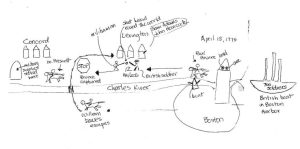
  • Use art. Photos, graphs, maps and cartoons attract.  They keep the reader engaged as they scroll down.
  • Stick to a format. You want to develop a recognizable style that you use in every blog.
  • Use subheads if you are writing paragraphs.
  • Use a sans serif typeface. Sans serif is quicker to read.
  • Use a big typeface—at least 12 point. It’s easier to read.
  • Avoid italics and ALL CAPS. People perceive italics as harder to read, so they don’t read them.  Words in capital letters seem to shout—not polite.
  • Use a plain light background. A graphic background cuts readability.
  • Keep your blogs short. Readers like to skim blogs.  Make yours skim-able.  Search engines pick up short blogs, too.

Use a cheat sheet to write better

Having a cheat sheet nearby when writing can, like a recipe, help students remember all the “ingredients” of good writing.  Here is a cheat sheet I recommend:

As the parent/teacher, you can reproduce this cheat sheet to be used as a check list each time a student writes.  You can go over the list together and compare the student’s writing to the check list.  Using such a list doesn’t guarantee great writing, but it guarantees improved writing for upper elementary grade, middle grade, and ESL students who are new to writing in English or are not confident about their skills.

Are curse words no longer taboo in writing?

“I don’t give an obscenity.”  “Who the obscenity cares?”  “Go obscene yourself.”

Sentences like these were peppered through the  pages of  For Whom the Bell Tolls, an Ernest Hemingway novel, which I read when I was 18.  Naïve and confused, I wondered, who talks like this?

Well, of course, no one does.  But Hemingway’s publishers in the 1920s and 1930s wouldn’t allow the actual crude words Hemingway wrote to be published.  Their solution was to take out Hemingway’s expletives and replace them with the word “obscenity.”

How published writing has changed in the past 100 years!  Gradually “damn” (“Frankly, Scarlet, I don’t give a damn”) and “shit” became acceptable in literature.  Now the word “bullshit” is everywhere, even in The New York Times and other publications with high language standards. Profane language has slipped into writing meant for children, too, such as the graphic novel This One Summer.  Within five frames on pages 246 and 247, “fuckin’,” “fuck,” and “fucking” are used four times in casual speech overheard by a preteen.

I grew up in a home where adults did not curse.  As adults, my husband and I rarely curse, and even then, the words we use are mild.  (“Oh, damn” or “hell.”)  Some of my children’s generation, now adults, rarely curse, but others use words like “shit” and “fuck” and “asshole” routinely, even in front of their children.  Is this a change in our spoken language, or have people always spoken this way, just not in my family?

Hemingway’s novels, after all this time, are still some of the most banned or challenged classic novels, not only in the US but around the world, according to the American Library Association.  Hemingway, with his almost immortal literary reputation, needn’t worry.  But how about us mortals?  Should we be using obscenities in our writing?  Is using them an aberration reflecting our increasingly uncivil society?  Or have past publishers, by censoring obscenities, provided literature which inaccurately reflected the speaking  of the people of those eras?

Changes in our spoken language precede changes in our written language.  Listen to the speech of people around you.  Do they use obscenities?  Do others censor them or walk away?  Do speakers edit their language depending on their audience?

If we want our writing to reflect our times, then we need to use the language of our society.  The problem is, today our American society is fragmented more than at any time since the Civil War.  Which society are we reflecting in our writing?  Teenagers experimenting with adult words?  Men railing against their loss of jobs and power?  Immigrant women with old country values?  Working women competing against men for promotions?  Children repeating the words of their parents?

We also must think of our audience.  For whom are we writing?  Would they bristle at the use of profanity?  Would they be unaware of it?  Are they children?

The dilemma and the choice are ours.


Write first, revise second, third, fourth, and edit last

Revising and editing are distinct actions.

Revising means changing text in significant ways, such as adding or deleting words, sentences, paragraphs or even whole scenes.  Revising means changing weak verbs to stronger, specific verbs.  Revising means changing sentence order or sentence beginnings or combining sentences or separating too many ideas in one sentence.  Revising means making big changes and should be done before editing.

Editing means polishing text in subtle ways, such as changing punctuation, spelling, and choice of synonyms and antonyms.  Editing means deleting most -ly adverbs, many adjectives, and obvious information.  Editing means making small changes, sometimes stylistic changes, and should be done after revising.

Which are revising and which are editing?

revising editing
Deleting backstory from the beginning of text
Using simple Anglo-Saxon vocabulary instead of longer, more complicated words
Replacing abstract nouns with concrete verbs
Deleting vague, qualifying words (e.g. some, never)
Deleting “that” except when needed for clarity
Combining sentences to delete unnecessary words
Adding information for clarity
Using “said” instead of “told,” “related,” “cried,” and other words saying how a person spoke
Replacing forms of the verb “to be” with specific verbs, action verbs if possible
Rewriting sentence beginnings for variety
Replacing most compound sentences or compound predicates with complicated simple sentences
Deleting overused words like “so,” “then,” “just” and “like”
Rewriting conclusions to add meatier ideas
In dialog between two people, not identifying who is speaking for each line of dialog
Writing direct dialog rather than indirect dialog.
Calculating words per sentence to keep within 15 to 20 words on average.
Looking for the kind of grammar mistakes you often make, such as run-ons, and fixing them.
Showing, not telling.

A mistake student writers make is to edit as they write, losing the flow of their thoughts.  It’s better to keep going, even though you know you spelled a word wrong and are tempted to look it up.  Writing is harder than editing which is why writers are tempted to edit as they go.  This is particularly true of perfectionists.

Editing before revising is a waste of time.  Good revising will delete many early edits.  Write first, revise second and third and forth, and edit last.

Annotating: why, what and how

Why should you annotate?

  • Annotating saves time later on. When you need to study a text, annotating creates a shortcut way to review a text and its graphics.
  • Annotating helps you understand now. When you initially read a text, annotating helps you understand it better.  You mark what’s important.  You connect ideas.  You paraphrase.  You sequence information clearly.
  • Annotating helps you retain information. The more senses you use to learn, the more likely you are to remember.  With annotating you don’t just read a text with your eyes (one sense—sight).  You write, underline, number, color code, and draw arrows with your hands and your eyes (two senses—sight and touch), and if you speak aloud to yourself as you work, you use another sense (listening).
  • Annotating makes the source material and your notes one document. If you write on your text, your notes and the text are forever together.  You can go back and forth as needed to check the original and to add more notes, more depth as you become aware.
  • Annotating makes you aware of your own learning. Sometimes you read on automatic pilot, and after a while, you realize nothing went in.  With annotating, you have to think about the material.  You stay focused.
  • Annotating puts difficult ideas or vocabulary into your own words. By paraphrasing, you learn whether you understand a text or not.

What do you annotate?

  • Main ideas. Often you can find these in the first sentence, in the last sentence of the first paragraph, in the last paragraph, and in titles, headlines and subheadings,
  • Subtopic ideas. These are often the first sentences of the body paragraphs.
  • How a text is organized. Chronological?  Most important to least important?  Sequential?  Something else?
  • Findings for scientific texts.
  • Evidence in persuasive and argumentative texts.
  • Themes, symbols, motifs, main characters, inciting action, problem to be solved and climax in fiction.
  • Ideas which when linked form a summary.
  • Vocabulary that seems important or that you don’t know.
  • Inferences, both obvious and suspected.
  • Figures of speech.
  • Patterns.

How do you annotate?

  • Identify important words or ideas. Usually these are verbs and nounsUnderline them with clearly visible ink or highlight them with a light enough color so they are easy to read.  Limit your underlines to only important information, not details.  If you underline almost everything, the underlines are wasted.  (See these paragraphs as examples.)
  • Use margins for your words. Draw conclusions, define words, ask questions, make inferences.
  • Number ideas. Some labels become buried in the midst of paragraphs. Make them obvious by numbering ideas boldly or drawing arrows from one idea to the next.
  • Draw question marks in margins. Box or bracket confusing information, and then put a question mark in the margin. Ask your teacher to explain that part.
  • Use abbreviations.  Use text message short cuts.  Or develop your own.  For example, I write the words “most important” or “very important” as “VIP” when I take notes.  If I hurry, I don’t cross t’s or dot i’s.  I write “about” as @.