Monthly Archives: May 2018

Finding good writing topics for children is hard

When I tutored a third grader this week, I suggested writing topics.

“Swimming.  Aren’t you on a swim team?”

“I already wrote about swimming.”

“Greek myths.  I know you like them.”

“Yeah, but I already wrote about all the Greek myths I know.”

“Hmm.  How about a class field trip.”

“None.”

“What it’s like to be the youngest child?

She rolled her eyes.

“A book you’ve read?”

“I already wrote about the book I read.”

As a writing tutor, I find the hardest part of the job is coming up with writing topics.  Oh, sure, there are lists upon lists of topics online, but I find the best topics are ones which students care about or at least which they have studied and know about.  And for young children who can’t do research yet, the only good topics are ones from their personal experience.

One solution to this problem is for me to contact the parent ahead of time and ask for a list of activities the student is interested in.  I hadn’t done that with this student, but I will.  Many parents can provide helpful topics such as a particular trip, a favorite TV show, a funny happening, an ambition, or something the student enjoyed studying.

Another way to get the student to write is to ask the student to use particular vocabulary words we are studying together.  Most students balk at this though, because 1) it is hard and because 2) it seems like an assignment, not genuine writing.  Good writing can come from this kind of assignment, but convincing a student it is worthwhile is hard.

I have had success using books students have read.  One writing assignment might be a summary of the book or of a chapter.  Another might be a comparison of a character in a book with another character or with the student herself.  A third writing idea might be to put characters in the book into a different story.

“Fractured” fairy tales can be fun.  We discuss changing the point of view of the fairy tale and rewriting it from the point of view of the big bad wolf or Prince Charming.

Sometimes I bring an object or two for the student to write about.  I have had students successfully compare several fall leaves and (for older students) several rocks.  One girl who sews did an excellent job comparing two quilting squares.  Another analyzed the unusual face of a child from the newspaper.

When time permits I let students read what other students have written.  Sometimes this leads to friendly competition or pricks a memory.

But the best topics are usually student generated.
 

When you are writing the sentences of an essay, where do you begin?

  1.  with the hook?
  2. with the introduction?
  3. with the thesis or essay topic sentence?
  4. with the supporting topic sentences?
  5. with the conclusion?

The answer is with the thesis /  essay topic sentence.

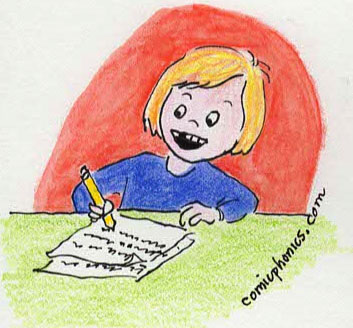
3rd grader writing an essay.But too many students don’t start there.  They start with a topic—say Harry Potter books—and then focus on writing a hook to get someone to read their essay about Harry Potter books.  When they are writing their hook they have no idea about the precise topic of their essay, just that it has something to do with Harry Potter books.  Wrong approach!

To impress upon my students how primary the thesis is to an essay, I have them write it on their planner before they plan in detail.  Then when they begin to write sentences, I have them skip five or six lines on notebook paper (or on a computer) and write their thesis there, partway down the paper, leaving room to add an introduction later.

The thesis is the anchor of the whole paper.  I have students box that sentence in color for easy referral.

Next, I have the student write the body paragraph topic sentences. This time I ask students to skip ten or more spaces after each body paragraph.  Later they can come back and fill in those spaces with details.

We read over those topic sentences and check out each one against the thesis.  Does the topic sentence support the thesis?  If yes, keep it.  If no, toss it and write another topic sentence which does.

Next, students write the body paragraph sentences with all the details which back up the paragraph’s topic sentence and the thesis.

Now that they know what their essay is about they can go back and write the introduction and the conclusion.

Think of an essay as a wedding ceremony.  What is most important in the ceremony?  Is it the music as the bride walks down the aisle?  Is it the flowers?   Is it the witnesses?  The kiss?  Of course not.  It’s the vows.  The vows are just a few words.  “I take you, Harry, to be my husband.”  “I take you, Meghan, to be my wife.”  Those vows are followed by supporting details like “for better or for worse,” and “in sickness and in health.”

The vows are like the thesis.  “In good times and in bad” and the other details are like the body of the essay.  The music is like the introduction and conclusion.  And the bride’s beautiful dress is the hook.  You can have a wedding without the dress and the music, but you cannot have one without the vows.  The vows are where you begin, just as the thesis is where you begin an essay.

An essay is a planned, organized piece of writing with one overarching idea expressed in a topic sentence / thesis.  Until you know what that thesis is, it makes no sense to write any other sentences because every other sentence must support the thesis.

Where do you start writing an essay?

An essay always starts with a topic.  Your teacher might assign a topic based on what you are studying in school, such as evolution or Romeo and Juliet.

But then what?  Do you just start writing?  Not if you want a good essay!  No, you think about the topic, about what interests you.  Does Harry Potter’s relationship with his aunt, uncle and cousin interest you?  Does the paucity of strong female characters—just Hermione and Professor McGonagall—in the Harry Potter series interest you?  You need to narrow down the topic.  At this point, you may have written a list but no sentences.

So when do you start writing sentences?  You start with a working thesis or topic sentence for the whole essay.  Your thesis needs to be a statement, and it should be an opinion which you can back up with evidence.  “Harry Potter’s aunt and uncle were lousy parents for him.”  “Harry Potter books contain few strong female characters compared to strong male characters.”

Now what?  Now come up with two, three, or four supporting ideas for that thesis statement (three if your teacher demands a five-paragraph essay).  Write those supporting ideas as statements.  “Harry’s aunt and uncle were lousy parents because they forced him to live in a closet while Dudley had a big bedroom.”  “Harry’s aunt and uncle were lousy parents because they bought few toys for Harry and many for Dudley.”  “Harry’s aunt and uncle were lousy parents because they didn’t tell him the truth about his dead parents.”

Thesis written.  Supporting ideas written.  Now what?  Do you start your introduction?  No.  Now you search for evidence to back up your supporting ideas.  Under each supporting idea, use three or more bullets to identify evidence.  Use direct quotes or paraphrases.  Add page numbers or other citation information.  You want to have plenty of proof that your supporting ideas are true.  If you can’t find enough evidence, eliminate that supporting idea and write another for which you can find data.

Thesis written, supporting ideas written, evidence jotted down.  Now do you begin your introduction?  Yes.  Think how you can start out with either a hook or with general information about your thesis, narrowing your information with each introductory sentence you write.

For example, you could start by saying that Harry was raised by his aunt and uncle, a general fact.  Next you could say that his aunt and uncle have a son about Harry’s age, another general fact.  Now you say that Harry and Dudley are treated differently by Harry’s aunt and uncle, and that Harry is not treated well.  Do you see how you are going from general information—Harry is raised by an aunt and uncle—to more specific information—Harry is not treated well by his aunt and uncle.  Now you can add your thesis as the last sentence in this introductory paragraph.

Adding your body paragraphs should be easy.  You already wrote the first sentence of each body paragraph, and you listed evidence.  Turn the list into sentences and your body is done.

Now it is time to write the conclusion.   Two “go-to” conclusions that work well are a full circle conclusion–returning to something you said in your introduction–or future looking introduction–talking about the future of the topic.  For example, you could go full circle by saying that Harry’s aunt and uncle were lousy parents, but they provide a great deal of humor at the beginning of the Harry Potter books, hooking young readers.  Or you could look to the future by saying that Harry Potter would certainly raise his children differently from the way his aunt and uncle raised him, providing comfortable bedrooms and using closets for clothes, broom sticks and wands–and maybe for a photo of their great uncle, great aunt and cousin.

Use adult vocabulary for academic words

I was working with a high school freshman writing an essay.  He was baffled by his teacher’s directions to write a chicken foot and buckets.  So was I.  There was a drawing of a horizontal line with three diagonal “toes” going out from the end of the horizontal line.  This was the chicken foot.  There was another drawing of four cans with a space for a label at the top of each one.  These were the buckets.  But there was no identification of what these terms or diagrams meant.

Emails back and forth solved the problem.  The chicken foot was the thesis.  The horizontal line was the opinion and the three toes were the supporting ideas backing up the thesis.  The buckets were the details for each of the chicken’s toes, with an extra one  in case.

The more I thought about these terms, though, the more annoyed I became.  Why not use the terminology that the student will need to use in other high school English classes and in college classes?  Why not call a thesis a thesis and its supporting topic sentences supporting topic sentences?  Why not call evidence “evidence” or “citations”?

What my student’s teacher is doing is what so many parents do for babies learning to talk.  The parents say “night-night” instead of “sleep” or “bye-bye” instead of “we’re leaving.” But eventually the children need to learn the proper names for “sleep” and “leaving.”  Why introduce “baby” versions of the words?  Isn’t “sleep” just as easy to understand as “night-night”?

I know the teacher is well meaning.  And I know she explained “chicken foot” and “buckets” during class.  But my student didn’t understand, and looking up those words on the teacher handout didn’t help.  If the teacher had used the word “thesis,” he could have looked that word up and found plenty of explanation.  If she had used the words “topic sentences” or “supporting topic sentences,” he could have found those words and their meanings online.  If she had used the words “evidence” or “citations,” my student could have figured out what they meant and what he was expected to do.

Children eventually need to learn proper vocabulary for ideas, whether it is “identify” or “cite.”  Babying their vocabulary does no service to children; rather it confuses them and stalls their acquisition of adult vocabulary.