Yearly Archives: 2017

If it matters, put it last

When most people talk, they make their point, pause, reconsider it, and add a bit more.  They ramble.  For example,

  • I went to the store this morning, and bought some coffee, but not my usual brand–they were out of that–but you know, I am glad I  did because I like the new brand better.
But when good writers write, they consider their sentence structure carefully, naming their most important information last for emphasis.  For example,

  • Grandpa watched the fly flit from lamp to chair to table, chuckling as the curious insect enjoyed a balmy summer flight before Grandpa smashed it dead.

If you write a compound sentence, with clauses connected by the coordinating conjunction “and,” you lose the opportunity for most end of sentence emphasis.  That is because “and” connects clauses of equal weight.  Even so, whatever is said in the second clause gains a slight weight just because it comes last.

If you change the “and” to “but,” a stronger end of sentence emphasis emerges.  That is because a clause after the conjunction “but”  either qualifies or contradicts the previous clause, thereby having the final word.  For example,

  • I ate the sandwich Mom prepared, but first I removed the cheese.

If you write a complex sentence, you write an independent clause and a dependent (subordinate clause).  The information in the independent clause is always more significant because an independent clause is more significant than a dependent clause.  Even so, whichever clause is written last in the sentence gains additional emphasis simply because it comes last.

Abraham Lincoln used this end-of-sentence emphasis to his advantage when he wrote his “Gettysburg Address.”  His uppermost thought throughout the speech was that the the US democracy must survive.  Notice how he emphasizes this thought in the last few words of his last sentence:

  • “. . .that we here highly resolve that these dead shall not have died in vain, that this nation shall have a new birth of freedom, and that government of the people, by the people, for the people shall not perish from the earth.”

Many poems place great emphasis on the last words.  Notice how important–and thought provoking–is the emphasis on the last word in “The Road Not Taken” by Robert Frost.

  • Two roads diverged in a wood, and I—
    I took the one less traveled by,
    And that has made all the difference.

Jane Austen’s opening sentence in Pride and Prejudice, like the punchline of so many jokes, uses the last word for irony and humor:

  • It is a truth universally acknowledged, that a single man in possession of a good fortune, must be in want of a wife.

To write better, consider your point and make it the last word.
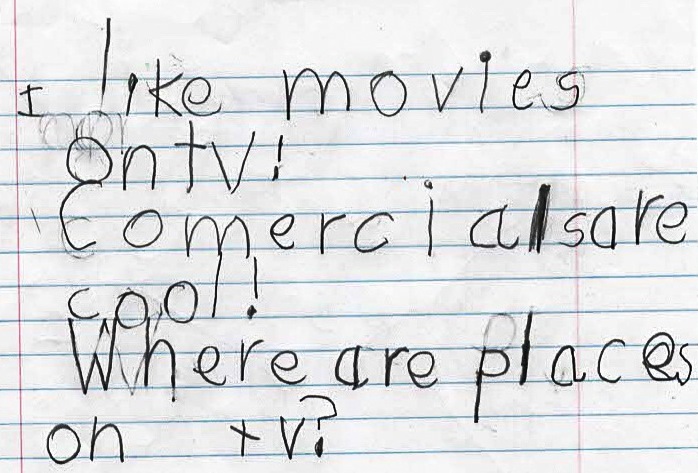
How a grandmother encourages her seven-year-old grandson to write

I received a note from a reader, describing how she teaches her grandson to write.  The boy, who turned seven this summer, is an active skateboarder, bike rider and swimmer, but he finds school work hard.  I contacted the grandmother, and here is our conversation:

Does your grandson like to write?

No.  He hates to begin.  But once he starts, he relaxes and actually enjoys it.  He feels pride in his work.

How do you get him started?

Late afternoon is best when I am getting dinner ready.  He sits at the kitchen table.  It takes lots of conversation while he tries to negotiate a way out of writing. It is difficult to endure but I persist.  If I let him wait until after dinner, he is too tired. So I refuse to change the time.  I bribe him with food treats, which I would give him anyway.  Or I promise a chance to play on my iPad for 15 minutes after he is done.

And then?

I give him a choice of three topics to write about.  More discussion.  Eventually he decides on one topic.  I write that word in the middle of a PLAN paper and now we decide on three ideas about the topic.  I write three more idea words.  He connects those words to the topic word in the center of the page. The key is the PLAN.  Now the struggle s over.  He has a plan to follow, so there is no more pulling info out of him.  It is a task to be completed.  He can work independently for a moment using the notes in the PLAN.

I try to walk away and let him do his own writing.  I will spell a word or write a big word on his PLAN paper if he asks.  It is quite amazing how his attitude changes once he has a sentence written.  He is happy that his sentence is written.  He loves being praised for how nice he makes letter A. He rereads his first sentence to me.  I ask if it is missing anything at the beginning or the end.  Then he gets his first reward, one m&m for each word.  Now we proceed to the next sentence.

He writes three sentences for each writing task.  He enjoys reading his entire essay.  Then we are done.

His mother has said that it is difficult for him to remember his ideas when he is writing.  I hope this technique will help in the future.  I’ve learned most of it from reading your blog.

Is that it for the day?

No, next is flash cards, computer reading apps, or a real book.  With flash cards, I have him hold each card and make a little colored mark in the corner if he knows the word.  This keeps him from fidgeting and gives him an activity.  The cards get marked up, but so what!

Intensifiers don’t intensify

What do “very,” “awfully,” and “rather” have in common?

They are adverbs.  True.  Anything else?  They are meant to intensify a word or idea.  True again.  Anything else?  Not sure?  Consider these sentences.

  • I’m tired.
  • I’m very tired.
  • I’m awfully tired.
  • I’m rather tired.

What is their difference in meaning?  Is “very tired” more tired than “tired”?  Is “awfully tired” more tired than “rather tired’?

The truth is that “very,” “awfully,” and “rather” are empty words.  They are meant to intensify, but they fall short.  They are like the second exclamation mark after “Wow!!”  Totally unnecessary.

We have many useless intensifiers in English.  “Really, “terribly,” “utterly,” “completely,” and “wholly” are some.

Here is my favorite quote about using intensifiers:

Mark Twain:  “Substitute ‘damn’ every time you’re inclined to write ‘very;’ your editor will delete it and the writing will be just as it should be.”


Periodic and cumulative sentneces

Sentences come in two primary structures which can be described much like this:

  • A main clause starts early in the sentence, is interrupted by details,  and ends with a final important word or idea.
  • A main clause starts and ends early in the sentence, and then it is followed by details.

The first kind is called a periodic  or climatic sentence.  You can  spot it because it builds to a climax.  For example,

  • John Kennedy, in one of the tightest Presidential elections in US history, by a margin of 112,827 votes, won.
  • Six-month-old Ellis, sitting in his high chair, and watching Mom’s hand with its spoonful of carrots draw closer, clamped his two baby teeth shut.
  • Hillary hit a low, skipping, two-run grounder.

The second kind is called a cumulative sentence.   You can spot it because it mimics the way people talk, starting with a complete thought,and then adding details to embellish that thought.  For example,

  • John Kennedy won by 112,827 votes, in one of the tightest US Presidential elections.
  • Six-month-old Ellis clamped his two teeth shot as Mom, holding a spoonful of carrots, drew that spoon close to his mouth.
  • Hillary hit a two-run grounder, the ball skipping past the pitcher and through the legs of the second-base player.

Each is useful for different purposes.

  • The periodic sentence, because of the details which delay the ending, creates both grammatical and meaningful suspense.
  • As the words build to a point, the periodic sentence emphasizes a point embodied in the last few words of the sentence.
  • The periodic sentence releases information formally and logically, showing planning and control by the writer.
  • The cumulative sentence, on the other hand, sounds natural, mimicking the way that people talk.
  • A cumulative sentences sounds informal and conversational.  It adds a stream of consciousness feel to writing and works well in dialog.
  • A cumulative sentence elongates and elaborates on action.

How to encourage primary school students to write better

If you are helping a student in kindergarten through second grade to learn how to write, you might want to check out Conferring with Young Writers  by K. Ackerman and J. McDonough.

ConferringWithYoungWritersThese primary grade teachers decided that they could have the most impact by changing the way they conference with student writers.  Here are some of their tips.

Establish trust with the student before trying anything else. How?  Let students see you writing and encountering problems.  Focus on the meaning of the child’s words and ignore sloppy spelling and punctuation.  Compliment students on their writing, focusing on particular things they do well.  Listen when the child talks about the writing process.  Get to know students as whole people first and as students and writers second.

Establish a routine for writing—a set time and place with pencils sharp, erasers in reach and plenty of paper.

Focus on one writing goal per lesson or unit. The goals should include choosing good ideas, structuring the writing appropriately, using conventions properly, sticking to one main point, writing in a natural voice, and providing details.  Teach those goals, model them, practice them and discuss with students how they can do them better.

Follow up on the points which they should have shown in their writing. The book shows several assessment tables, rubrics, and checklists which can be adapted by parents or classroom teachers.

Encourage students to choose their own writing topics and genres. Students will be more engaged and cooperative if they have choices.

Let students know it is not only okay but good if they talk to one another about the process of writing. Encourage them to read their writing aloud as they work.

Help students find good ideas to write about. Deciding on topics is one of the hardest things for some children.  Conferring with Young Writers offers several approaches to helping students identify what they might enjoy writing about.

Conferring with Young Writers offers a three page bibliography of books about teaching writing to children as well as an index.  At 144 pages, it is a quick but rich read for parents and teachers who don’t know how to begin teaching writing to primary grade students.  For more information, go to http://www.stenhouse.com.