Monthly Archives: May 2017

How writing instruments have changed

“What’s a typewriter?” a student asked me recently.  Her question made me realize 1) how old I am, and 2) how quickly the instruments we use to write have changed.  Looking only at instruments used after WWII, here is a brief history of writing instruments.

  • Pencils began when a large deposit of graphite was discovered in Britain in 1564. Almost 100 years later they were first produced in Germany, filling hollowed-out cylinders of wood.  For the past 100 years US pencils have been made of incense cedar, a tree which grows in California.  Since 1890, American pencils have been painted yellow.  That is because at that time the best graphite came from China.  To show that the graphite was of Chinese origin, the pencils were painted yellow, a color associated with Chinese royalty.
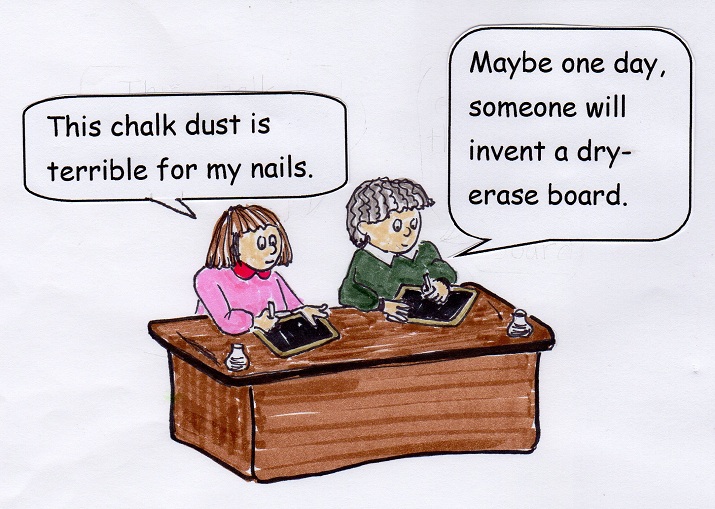
  • Typewriters were invented in 1868, and quickly caught on for office use in the late 1800’s. The keyboard we know today was standardized around 1910.  With a heavy hand, the typist struck one key at a time.  That key in turn struck a ribbon which pressed a raised image against a paper.  After typing, the typists’ arms would ache.  In 1961 the first electric typewriters became available.  Typewriters are rarely used any more, made obsolete by the invention of the keyboard.
  • Leonardo da Vinci might have invented the fountain pen (called nib pens), but for sure in Europe two quills were used together to form fountain pens in the 1600’s.  Such pens became available for purchase in 1828.  But they leaked; filling them was a dirty business; and they needed to be blotted.  They weren’t widely used until the 1880’s.  By the 1940’s and 1950’s these problems had been largely solved, and fountain pens dominated for handwriting.
  • Ball point pens date to 1888, but they had many ink delivery problems in their first half century. The size of the ball socket might release too much ink or too little.  The ink smudged.  An Argentine solved the problems, and an American, visiting Argentina after WWII, recognized the potential of this invention, patented it in the US, and sold the first ones on October 29, 1945, for $12.50 each.
  • Fiber- or felt-tipped pens appeared in the 1960’s. These led to markers and highlighters.
  • Computer keyboards became popular in the 1980’s, beginning in 1981 with the production of IBM’s first computer with a built-in keyboard. Now keyboards abound in various materials and shapes. (I’m typing on an ergonomically-shaped plastic one.)
  • Touchscreen technology has been around since the early 1970s, but was not widely used for writing until 2010 when Apple introduced the iPad. Now that technology is widespread in tablets and phones.

Peer evaluation of writing

Is it worth taking time to let students evaluate others’ writing?

Recently I asked second graders to write stories based on the picture book, Flora and the Penguin by Molly Idle.  Since the book is wordless, the students were forced to write their own versions of the story relying not on the author’s words but rather on the illustrations for guidance.

Later, I selected portions of two students’ stories for comparison.  I typed and printed them side by side, so students could compare how the two students wrote the same parts of the story.

Here are some of the comments students (second through eighth grade) made:

  • I like Student One’s opening because it tells when the story happens.
  • I like Student Two’s opening because it names the girl.
  • I like the word “poked” by Student One because it shows exactly how the penguin acted.
  • I like all the ways Student Two shows what Flora and the penguin did. They skated, danced, jumped, twirled and slid.  You can see it happening.
  • I like the dialog that Student Two uses when Flora asks, “What are you doing?”
  • I like Student One’s word, “outraged.”  That is a strong word.
  • I like Student Two’s word, word “disgusted” because it shows how Flora felt.
  • I like Student One’s writing where it says that Flora feels sorry because it shows that Flora cares.
  • I like when Student Two says “just like a fishing net.” I can see it.
  • I like when Student Two says “they tugged and tugged,” but maybe there are too many “tugs.”
  • I like Student One’s ending because it says Flora and the Penguin are happy.

After their blow-by-blow analyses, I asked my students what they learned from evaluating other students’ writing.  They said:

  • Use details, lots of details.
  • Use dialog or thoughts.
  • Use names.
  • Show emotions of the characters.
  • Verbs are really important to show action.
  • Use good vocabulary words.

One second grader, who rushes through her writing, compared her  plain version with the two shown here and said, “I’m starting over.”

A seventh grader who read the two versions, said, “Second graders?  Really?  I didn’t think I could learn good ideas about how to write from second graders.”

Is peer evaluation of writing a good idea?  You decide.

Connect back to the thesis in persuasive essays

Click on the chart for a larger version.

Suppose you need to write a persuasive or argumentative essay, as do many seventh graders whose states are following the Common Core curriculum.  Suppose you need to take a position on the following statement:  Santa Claus is real.

You decide to take the position that yes, Santa is real.  For your evidence, you use the following points:

  • The Weather Channel and many other news media track Santa’s whereabouts all over the world on Christmas Eve.
  • Santa’s image is used in advertising by Coca Cola and retailers during the Christmas season.
  •  Many movies have been made featuring Santa, including Miracle on 34th Street, The Polar Express, The Santa Claus I, II and III and A Christmas Story.

For your first body paragraph topic sentence, you write, “Many television and radio stations track Santa’s sleigh and reindeer around the world on Christmas Eve.”  If you add, “thus proving Santa is real,” you have a perfect topic sentence.  Then to back up your topic sentence, you list  TV and radio stations which do this.

So far so good.

You start your second body paragraph with, “Second, Coca Cola and other retailers use Santa’s image to sell items.”  The problem here is, “second” what?  You need to say something like, “A second reason to prove that Santa is real is that Coco Cola and other retailers. . .”

Every sentence in every body paragraph should support the topic sentence of that paragraph.  Just as importantly, every topic sentence should support the essay’s thesis.  Some students think, well of course, if I say “second,” the reader knows that what I mean is that this is the second reason why Santa is real.  Not so.  You need to say that.

You always need to state the connections between the evidence and your topic sentences, and between your topic sentences and your thesis.

In working with students writing persuasive essays, I see this lack of connections all the time.  To show the flow of connections, I draw arrows on students’ essays.  One group of arrows goes from the data in a body paragraph to the topic sentence of that body paragraph.  Another arrow goes from that topic sentence to the thesis or topic sentence of the whole essay found in the first paragraph.  If the connections is not stated, I draw the arrows with dashes rather than with solid lines to show that the connection is not explicit.

Make your connections obvious.

Why does “there is” and “there are” lead to poor writing?

Sentences which begin with “there” followed by a form of the verb “to be” put the subject after the verb. Most sentences, like the one you are reading now, name the subject first, and then tell what the subject does.  But when the sentence begins with “There is” or “There was” the subject is the third or fourth word, a weaker construction than the typical subject-verb construction.

“There is” and “there were” compound the weakness by using the weakest verb in the English language, “to be.” In a sentence like “There are two dogs,” we know nothing about the dogs except that they exist.  Even if we add a bit more information, such as “There are two dogs across the street,” we know little except that they exist across the street.

“There” like “It” (It’s raining out. It’s three o’clock) is a filler word, a word to get the sentence going without adding any information.  This construction is similar to a child starting a paragraph with, “I’m going to tell you about my pet dog.”  This child’s sentence offers a way for the child to start, but a poor way.  If the sentences which follow are about a dog, do you really need to start off by saying that you are going to tell us about your dog?

Sometimes the noun that follows “There is” is a noun which can be changed into a verb. When the sentence is rewritten, the sentence becomes more dynamic.  For example, take the sentence, “There was anger in the school about the school lunches.  “Anger” has no verb form, but “fume” or “seethe” are synonyms which could be used as the desired verb.  But now we have another problem.  Who fumes?  Who seethes about the lunches?

This problem leads to another shortcoming of “there is.” Many times “there is” creates a passive construction, one in which the reader doesn’t know who is acting.  Most of the time, the writer isn’t intentionally hiding who is doing the action in a sentence.  The writer is rather relying on an easy way to begin a sentence.  Why not come right out and say the actor, making the sentence more direct?

Another reason not to start a sentence with “There is” is that the beginnings of sentences receive the most focus. English speakers are accustomed to hearing the doer of the action named first.  (“John bounced the ball” not “The ball was bounced by John.”)  But when the beginning is a filler word like “There,” that opportunity to highlight the subject is squandered.  We focus on a meaningless word.

Analyze a piece of your own writing.  Circle all the “there is” and “there are” constructions whether they occur as the first words of sentences or the first words of subordinate clauses.  Now figure out how to eliminate them.

One exception:  When you write dialog, write the way people speak.  People say “there was” and “there will be” habitually.  On the other hand, if you want your speakers to sound dynamic, active, animated or enthusiastic, don’t put the words “there is” into their mouths.