Monthly Archives: February 2017

Should my child do reading and writing in the same lesson if the lesson is supposed to focus on writing?

EPSON MFP imageAs a tutor, this is an issue I have struggled with.  Most of the time, I combine reading and writing.  Here’s why:

  • A kindergartener or even a sixth grader has little personal experience to write about. They quickly exhaust “my dog” or “my family” as topics.  It makes sense for me to provide a topic to write about.  A quick and easy way to do that is to supply a picture book or a short essay.  But if I learn the student has taken an outing over the weekend, I switch gears and ask the student to write from his or her experience.  I might need to generate many questions about the outing to develop enough material to write about, but a personal experience trumps a reading experience, especially for young children.
  • Reading gives students a quick start. I might ask a young children to read part of a picture book (limiting the time spent reading to between five and ten minutes of an hour-long lesson).  For an older child, I might bring an essay or news story (again, limiting the time spent reading and discussing it.)  Our discussions focus on ideas related to writing, such as organization, characters, setting, suspense and conclusions.  Then we talk about the kind of writing I expect the student to write.
  • For students who don’t like to be told what to write, I might bring two reading selections, offering a choice. The child has a sense of control and I am happy with either choice.
  • Reading gives students various genres to analyze or to use as prompts. If the student is writing a persuasive essay, for example, reading one first offers ideas for organization and vocabulary.  I focus less on the content and more on the structure, details, figures of speech–the writing–during a writing lesson.
  • Reading offers excellent models for writing. If I am teaching how to write a formal essay with a thesis, obvious topic sentences and a good conclusion, reading such an essay first is a great way to begin the lesson.  We can talk about what makes the example good (or poor if it is poor) and how it could have been improved.

Everyone writes to be read, even if the reader is a later-day version of himself or herself.  We talk about this during our lessons, offering a solid reason to read before we begin and just as solid a reason to read the student’s work after it is complete.

When to use parentheses

Parentheses are marks of punctuation used to separate a word, phrase, or sentence from the rest of a sentence.  Here are some suggestions on how to use them.

parenthesesIf the parentheses contain words which are part of a sentence but not a complete sentence themselves, don’t use a period or a comma within the  parentheses.  The exception is when the words within the parentheses are a question or an exclamation.  Then use a question mark or an exclamation point as appropriate.

  • My mother (but not my father) has blue eyes.
  • Both of my mother’s parents had blue eyes (no surprise there!).

If the words in parentheses are a complete sentence, use punctuation at the end of the sentence, within the parentheses. 

  • My father and his mother had brown eyes. (But they each had at least one parent with blue eyes.)
  • My father’s father had blue eyes. (So why didn’t my father have one brown eye and one blue eye?)

Parentheses within parentheses can be grammatically correct, but they can be confusing to the reader.  It’s a good idea to rewrite those ideas using one or no parentheses.

  • I have brown eyes (the brown from my father (who probably had a recessive blue gene, like me)).
  • I have brown eyes.  The brown gene came from my father, who probably had a recessive blue gene, as I do.

When a name can be reduced to its initials, say the complete name first, and immediately after the name put the initials in parentheses.  Later, when you use the initials in place of the name, you need to use an article in front of the initials.

  • Both my mother’s parents were born in the United States (US), but neither of my father’s parents were born in the US.

When writing a research paper, you will be directed by your teacher to to use a particular style book.  That style book will have  information on how to use parentheses for citations and specific Latin abbreviations.  If you are not told to use a particular style book, you can use the Associated Press (A.P.) style book, or you can use a dictionary.  Name that book in the references part of your paper.

In general, it is better not to use parentheses if you can separate information with commas, or if you can rewrite idea to obviate the need for parentheses.  Too many parentheses can muddy the meaning, and the first rule in good writing is to be clear.

Getting one reluctant child writer to write

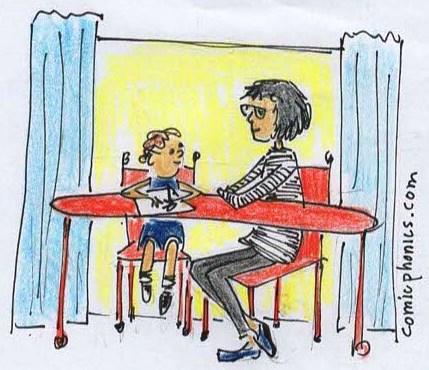
Last week I worked with a third grader on writing.  Knowing that it would take time to figure out a topic, I brought a picture book which she read in five minutes.  She read in an engaged fashion, commenting as we read and paging back and forth to check a fact or to compare an illustration.  She understood the book well, including the emotional inferences.

EPSON MFP image

I asked her to write down the story in her own words.

No.

I asked her to make changes in the story—a different setting, a boy instead of a girl main character, or a different ending.

No.

I suggested we make a list of what she liked about the story and what she didn’t like, and we write about that.

No.

This went on for a while.  Not prepared to struggle any longer, I suggested we move on to grammar.

Today I returned with a different strategy.  Yesterday I went to the library and checked out a handful of books that I thought would delight her.  Before today’s lesson began, I said that I would give her the books to read if for our writing lesson she would promise to write about the book we had read last week.  She looked at the stack of books and looked at me.

Okay.

But after a half a dozen lines of writing, she stopped, eying the enticing books.

“Done.”

“Not done.”

I pulled out a piece of notebook paper and started writing my version of the story we had read the past week.  She read over my shoulder.

“Janie X. Cuse?  What kind of a name is that?”

“A funny one.”

“Hey, you put my baby sister in there.”

“Inspiration.”

“Whoever heard of a teacher named Mr. Snooze?”

“You did.  Just now.”

Shereturned to her writing, scowling at me.  She changed the word “school” to “Small Creek Elementary” because she goes to “Big Creek Elementary.”  She named the teacher in her writing Mr. Snooze.

“Hey, you took my teacher’s name and put it in your story,” I said.

She grinned.

“Well, if you are going to do that, then I want you to write the name of this character in my story in Chinese.”

She erased the name I had chosen, thought for a minute, and in Chinese characters wrote. . .something.

“What does it say?”

She told me—in Chinese.

“But what does it mean?”  She grinned.

And so we went on.

This girl is motivated by competition.  And by humor.  And by good books to read.

Whatever it takes.

Spelling: What works, what doesn’t work

Because no national student tests focus on spelling only, experts can’t say how widespread spelling problems are.  But ask any teacher, and she will tell you many, many children learn to spell with difficulty or depend on phonetic spellings.

EPSON MFP image

If you are the parent or teacher of such a child, what do you do?

Here’s what doesn’t work.

  • Teaching spelling rules rarely works. When students see a worksheet or test on one aspect of spelling, they can do okay.  That’s because they are focusing on one rule of spelling.  But if you test on several rules, or wait a week to retest on one rule, a poor speller makes numerous mistakes.  And if you ask the child to write a few sentences with words which use some of these spelling rules, spelling errors abound.  It’s as if you never taught the rules.
  • Having the child memorize often used words can work if the word is simple. But not always.  Many children spell “went” as “whent,” or confuse “then” and “than,” or use “b” for “d,” or spell “was” as “saw.”  These children might have great visual memories for colors and landmarks, but not for spelling.  Experts think this is because the brain’s “wiring” for spelling is part of the language processing part of the brain.  Poor spelling is one sign of underlying language processing problems.
  • Teaching word parts—prefixes, suffixes and roots—can help a child guess at the meaning of words, but it doesn’t help much with spelling. The child will say the word in her mind and spell it the way it sounds to her.  “Useful” might come out “youzful.”

Here’s what does work.

  • Accommodations, especially allowing the child to use electronic writing equipment, reduce some but not all spelling errors. Spellcheck alerts the child that a word has been misspelled.  She can click on the misspelled word and the correct spelling appears.  She clicks on the correct spelling and eliminates the problem.  You might think:  but then she will never learn correct spelling.    But how about you?  When you make a spelling error on your computer or phone, don’t you click and replace?  So why shouldn’t a student?  Because of ubiquitous technology, the same rules which applied to us when we were students shouldn’t necessarily apply to students today.  The SAT allows calculators.  It didn’t when I took the test.
  • Teachers who limit the number of points off for spelling errors would lessen the stress on poor spellers. What if teachers would limit the percentage of a writing grade devoted to spelling to 5%, no matter how many words are misspelled?  Spelling is a way of delivering a message, the same as sentence structure and vocabulary and type faces.  If teachers would focus more on the content of writing, on its organization and message, and focus less on spelling and handwriting, poor spelling would be less of an issue.
  • If a child focuses on learning the spelling of the 100 or 200 most commonly used words in English, and ignores the rest, her spelling would improve. If those “most used” words were posted in the classroom as a universal word bank available to any child any time, spelling would improve.  Or those words could be offered to each child in a little booklet which the child could keep in her desk and refer to at any time. Why not?  Do you remember every one of your relative’s phone numbers anymore?  Or do you let your smart phone remember for you?  Is it “cheating” for you to press a name rather than to key in a  ten-digit phone number?  Then why can’t a child look up a spelling word?

English is a tough language to spell–maybe the toughest.  So many rules, so many exemptions.  Let’s take away some of the energy that goes into spelling correctly and put it into more important skills, like writing well.