Yearly Archives: 2016

Is it okay to use bullets in academic writing? My kid’s seventh grade teacher forbids it.

That’s too bad because research shows that bulleted items are well-read.

  • Perhaps it is the white space preceding a bullet or following the bulleted item that draws the eye. White space is known to make writing look friendlier and less intimidating.
  • Or perhaps it is the brevity of most bulleted items that lures the reader.
  • It could also be the obvious organization that bullets imply.

Using bullets (called glyphs) is common in business and technical writing.  Bulleted items can be lists of words, sentences or paragraphs.  Go online and you can find many sites that offer advice on how to use bullets.

More recently bullets have become accepted in academic writing, but to be sure, check the style manual a discipline or teacher recommends.

This is a fifth grader's organizer for a story she wrote about meeting Harry Potter.

This is a fifth grader’s organizer for a story she wrote about meeting Harry Potter.

I checked the SAT website to see if bulleted items are allowed on the new SAT essay, but I couldn’t find an answer.  However, the rules explaining the new essay used several sets of bulleted items.

When doing power point presentations, students should use bullets in their slides, not sentences.  For example

Bears eat

  • berries
  • honey from bee hives
  • bird seed from bird feeders
  • fish

Students create Power Point projects all the time.  They need to learn this useful skill.  On science project presentations and on posters, bullets are more apt than paragraphs and are better read.

At your next teacher meeting you might ask your son’s teacher why she doesn’t allow bullets.  She might think that bullets are not formal enough for academic writing.  Wrong.  Or she might think that some students would turn in a laundry list of bullets rather than write fully developed paragraphs.  Right.  She would be better off teaching the proper use of bullets than forbidding them entirely since eventually almost all students use them.


Use a diagram to “see” the structure of the new SAT essay

When working with students learning how to write an essay for the new SAT exam, I draw diagrams of an essay pattern they can follow. The diagram acts as a prewriting organizer.  It shows students an overall perspective of what they must write.  Here is a diagram that is easy to follow yet leads to an effective SAT essay.

diagram-of-sat-essayThis diagram separates the persuasive techniques from the summary.  In the SAT workbooks, the best essay samples entwine the summary and the persuasive techniques, a more sophisticated pattern to follow.

What is important is to cover all three of the criteria which will be judged:  1) clearly showing that you understand what the essay prompt is all about (the summary), 2) recognizing and analyzing persuasive techniques, and 3) doing all this using excellent English (perfect  grammar, a variety of sentence patterns, advanced vocabulary and–most difficult of all–your own voice).

Is there an ideal election ballot?

Is there an ideal election ballot, one written and designed clearly so that it is easy to read and use?

Yes.  It has ten features.*

2016-election-ballot

  • The ballot uses mostly lower case letters. Why? ALL UPPERCASE LETTERS ARE HARDER TO READ compared to lower case letters.
  • The names on the ballot, instructions, and other words are aligned to the left, not centered. With left-aligned type, it is easy for the eye to find where the next line begins.  With center-aligned type, the eye has to work to figure out which is the next line.
  • Font size matters. For ballots on a touch screen computer, type should be at least 25 point.  For optically scanned ballots, type should be at least 12 point.  Voters should not need magnifying glasses in order to read the ballot.
  • Fonts should be sans-serif (a lettering style without those little tabs at the tops or bottoms of letters). Sans-serif type faces are cleaner and therefore quicker to read than serif styles.
  • Optically scanned ballots should have instructions at the beginning and page numbers on every page. Touchscreens should offer continuous instructions (for example, at the top of each screen), language options, and a navigation system which is identical on every page of the ballot.
  • Instructions should be presented in simple, easy-to-understand English (or other language). So should ballot initiatives, changes to constitutions, and proposed changes to tax law.  Sample ballots should be available at polling stations so that voters can read complete written instructions and law changes before entering the polling booth.
  • Visual instructions, such as an arrow indicating to turn the page at the bottom of a touchscreen ballot, should be obvious and consistent.
  • Only informational icons, such as a stop sign at the end of the ballot, should be used—no elephants or donkeys.
  • Color, boldfacing or boxing should be used consistently. For example, if instructions are in color or in a shaded box on page one, they should appear the same way throughout the ballot.  However, color cannot be the only way to call attention to important information.
  • Layout and text size should be used to indicate importance of information. For example, on the page of Presidential candidates, the words indicating a vote for President should be bigger and more obvious than the names of candidates.  The candidates’ names should be bigger and more obvious than their party affiliation.  Also, all candidates’ names should be presented equally in font size and darkness of font.

* Design for Democracy, a strategic initiative of AIGA, the professional association for design, developed these guidelines.  AIGA worked with the US Election Assistance Commission and did testing on potential voters to develop these guidelines.  Because holding elections is a function of the states and not the federal government, each state is free to create its own ballots according to its own criteria.  After the election of 2000, many states changed their ballots to make them clearer, easier to use and less likely to be challenged.


Can sentences start with “because”? My son’s teacher says no.

“Because” is a word that is often misused in writing.  “Because” is a connecting word, connecting an independent clause with a dependent clause in a sentence.  If you use it, you must connect two ideas.  For example,

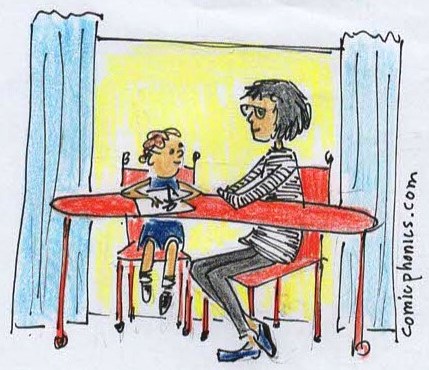
child writing in sleeping bag

I went to bed because I was tired.

“I went to bed” is the independent clause.  “Because I was tired” is the dependent clause.  “Because” is the connecting word.

Teachers tell students that they cannot start a sentence with “because.”  Actually, they can, if they connect the “because” clause to an independent clause.  For example,

Because I was tired, I went to bed.   (This is a perfectly good sentence.)

The problem is that many kids forget to add the independent clause.  Let’s look at three problems and how to solve them.

1.  Suppose a reading question asks you to tell why the dinosaurs died. You write, “Because a meteor hit the earth.”  This is a good fact but bad grammar.  “Because a meteor hit the earth” is not a sentence.  It is part of a sentence.  You need to add an independent clause to make it a complete sentence.  If you write, “Because a meteor hit the earth, the dinosaurs died,” now you have a sentence.

2.  If you find yourself starting what you think are sentences with the word “because,” there is an easy way to fix those mistakes. Just cross out the word “Because” and put a capital letter on the next word.

Why did Harry Potter go to Hogwarts School?

Because he wanted to be a wizard.  (Cross out Because and capitalize He.)

3.  Cause and Because are not the same thing. In writing, you cannot use “cause” if you mean “because.”  Cause is a verb or a noun.  Because is a subordinate conjunction (a connecting word.)

I went home cause I felt sick.  Wrong.  I went home because I felt sick.  Correct.

If you are writing dialog, write the way people speak even if their grammar is wrong.  Write ’cause when the speaker says “cause” meaning because.  The apostrophe indicates some letters are missing.

Find a topic for a student to write about by using picture books

Many children hem and haw about choosing a writing topic.  I ask for their suggestions and they shrug.  I give them options.  They object.  It’s possible to waste so much time during a writing lesson settling on a topic.

EPSON MFP imageI’ve figured out a way to end students’ angst and to start the writing lesson quickly.  I bring a children’s picture book to the lesson.  The student reads the book aloud.  Then I tell the student he is going to write a book patterned after the book he has just read.

“You can redo the same story, or you can use that story as a starting point for a different story,” I say.  This way the student has choices.

Let me show you two results.

One second grade girl read Alexander and the Terrible, Horrible, No Good, Very Bad Day by Judith Viorst as her prompt.  It concerns a boy for whom everything goes wrong one day.  Here is my student’s result.

Terrible Very Bad Day

Nick woke up in the morning and he fell out of his bed.  At breakfast his brothers ate all the cereal.  I think I’ll move to Washington, D.C.  In the bus he had to sit next to girls that he liked and everybody laughed at him even the girls.  In class Jackson said he was not his best friend.  At lunch everybody had desserts like cupcakes except him.  After school his mother took him to get shoes but he did not get what he wanted which was blue with red stripes.  At dinner his mom had spinach and he does not like spinach.  When his brothers got to watch TV he had to sleep.  Tomorrow is going to be a good day, he said.

That same second grader read Jack’s Worry by Sam Zuppardi as her prompt.  It is about a boy who fears playing his trumpet in a school concert.  Here is what she wrote this time (with names changed).

Sue loved making friends.  For weeks she had been looking forward to meeting the new girl in her school.  On the day she was meeting the new kid, she had a worry and it became bigger and bigger.  She was worried that the girl wouldn’t like her or that she would say something mean to her.  When it was time to go to school, she did not want to go.  Her mother said, “Is something wrong?”  She said, “Yes.  I am worried that the new girl will not like me.”  Mother said, “She will like you even if you make a mistake and I will love you.”  Sue’s worry was gone.  When she was at school, she met the new kid, Annie, and they became best friends.  Sue learned worrying is silly.

Some tips for using this technique:

  • Choose a book that the student can read in five to ten minutes so that most of the lesson is devoted to writing.
  • Beginnings are hard. Let the student see how the author started the novel.  Then suggest alternatives.
  • You might show the student the illustrations as she writes, but cover the words. Encourage her to write her own words.
  • Endings are hard. Suggest she write a moral if that makes sense.  Or suggest she reread her first two or three sentences and see if the character she is writing about has solved the problem presented.  Let the ending be a comment on the solution.  Or let the ending look to the future in light of what the student has written about.
  • Incorporate some particular aspect of writing into the lesson. In the first example I asked the student to keep going because I know she wants to finish quickly.  In the second example, I asked her to use direct quotes, and we talked about how to punctuate them.