Don’t put the cart before the horse

What’s wrong with these sentences?

  • The rocket exploded shortly after takeoff.
  • Without warning, the town’s tornado siren blared.
  • A mosquito suddenly bit my arm.

Grammatically, all three are correct sentences.  Spelling, punctuation—both are okay.  Clarity?  No problem.  So what is wrong?
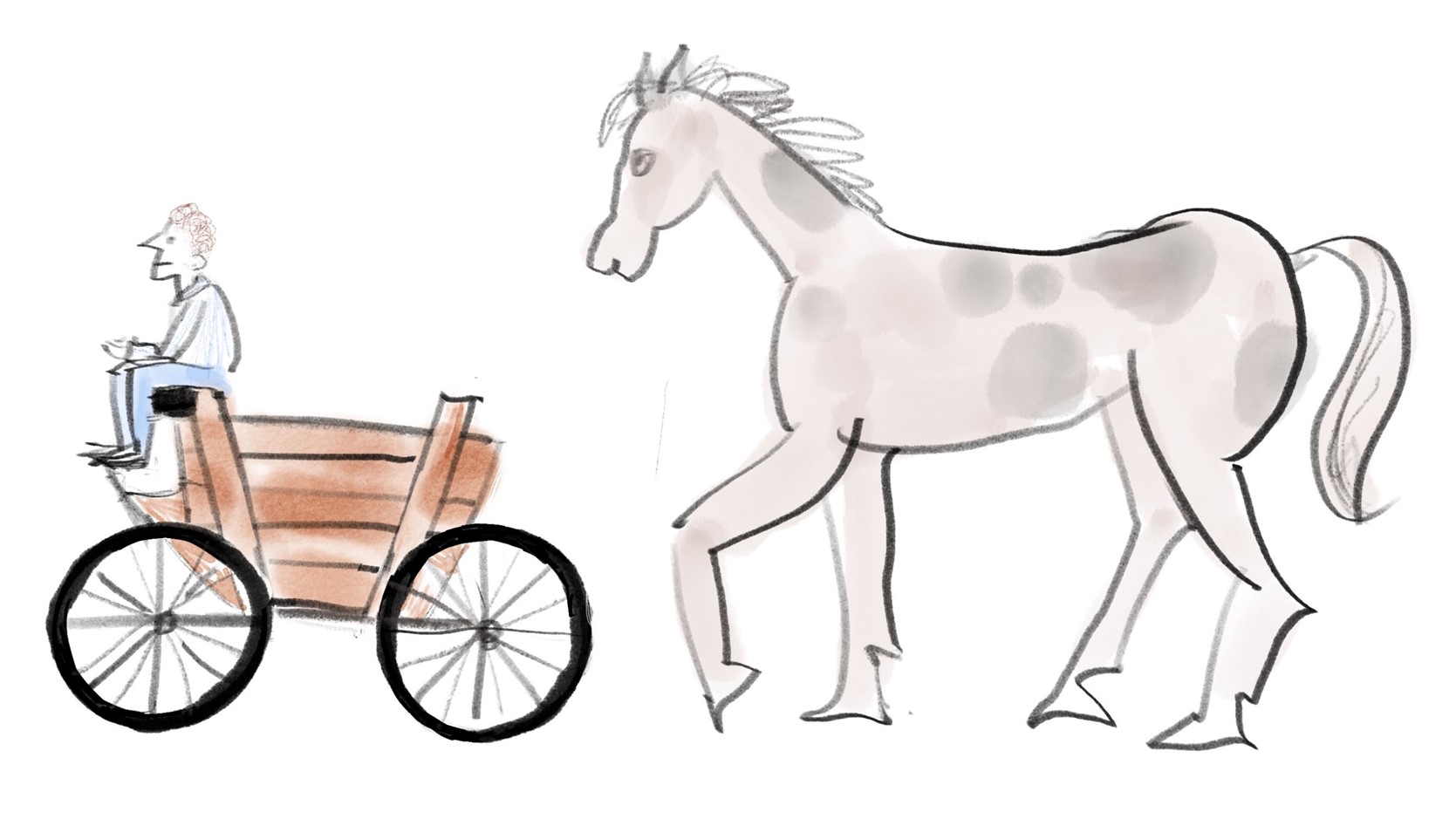
All three put the cart before the horse.

Suppose you are an onlooker at the rocket launch.  Which do you see first?  Does the rocket explode first or does the rocket take off first?  It takes off first, right?  So that information  should come first in the sentence, in chronological order.

Suppose you are in town when the tornado siren blares.  Which are you aware of first?  That a tornado is coming without warning, or that a tornado siren blares?  The blaring of the warning system, right?  So it should precede that it happened without warning.

Suppose you see a mosquito bite my arm.  If you saw the mosquito fly over my arm and then move on without biting, would you use the word “suddenly”?  No.  It’s because the bite is unexpected that we use the word “suddenly.”  “Suddenly” should come at the end of the sentence—or maybe not at all.

Is “At first, I saw nothing” an okay sentence?  For technical reasons, yes.  But would you use words like “at first” if nothing happens?  Shouldn’t what happens—or in this case what doesn’t happen—come first in the sentence?  When you say “at first,” you are alerting the reader that something else will happen, and probably it will be better or worse than what happens first.

Try to put yourself in the shoes of the character you are writing about.  Write about events in the same order that the character experiences them without clues to the outcomes.  Let the reader find out what happens in the same chronological order as the character in the writing.
5 steps to nail a two-sentence fiction summary

Is it possible to summarize a novel in two sentences?  Yes, and here’s how.

Identify the five elements below to create a two sentence synopsis. They elements are

  1. A Hero/protagonist—Who is the main character?  Don’t confuse narrator with main character.  Dr. Watson is the narrator, but Sherlock Holmes is the main character.
  2. A Situation the protagonist faces—What problem does the protagonist need to overcome?
  3. A Goal the protagonist needs to achieve—What would mean victory for the protagonist? Usually it means returning life to the way it was before the inciting incident of the story.
  4. A Villain opposing the protagonist’s goal—Who or what is blocking the hero?  If the villain is personified, all the better.
  5. A Disaster happening if the villain succeeds—What disaster will follow if the protagonist does not succeed and the villain thwarts the protagonist’s goal?

The first three elements are written as a one-sentence statement, and the second two are written as a one-sentence question.

Here are two examples from To Kill a Mockingbird accompanied by an explanation of how the five elements apply to that fictional story.  (I use Mockingbird as an example in my blog often because most American middle school students are required to read this novel.)

Example one: In a small town in Alabama in the 1930s (part of the situation), a girl (the protagonist) and her brother try to lure their reclusive neighbor into the open (another part of the situation and the goal).  But can they overcome his extreme shyness and his brother’s violent control (villains) or will he remain a prisoner of his brother forever (disaster)?

Example two: A small town attorney (protagonist) must convince (goal) an all-white jury in 1934 Alabama that a black man did not attack a white woman (situation).  Can the attorney overcome the racial prejudice of his neighbors and the testimony of the woman and her father (villains) to paccused (disaster)?

Some tips on how to write this kind of summary:

Follow the story arc during the first third of the novel to find the information to include.

Write concisely.  Rarely use names, dates, locations or other details.  They will muddle the summary and confuse the reader.

Focus on action.  Skip themes.

For more on this kind of writing, see Techniques of the Selling Writer by Dwight V. Swain.

Use PEE or PIE to develop body paragraphs in persuasive writing

PEE (Point, Evidence, Explain) is term to describe how paragraphs in persuasive writing should be developed.  It comes from research at the University of Arizona by Dr. Anne-Marie Hall who called it PIE (Point, Illustration, Explanation).  Paragraphs developed this way form good body paragraphs of persuasive writing.

Using this format, students write an opening topic sentence.  They follow it with facts to back it up.  Lastly, they connect the topic sentence and facts, analyzing how the facts support the topic sentence.

PEE is a method used in elementary grades to prepare students for persuasive writing.  Older students will use the same kind of logic in writing a thesis and in locating good research to cite to back a thesis.  PEE also teaches children the importance of facts such as names, numbers, and precise quotations if they want their opinions to be respected.

Here is a break-down of what PEE means, using and example that fourth graders could write:

P stands for Point, the point you are making in your answer to a question.  This point is made in a single sentence.  For example, the question could be, “Are you having a spelling test today?”  Your answer (point) could be, “Yes, I am having a spelling test today.

E stands for Evidence, the facts or examples that prove your point.  This evidence consists of facts such as numbers, dates, precise names, sources, and direct quotations.  For example, the evidence could be 1) It is Friday, and my teacher, Mrs. Spilling, always gives spelling tests on Friday.  2) Mrs. Spilling posted on September 23 on her school website (MrsBSpilling@ABCschool.edu) that my class is having a spelling test today.  3) My mother heard me my spelling words at 7:30 last night the way she always does the night before my spelling tests.

The second E stands for Explain.  That means to connect the point and the evidence.  For example, So because today is Friday, and my teacher, Mrs. Spilling posted on her website on Tuesday, September 23 that my class would have a spelling test today, and because my mother heard me my spelling words last night, I know I am having a spelling test today.

(A related idea which I have discussed previously in this blog is the sandwich method of introducing a quotation/citation into writing.)

The PEE or PIE format is not used for essay introductions or conclusions.  It shows a way to develop body paragraphs.

Making peace with AI, one word at a time

A student was writing about a vacation experience using an iPad.  As he lengthened words into phrases and phrases into sentences, corrections automatically appeared on his google document.  For example,

  • My student wrote, “We stoped at” but before he could write the next word, google’s AI changed “stoped” to “stopped.” My student did not need to think why his spelling was wrong or how to fix it.  AI subtly did that for him, allowing the student to focus on the content of what he was writing.
  • My student wrote, “but we couldn’t eventually see.” Google AI changed the word order to “but eventually we couldn’t see.” No explanation was given to my student for this change.  He probably didn’t notice it because he was finishing the sentence.

When I work in Microsoft Word, that software makes similar changes.  Right now, as I type the word “type,” over that word appears the correct spelling.  The software has guessed what word I want and has suggested how to spell it.  I don’t need to know how to spell.

As a teacher [teacher, teaches, and teaching just appeared as I wrote the word “teacher”], I realize my students are not forced to spell correctly, or to understand proper word order, or to remember that the pronoun “I” needs to be capitalized.  As long as they compose on electronic equipment in its default mode, they need not learn the nitty gritty of writing.

What is a teacher to do?  Allow AI to do its magic?  Or interrupt a student’s flow to ask why AI made a particular change?

My decision is to allow AI to fix my students’ work.  My students will likely be writing on a computer or tablet or phone for years to come, and will avail themselves of these fixes outside of class.  So why not in class?  Kids used to take pencil to paper to write; now they take fingers to a keyboard.  I see this situation as similar to allowing math students to use calculators, or letting my phone remember phone numbers, or letting GPS direct me on vacation.

I have another student taking an AP course.  Soon she will need to take a test requiring her to write several paragraphs in longhand.  Without AI to correct her, her poor grammar skills will show.  Even if her thinking is flawless, if she cannot write a coherent sentence to show her thinking, her grade will disappoint.

Yet looking at my students’ futures, how often will they be required to write in longhand?  Is the teacher requiring longhand for a test being realistic?  Writing in longhand is becoming passé.

I suspect this blog will seem ridiculous to my grandchildren when they are my age.  Technology will have changed so much by then.  And the changed technology will change the expectations of teachers and students.  Better they learn to use technology than how to spell “stopped” correctly.  Their future depends on technology, not on correct spelling.

Pantster or plotter? What kind of writer are you?

Writers come in two classes:  panster and plotter.  Which are you?

A pantster is a writer who doesn’t like to plan, someone who likes to write by the seat of their pants.  A pantster likes to discover his story as he writes it with plot twists he didn’t anticipate until he started writing.

A plotter likes to plot his stories before he writes them.  Some plotters write with minimal plots figured out before they start.  Other plotters anticipate every scene, setting, character, dialog and surprise in the outline.  They want to know what happens before they write.

Is one better than another?  It depends on the type of writing you are doing.

Essays require organization, a strong thesis statement, a development of that one idea, and a conclusion.  They require at least a minimal of plotting.

Biographies require some kind of plotting–usually chronological.

Whodunits require a murderer who is one of the characters.  Readers today don’t accept villains who come out of nowhere.  So plotting backwards is inevitable.  I can spot mysteries whose villain has not been well integrated into the story.  I feel cheated by these endings.  I have invested all this time into reading, and I expect the writer will respect me by providing a clever ending.  That takes careful planning.

Some fiction is comprised of self-contained short stories with one factor in common, such as a location or a character.  There might be an arc showing development, or there might not be.  Individual stories  might require some plotting, but the novel as a whole might not.  Or the story arc might be vague, such as a little brother annoys his big brother, and the big brother doesn’t like it.  These are more pantster than plotter.

Journey stories can be well written by a pantster.  You start the protagonist on his way, and then you add one difficult situation after another until he has faced enough perils.  Then you end the story with victory.  The order of the obstacles doesn’t matter.

The pantster does an awful lot of rewriting.  The plotter rewrites too, but not as much because so much writing was done in the planning stage of the story.  The plotter seems to finesse his writing while the pantster chucks page after page of irrelevant material.  Or maybe he saves it for another book.

Which we are—pantster or plotter—might depend on our personalities.  Detail-focused writers might prefer plotting to be sure all the details are included and in the right order.  Freedom-focused writers might prefer pantster’s lack of restrictions.

Perhaps the best-loved writers are a little bit of both, using sophisticated plotting paired with imaginative, surprising events.

Which kind of writer are you?