Avoid using adverbs for better writing

When we are in elementary school, teachers tell us to use adverbs. When we reach high school, teachers tell us not to use adverbs. What’s going on?

First of all, what are adverbs? Adverbs are parts of speech which describe verbs, adjectives, adverbs and whole clauses. Most of them end in –ly, such as quickly, obediently and awfully. (But not every –ly word is an adverb.) The most commonly used adverbs do not end in –ly and include words like not, seldom, never, today, very, more and less.The –ly adverbs are considered weak words by many writers because they tell, not show. For example,

  • Weak: The toddler walked quietly to bed.
  • Stronger: The toddler tiptoed to bed.
  • Weak: That baby is very tired.
  • Stronger: That baby could hibernate all winter.
  • Weak: The awfully pretty child looked at us flirtatiously.
  • Stronger: The dainty child beguiled us with her smile.

In each of these three examples, a weak adverb is replaced by a stronger, specific verb or adjective.

Another reason writing teachers say to avoid adverbs is because using them weakens ideas. The word “very” is a good example. In almost every sentence you can think of, when “very” is used as an adverb, the idea becomes weaker.

  • It’s very chilly out.
  • It’s freezing out.
  • That cake is very tasty.
  • That cake tastes delicious.
  • Rex is a very well-behaved dog.
  • Rex behaves well.

Some adverbs state the obvious. “The boy fell down.” Can a boy fall up? “Grandma hollered loudly.” Can Grandma holler softly?

We need some adverbs. We don’t have negative versions of most verbs, so the word “not” is the way to make most verbs negative. “Yesterday,” “today,” and “tomorrow” provide crucial time information, as does “now” and “then.”  When we are organizing an essay, sometimes it makes good sense to start paragraphs with words like “first,” “next,” and “finally.”

As a general rule of thumb, adverbs which end in –ly are less organic to writing and should be eliminated or rewritten with stronger verbs. Adverbs which don’t end in –ly are harder to dismiss and might be essential to good writing.

In a narrative, what comes first when you write a reaction to an incident?

Someone steps on your toe. What comes next?

a. You say “Ow!”

b. You feel pain.

c. You withdraw your foot.

d. A, b and c happen at exactly the same time.

In real life, d might seem like the right sequence since our bodies’ nervous systems react so quickly that it might be hard for us to distinguish thousandths of a second meaningfully.

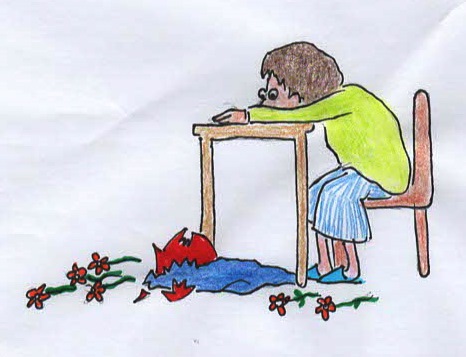
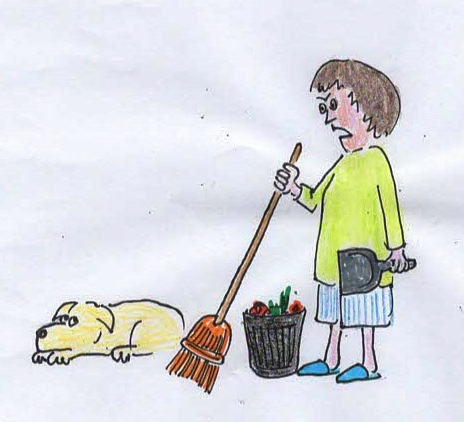
A dog pulls table cloth, knocking down a vase of flowers a woman is working on.

Stimulus

But when we write about this experience, order does matter. Why? Writing is a means of communication based on putting one word after another. Writing is based on sequencing ideas. We can’t write about two things happening at the same time without first naming one idea, and then using a word like “simultaneously,” and

Woman is dismayed

Emotional reaction

then naming the other idea. One idea has to be expressed first and another has to wait its turn.

Knowing this, good writers have developed an order in which to express reactions, and it is this:

  • Something happens (the stimulus).
  • Someone has an emotional reaction.
  • That same someone has a physical reaction based on his emotional reaction.
  • That same someone speaks or not based on a rational reaction.

    Woman lowers her head, discouraged

    Physical reaction

If, for example, a raccoon walks across the deck while the family dog is watching from inside the house, the order of action and reaction is

1. A raccoon walks across the deck (the stimulus).

2. The dog sees this and has an emotional reaction of protection. “Hey, this is my territory. Mine, not yours!”

3. Aroused, the dog jumps up and

4. The dog barks.

The woman yells at the dog.

Spoken reaction

Knowing the order of responding to a stimulus is an advanced writing skill, but one that some fourth and most fifth graders can learn. One way to teach this skill is to show four index cards with pictures on them. One might show a raccoon on a deck. Another might show an aroused dog, his eyes bulging (or the way cartoonists sometimes do, with a lightbulb over his head). The third might show that same dog lunging toward the window, and the fourth might show the dog barking at the raccoon.

Another way is to show a series of poorly written reactions to stimuli and to ask the student to rewrite the sequence in a better order.

One warning: Not all four parts of this stimulus/reaction sequence need to be used. A stimulus is necessary, and an emotional reaction is necessary (although that emotional reaction could be trivial if the stimulus is not important). Sometimes a physical reaction will occur, and sometimes not; sometimes a spoken reaction will occur, and sometimes not. The more serious the stimulus is, the more likely all four parts of the reaction will be present.

Use active verbs, not passive verbs, to improve your writing

What are active verbs? In a sentence with an active verb, the subject does the verb.

  • “The cat licked her paw.” In this sentence, the cat is the subject, and it is doing the licking.
  • “Lee ate a sandwich.” In this sentence, Lee is the subject, and Lee is doing the eating.
  • “The red car crashed into the blue car.” In this sentence, the red car is the subject, and it did the crashing.

What are passive verbs? In a sentence with a passive verb, the subject does not do the verb. In fact, we may not know who does the verb.

  • “I was followed home by a dirty dog.” In this sentence, I is the subject, but I does not do the following.
  • “By that time, the contract had been accepted.” In this sentence, the contract did not do the accepting. We don’t know who did the accepting.
  • “Homework was assigned by every teacher.” In this sentence, the homework did not do the assigning.

What are the advantages of active verbs?

  • Clarity—Active verbs make your writing easily understood the first time.
  • Brevity—Using active verbs is almost always the most concise way to write.
  • Action—Your writing zips along when you use active verbs.

Then, why do we have passive verbs?

  • To mask the doer of an action. Sometimes we don’t want to say who did the action of the verb because it might be more diplomatic not to identify who did the action. Or we might not know who did the action. For example, you could say, “Explosions were set off at the port.”
  • To obfuscate. Sometimes a writer deliberately wants to keep the reader confused or unsure.
  • To slow down the action in a narrative.

Henry James is a 19th century American novelist who wrote in the passive voice and often used the verb “to be.” Many readers find his writing ponderous because of its long sentences and lack of action. His writing demands that you reread a sentence to understand it. This kind of writing seems quaint and tedious to 21st century readers who want James to get to the point. But maybe the people he wrote for had leisure to appreciate a slower pace in fiction.

How to write well, according to Swain

If you could boil down how to write well into just a few ideas, what would they be?

How about

  • Choose vivid, specific words, words that excite our senses. Avoid generalities by using concrete words that create pictures in the readers’ minds. If you write about groups of people, focus on an individual.
  • Choose active verbs, verbs that put action into those vivid pictures. Avoid the verb “to be.” Use the simple past tense whenever you can, not past progressive or the perfect tenses.
  • Rarely use adverbs. Instead, through action show what the adverb suggests.  If you must use an adverb, put it at the beginning or end of the sentence for the most impact.
  • Vary your sentence structures. Use long sentences, short sentences; simple, compound and complex sentences; sentences that start with prepositional phrases, dependent clauses and gerunds; and sentences that aren’t sentences at all.
  • Don’t try to cram too much information into a single sentence.
  • If you repeat words, repeat enough times and close enough together so those words create impact.
  • Concise is better than verbose.
  • And most important of all, write clearly. The reader should “get it” the first read.

These suggestions come from a single chapter in Techniques of the Selling Writer by Dwight V. Swain, 1965.

How should academic vocabulary be taught?

The new Common Core Standards call for students to learn “academic vocabulary.”

What many well-meaning teachers and parents do to “teach” this vocabulary is to ask students to look up in dictionaries or thesauruses the meanings of unknown words. This method of vocabulary instruction often fails because children don’t like to do it and so they pick the first meaning of a word, often the wrong meaning. If the children go online to look up the word, the result is even worse since online results list words but not nuances of meaning or usage.

So how can academic vocabulary be better taught and learned?

Cartoon of a waterskiier withe the caption, Aquatic:  relating to water

Aquatic: relating to water

One good way is to follow the advice of Robert Marzano, author of Building Academic Vocabulary (2004). He recommends

  • First, a teacher (or parent) explains the meaning of a new word to a child, giving an example that the child can remember. (I have found that the funnier the example, the easier it is for the child to relate the word to the example later on.)
  • Second, the child explains the new term in his or her own words. (If a word is difficult to pronounce, make sure the child says the word several times. I write the word phonetically, using syllable breaks, to help the child pronounce it.)
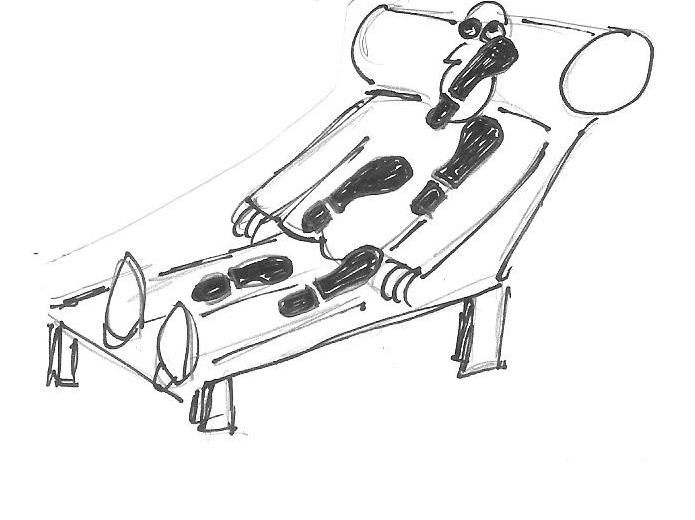
Cartoon of a man with footprints up his body and the words, Unassertive:  wimpy

Unassertive: wimpy

  • Next, the child makes a drawing of the word. (Stick figures are fine, but the meaning needs to be clear. Again, humor helps the child to attach the picture to the word.) A more dramatic child could act out the word. The idea is to explain the word not using words.
  • In the days after learning a new word, and from time to time thereafter, the child should encounter the word and the teacher or parent should ask what it means. If the child forgets, start the process again. If the parent makes a habit of using the word when talking to the child for a week or more, the child will better remember it.
Cartoon of a man with footprints up his body and the words, Unassertive:  wimpy

Mutilate: to cut in order to disfigure

  • From time to time, the teacher / parent and the student, or the student and her peers, should discuss vocabulary words. This could be every Monday, or twice a month, but regularly reviewing what a child has learned cements the ideas better each time they are reviewed.
  • Children should engage in fun games to help them remember vocabulary. (I use BINGO review games: a board labeled with 24 or 25 vocabulary words and a stack of definition cards. In a classroom setting, either I or a student student calls out a definition, and the children cover the correct word.)
Cartoon of a skull and crossbones with the words, Lethal:  deadly, toxic, fatal

Lethal: deadly, toxic, fatal

Adding one more idea to Marzano’s suggestions, I suggest that the word be used correctly in sentences. Many students I have taught can tell me the definition of a word, but when it comes to using the word correctly, they cannot do it. They use a noun for a verb; they don’t use the past tense or past participle of a verb; they leave off the “s” of plural words or of third person singular verbs; and when adding suffixes, they misspell. This usage work can be done orally so that it goes faster and so students don’t balk at it.