Is a focal character the same thing as a point of view character?

Sometimes yes, sometimes no.  A focal character is the central character in a narrative. A point of view character is the character through whose eyes or mind we are learning about the story and the central character. Usually they are the same, but not always.
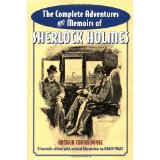
original cover of Sherlock HolmesIn the stories of Sherlock Holmes, Holmes is the focal character. We learn about his habits, such as his violin playing, his drug taking, and his disdain for people whom he considers his intellectual inferiors. More importantly we learn how his mind works—how he identifies subtle clues that others miss and how he uses them to solve difficult crimes.

But how do we learn all this? It’s though the eyes and ears of Dr. Watson. As Watson learns about Holmes, we learn about Holmes. As Watson is awed and appalled by Holmes’ behavior, we are awed and appalled. Dr. Watson is the point of view character.

Original cover of Huckleberry FinnIf a story is written in the first person, then the person telling the story is the point of view character. In To Kill a Mockingbird, Scout tells the story of her father’s legal defense of an innocent man. In that part of the story, Scout is the narrator but her father, Atticus, is the focal character. In Huckleberry Finn, Huck is both the focal character and the point of view character for the whole novel.

If a story is written in the third person, then the focal character can still be the point of view character. Hatchet is the story of teenager Brian Robeson who becomes stranded in the Canadian woods for a summer. It is written in the third person, but we hear the thoughts of Brian. “I have to get motivated, he thought, remembering Perpich. Right now I’m all I’ve got. I have to do something.”  Brian is both the focal character and the point of view character.

A few novels switch back and forth between point of view characters, both of whom are the focal characters. The first chapter focuses on Character One, giving the reader his emotions, thoughts and behavior, while the second chapter focuses on Character Two, giving the reader that character’s emotions, thoughts, and behavior. That there exist few books like this indicates that most authors—and maybe most readers—prefer a single point of view. Why? Perhaps two points of view are confusing. Or perhaps two points of view water down the impact of a story.

I recommend that if you are teaching children how to write narratives, that you explain the difference between focal characters and point of view characters by comparing versions of fairy tales. Read a traditional version of a fairy tale and then compare it to a “fractured” fairy tale. Use picture books to entice the students. Even high school kids will love this kind of lesson, but more importantly, they will remember the difference between focal character and point of view character.

Cover of "The True Story of the 3 Little Pigs!"Read a traditional version of “The Three Little Pigs,” for example. Ask who the focal characters are. (Who is the story about? Often in fairy tales, the title gives it away.) From whose point of view is the story told? Usually in fairy tales it is from an unknown, god-like narrator. Then read a “fractured” fairy tale about the same story, such as Jon Scieszka’s The True Story of the 3 Little Pigs. This version is told from the point of view of the Wolf, who of course, is the focal character.
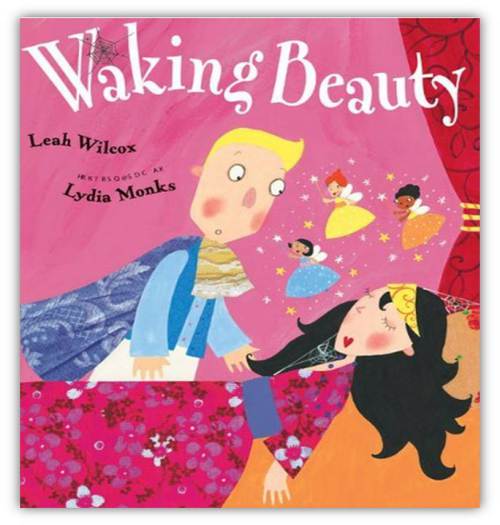
sleeping_beautyAnother good example is reading a traditional version of “Sleeping Beauty.” The focal character is the princess and usually the point of view is the “god-like” third person narrator. Then read Leah Wilcox’s Waking Beauty, which focuses on a prince who will do almost anything not to kiss the snoring Beauty—hollering, jumping on her bed, throwing water at her, even shooting her from a canon. The focal character and the point of view are the prince, certainly not Sleeping Beauty.

(The Common Core State Standards include a writing standard—ELAW1—which requires students to use an appropriate point of view. Also, a literature standard—ELARI6—requires students to understand an author’s point of view.)

In a dialog, don’t identify the speakers over and over. Trust your readers.

What do you notice about this dialog?

“Can I go with you?” the child asked her father.
“No, not this time,” her father said.
“Why not?” the child asked.
“Because,” the father said.
“Because why?” the child said.
“Because I’m going on a business trip,” the father said.

Beginning writers often identify the speaker in every line of dialog in narrative writing.  This slows down the action and needlessly irritates the reader. If there are just two characters talking, it is unnecessary to identify someone on every line. Compare the above dialog with this one:

“Can I go with you?” the child asked her father.
“No, not this time, hon.”
“Why not?”
“Because.”
“Because why?” She pouted her lip.
“Because I’m going on a business trip.”

Did you have any trouble keeping track of who was speaking?

Suppose the above dialog continued for another six or more lines? You might need to write “he said or “she said,” one more time to keep the speakers clear. But maybe not.

“Why can’t I go, Daddy?”
“Because you’re five years old.”
“So—” The child folded her arms over her chest.
“So when you are grown up, you’ll go on lots of business trips.”
“Really?
“Really.”
“Daddy?”
“Yes, angel.”
“Will you bring me a present?”

Did you notice there were no he saids or she saids?

How can you avoid over-identifying the speaker in a dialog, yet keep the speaker clear?

  • Make sure that the first one or two lines clearly show who is talking. Often both identifications can go on the first line, if the relationship between the speakers is made clear, as above.
  • Use the “voice” of the speakers, so their way of speaking—their grammar, their vocabulary, and their pronunciation—identifies them. “Because why?” is the way a child would talk.
  • Use details that identify who is talking. “Because I’m going on a business trip” would be said by a father, not by a child. “She pouted her lip” identifies that the child said the previous words without using “she said.” “Yes, angel” would be said by a father. A child would ask for a gift.
  • Make sure each character’s line of dialog becomes a separate paragraph, and the person speaking—if identified—is identified in the same paragraph with his spoken words.
  • Instead of using “he said” or “she said,” write words to let the reader “see” the speaker. “He snapped his suitcase closed. She hugged her Teddy bear.”

Should students illustrate their writing with drawings (like in the Wimpy Kid)?

Many of my students do. And here’s why.

  • Illustrating encourages students to write. The drawings become the carrot that entices the students to write words.
  • Information gleaned from the drawings can later be added as details to the writing during revisions. Some students add few details in their writing but add rich details in their illustrations. A teacher can encourage the student to transfer some of the visual details into words.
  • The internet has changed the language we use to communicate to a much more visual and less textual language.  Students live more and more in a visually designed online world, using icons, videos, tables, photos and cartoons. Why not let their school work reflect their real world?
  • Drawings can be an icebreaker between a teacher and a poor student writer. “Wow, Adam, I love the way you drew the expression on that guy’s face. Your art is really well done! Now let’s see how we can get that feeling into words.”
  • When students read one another’s work, they love the illustrations. Students may be more willing to accept peer criticism of their writing if they receive peer praise for their drawings.

Below is a narrative with illustrations made by a fifth grader.  The illustrations were in his first draft on notebook paper, but we added them to his final draft.  Click on the graphic below to enlarge it.

Illustrated narrative by a 5th Grader.

Use pictures as prewriting organizers for kids who can’t read yet

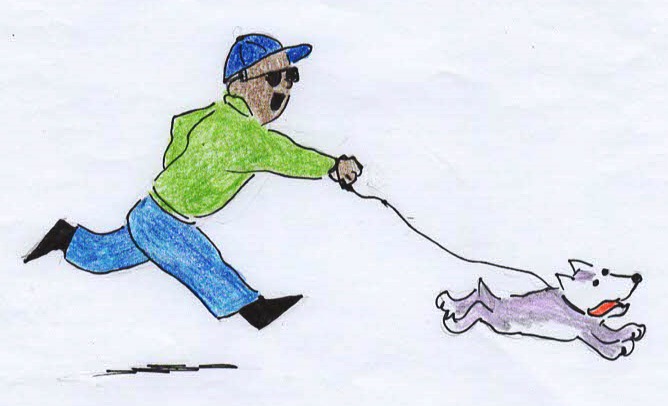
dog barking; wants man to go for a walkOrganizing their thoughts is something good writers do before they write their first sentences. But little kids who are learning to read (or ESL students without much English background) might not be ready for for mindwebs, timelines, comparison/contrast charts or Venn diagrams. What kind of prewriting organizers work for them?

dog brings man leashOne kind I have found effective is a group of drawings about a subject which can be sequenced into a meaningful order to tell a story.

For example, suppose you would like your child to write the story of Little Red Riding Hood.

  • First, read the fairy tale to her to reacquaint her with the details.

man runs with dog

  • Second, find a six-panel cartoon describing the story of Little Red Riding Hood. If the child is really new to writing, you might start with three panels which tell a story and work up to six. Cut out the six panels, shuffle them, and lay them in front of the young writer.

dog is exhausted

  • Encourage the child to put the cartoons in the correct order, discussing why one panel goes before or after another if she seems hesitant.
  • Explain to her that she is going to write down the story of Little Red Riding Hood in the correct order, according to the panels.
  • Capitalization mistakes, missing punctuation, spelling errors, verb tense inconsistencies—ignore them and focus on the storyline. When the child is learning, accept her invented spelling and grammar.
  • If there are three panels, you might expect the child to write three sentences. If there are six, she should be encouraged to write six or more.
  • Often beginning writers forget to use transitions. You might suggest words like “then,” “next,” “a little later” and “suddenly” to smooth out the sequencing of events.
  • Publishing is important too. Hang the finished piece on the refrigerator. Scan it into the printer and email it to Grandma. Print a copy to show the child’s teacher.

Where can you find drawings which tell a story and are suitable for sequencing?

  • Search online. I found some immediately when I looked.
  • Photocopy pictures from a story the child likes and let her sort them into the correct order.
  • Photocopy pictures from a wordless picture book from the library.
  • Goodwill sells dozens of children’s books every day that could be cut up for this purpose.
  • Use family photos. If there was a special event recently, and you have photos of what happened, the child could sort them into a meaningful order.

For some children, writing begins before reading. There is no reason to wait until the child is an adept reader before encouraging her to write.

Use the word “said” instead of one of its many synonyms

Using the most specific vocabulary word usually is good advice in writing, but there is one exception: the word “said.”

Told, stated, remarked, revealed, whispered, shouted, spoke—the list of substitutes is practically endless. But most of the time, “said” is the best option.

When you write, “He said,” you are informing that a person spoke, but you are not informing how he spoke, so the focus goes on the words he said aloud. In the sentence, “Jack said, ‘I am soaking wet from that rain,’” the focus is on what Jack said aloud, as it should be. In the sentence, “Jack hollered, ‘I am soaking wet from that rain,’” the focus is split. Part of the focus is on what words Jack said aloud, and part is on his manner of speech—a holler.

We are so used to reading the word “said” that it virtually disappears, much like the article, “a.” That is what we want. We need to let our readers know who is speaking, but usually the manner of speech is not important. By using any word other than “said,” attention is drawn away from what is said to how it is said, which we don’t want.

A good rule of thumb is to use “said” if you want your reader to focus on the words which were said aloud. However, if you want your reader to focus on the manner of speaking, then use another word. But do so sparingly.  Click on the listing (graphic) below for a larger version.

synonyms for said

Synonyms for the word “said” as compiled by http://www.synonyms-antonyms.com