What are the advantages of active verbs? of passive verbs?

Some of the advantages of active verbs are

  • Clarity—Active verbs make your writing easily understood the first time someone reads it.  The subject of the sentence usually comes before the verb.  The subject performs the verb, the usual way of expressing through sentences in English.
  • Brevity—The most concise way to write uses active verbs.  Compare:  Wilma ate the sandwich.  [active verb—four words]  The sandwich was eaten by Wilma.  [passive verb—six words]  If we omit “by Wilma” in the second version, we have four words, the same as the first version.  But those four words give less information.
  • Action—Your writing zips along when you use active verbs.  Active verbs  “slip.”  They make scenes go faster and conversations race.  That’s why sports writers write in active verbs.  Orders use active verbs.

Then, why do we have passive verbs?

  • To mask the performer of an action—Sometimes we don’t want to say who did the action of the verb because it might be more diplomatic not to identify the actor. “The last chocolate chip cookie has been eaten.”  Or we might not know who did the action. For example, you could say, “The market was targeted and bombed.”
  • To confuse. Sometimes a writer deliberately wants to keep the reader confused or unsure.  Detective novelists use this technique.  For example, you could say, “In darkness the body was buried in the woods.  It was covered with six inches of leaves, after which all footprints were swept until they were not noticeable.”
  • To slow down the action.  For example, you might say, “The history exam was returned to Jane.  It was folded, the grade hidden within where it could not be seen by classmates.”
  • To focus on the action of thinking.  Henry James, a 19th century American novelist, wrote in the passive voice and often used the verb “to be.” Many readers today find his writing ponderous because of its long sentences and lack of action. Actually there is action, but it is in characters’ heads.  This kind of writing seems quaint and tedious to 21st century readers who want James to get to the point.  But maybe the people he wrote for had leisure to appreciate a slower pace in fiction.
Never start a direct quote with “He said”

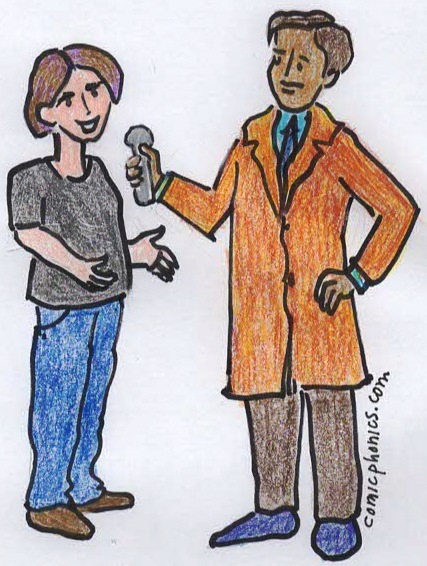
When you are interviewing someone, and you want to quote that person directly, how should you identify who is talking?  Compare these examples:

  • Mrs. Smith said that I might want to avoid the back yard because  the dog poops there.
  • Mrs. Smith said, “You might want to avoid the backyard.  That’s where the dog poops.”
  • “You might want to avoid the back yard. That’s where the dog poops,” said Mrs. Smith.
  • “You might want to avoid the backyard,” Mrs. Smith said. “That’s where the dog poops.”

Each of the examples offers the same information, yet one excels.  Let’s examine them individually to find out why.

  • Because what is said is more important than who says it, the first and second examples are not as good as the third and fourth examples. But the first example has another problem:  it uses an indirect quotation when a direct quotation is livelier.  The reader would prefer to hear the exact words of the person being interviewed, providing that person is not hemming and hawing.
  • The second example improves on the first example because it replaces the indirect quotation with a direct quotation.  But it still starts with the least interesting information, who is speaking.
  • The third example is better than the first two because it uses direct quotes to start.  However, the reader needs to wait until the completion of the quote before knowing who is speaking.  Since there are two sentences, it makes sense to identify the speaker at the end of the first sentence.
  • The fourth example identifies the speaker after the first part of the direct quote, the correct location to do so. And it directly quotes the speaker.  This example wins.

So, to recap, use direct quotes rather than indirect quotes when the quotation is lively and dramatic, or when it shows off the speaker’s personality or diction.  Start with the direct quote, but pause either at the end of the first sentence or at a natural spot in the first sentence to identify the speaker.


Forbidding am, is, are, was, were, be, been, being

1  What if you could not use any forms of the verb “to be”?  No am, is, are, was, were, be, been or being.  No progressive verb tenses.  Fewer passive verbs. No “that’s” or “it’s.”  Could you do it?

2  That’s what two of my high school students were asked to do on a research paper due today.  Any form of the verb “to be” was outlawed by their teacher, even if that verb was part of a direct quote.

3  With no choice, they wrote and rewrote sentences.  They pared down direct quotes or paraphrased them.  They eliminated passive voice.  And then they asked me to scour their writing to be sure no forms of “to be” still lurked.

4  And they did it!

5  I was telling this to another student, an eighth grader, whose writing we had just revised, and for the heck of it, we re-revised, eliminating the verb “to be” in all its forms.  A funny thing happened.

6  The student’s writing became more concise.  The student’s writing contained more active verbs and fewer linking verbs.  “It’s better,” the student said.  “Oops,” he added, realizing he had said “it’s.”

Let’s try the strategy on this blog now.

In paragraph 1, I cannot eliminate the forms of the verb “to be” or you might not know what I am talking about.

Paragraph 2 begins with “That’s,” meaning “that is,” and later in the sentence, contains the passive verb “were asked.”  I can rewrite that sentence to say “Two of my high school students needed to do. . .” dropping the “were asked” part.  In the next sentence “was outlawed” and “was” need to be eliminated.  Instead I can write, “Students could use no form of the verb “to be” even if the verb occurred within a direct quote.”

Paragraph 3’s last sentence contains the infinitive “to be.”  I could rewrite that sentence like this:  “And then they asked me to scour their writing until. . .”

Paragraph 4 passes okay.

Paragraph 5 begins with “I was telling.”  I could easily change that to “I told.”

Paragraph 6 passes okay.

When I first heard about the “confining” verb choices for my students’ assignment, I said to myself, “Ridiculous.”  But now I am an ardent fan of this way of writing.  The results convinced me.  Fewer words.  Tighter sentences.  Fewer linking verbs.  More specific verbs.  More active voice.

Win-win.

4 reasons to use direct quotes

Should you use direct quotes in writing both fiction and nonfiction in which there are people?  Definitely!

Below are examples from Akin by Emma Donoghue.  Akin is a novel about a 79-year-old former professor spending time with an 11-year-old street kid.  Part of the delight of the book is its dialog, especially the contrast between the two people’s world views reflected in their way of speaking.

So, why to use direct quotes? 

First, direct quotes show inflections, that is, how a speaker changes a word’s emphasis depending on verb tense, number, prefixes and suffixes and a use of modifiers.  Here, for example, the old man says,

“You must know singers with ludicrous stage names?  Like, ah 50 Cents.”

“50 Cent,” Michael said, pained.  “And it’s Ludacris.”

Here’s another example, with the old man asking the boy,

“Do you skateboard?”

“Skate.”

“Oh, you prefer skating.  Ice or roller?”

“It’s called skating, dude.”

Second, direct quotes show regionalisms, ages, education, socioeconomic and other differences.  For example, the boy explains that his skateboard was stolen.

“They skated right past, dissing me.  Grandma said”—Michael quoted—“’This is a test from the Lord, are you going to hold on to your wrath?  Are you going to pass the test?’”

Here is another.  The boy asks,

“Are you a atheist?”

Noah corrected him:  “An atheist.”

“That’s what I said.”

“It’s an, rather than a, when it’s followed by a vowel:  an atheist.”

“Like you’re an asshole.”

Third, direct quotes show how a person puts a sentence together—using standard English or some other way.  The older man, Noah, often uses long and complex sentences, yet adjusts his way of speaking so the boy will better understand him.  The boy, on the other hand, uses really short sentences or phrases without concern for grammar.  For example, the boy tells of his Uncle Cody:

“Cody used to smoke till I got him Juuling.”

“What-ing?”

“Vapes, you know?  E-cigs?”

In another example, Michael sees a bunch of balloons tied to the front railing of a house.  He asks,”

“Did somebody get offed here?”

Fourth, direct quotes reveal personality.  From the few quotes I’ve just used, you can see that Noah, is an academic from an educated middle class background and out-of-touch with children, yet willing, even eager, to know the boy. Michael is more tentative about knowing Noah, preferring the safety of his phone.  He uses the language of the street as an intentional emotional barrier between himself and Noah.

I recommend you read Akin.  I suspect you too will delight in the dialog, just part of the treat of this well written novel.


“He’s just not that into you.”

If you have watched Sex and the City, you might remember a particular scene. Miranda has dated a man whom she likes, but he doesn’t phone to ask for another date.  She frets until the current boyfriend of Carrie says, “He’s just not that into you.”

“He’s just not that into me,” Miranda muses.  And like the snap of fingers, Miranda stops blaming herself for the relationship not progressing.  It’s not her fault.  He’s just not that into her.

That’s the same attitude we writers need when someone shrugs off our writing.    “She just doesn’t like my point of view.”  “He doesn’t get my humor.”  “She disagreed with what I say.”  “He thinks my story is too sad.”

And that’s okay.  Just because someone’s not into your writing doesn’t mean you’re a bad writer.  It means whatever you’re “selling,” they’re not “buying.”  Next!

Even writers who today are considered great have their critics.  Hemingway writes too plainly.  Shakespeare’s too hard to understand.  Henry James’s novels contain no action.  All Tolstoy’s women characters are either childlike or fallen.  Agatha Christie’s characters are one-dimensional.

The next time someone criticizes your writing, say to yourself,  “They’re just not that into me.”  And then move on.