What’s a constructed response?

Constructed responses, like so many other terms, have become standard with the spread of the Common Core Curriculum.  But what are they?

They are written answers—not multiple choice answers or matching answers or fill in the blank answers, but written answers, usually one paragraph long.  To give a constructed response means students need to respond to a question or prompt with an answer they have “constructed” or built from information in their head, or in a text, or from research.

For example, for a second grader answering the question “Who is President of the United States?” a constructed response could be “Joe Biden is President of the United States.”

Rarely though is a constructed response so simple.  A prompt might ask students to explain the water cycle.  A student would need to write several sentences using the words “evaporation,” “condensation,” and “precipitation” to construct an acceptable answer.

Some teachers give detailed instructions for the responses they will accept.  For example, students might be required to respond to a text in four sentences.  The first sentence would need to name the text, author, and other significant information.  The second sentence would need to contain an assertion by the student concerning the text.  The third sentence would need to quote or paraphrase evidence from the text which supports the assertion in the previous sentence.  The fourth sentence would need to explain how the quoted text supports the assertion.

Constructed responses are required across the curriculum—in social studies, science and even math courses.  In the years prior to the introduction of the Common Core, many non-ELA teachers did not require written responses from their students.  They relied on the English teachers for that.  I worked with several social studies teachers who tested only using multiple choice tests.  A whole class’s answers, on Scantron cards, could be scored in two minutes.

Constructed responses take time to grade.  Teachers don’t like to grade them.  Yet the careers of students, especially college graduates, may require written responses.  This past weekend I edited a two-page constructed response of a phone app developer who needed to explain a project from start to finish—in sentences, using proper grammar.  Another time I edited part of a book on data mining by a mathematician.  It’s not just English teachers who need to write.

Constructed response is a new term for an old idea:  responding in writing.
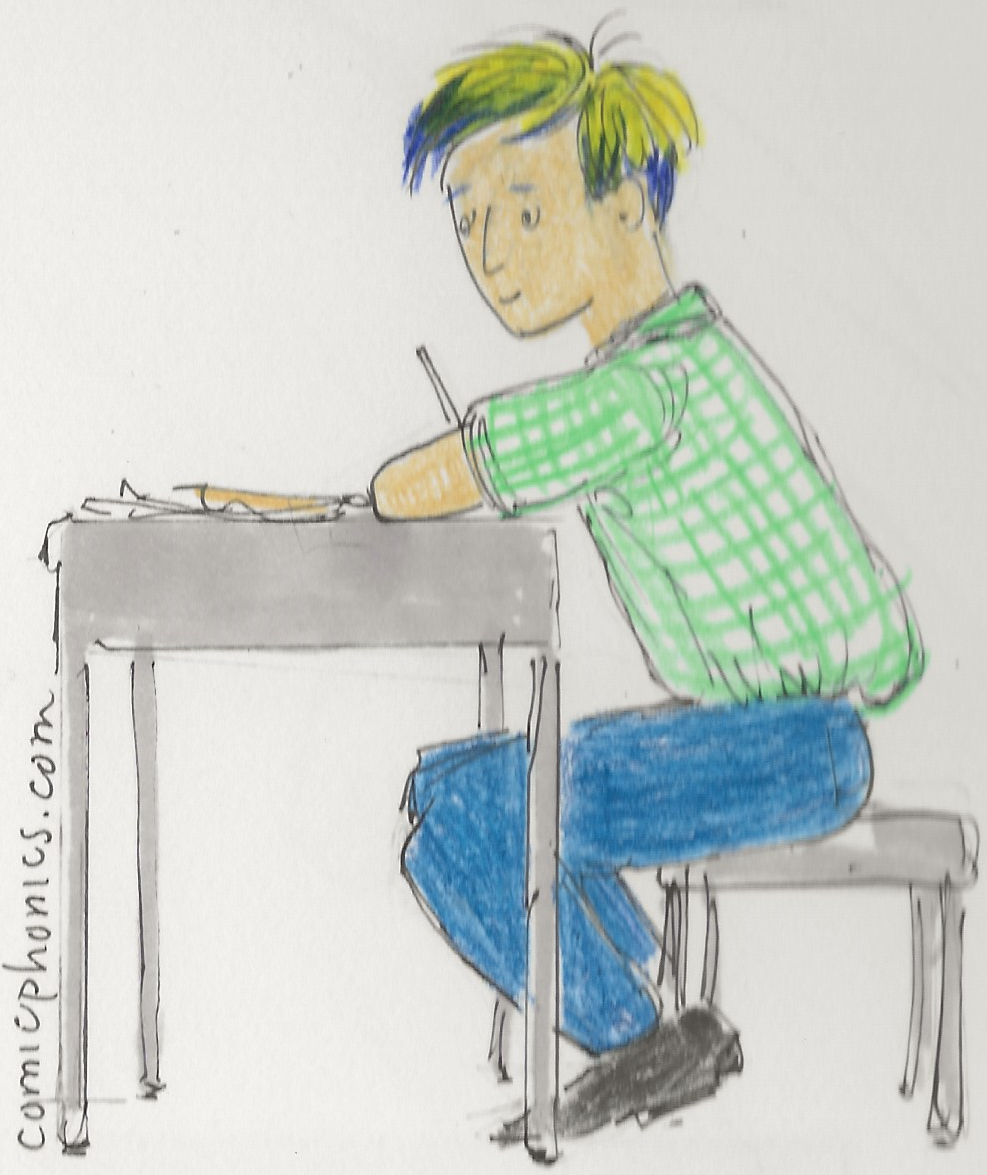
Applying to college? Use this 14-point checklist before submitting your essays

Checklist for college application essays

  • Identify when you need to submit your essay.   Write the due date on a Post-it Note and paste it to each application.  Write the dates on your calendars. 
  • Don’t wait until the last minute to write your essay or to submit it.  Internet service conks out.  You get sick.  Submitting early gives admission people more time to consider your application.  It also shows you are organized and punctual.
  • Understand the prompts.  Read and reread them until you are sure what is required of you.
  • Choose topics or incidents that are personal, that only you can write about.  The admissions people want to learn about you, not some generic high school senior.
  • Use specific verbs.  Your main verbs (not helping verbs) should be vivid.  Avoid these verbs as main verbs:  be, have, do, go, make, take, come, get, and see.  Replace them with specific verbs.
  • Write beginnings, middles and ends.  Treat these short essays as narratives and apply the characteristics of narratives.
  • Use details.  Use direct quotes.  Use colors, smells, sounds and textures.  Use names, dates, and places—not “my friend” but “my friend, Jenny.”
  • Vary your vocabulary, sentence structure, sentence openings.   Check the words you start sentences with.  Vary them.  Check the lengths of your sentences.  Check the kinds of sentences you use.  Vary them.  Check your vocabulary.  If you needlessly repeat words, vary them.
  • Revise, revise, revise.  Okay writing becomes great by rewriting.  Walk away from your essay and then come back an hour later, or better yet, three days later.
  • Read your essay aloud.  You will hear mistakes that you don’t see.
  • If something sounds odd, search for a grammar mistake.  Common grammar mistakes are run-on sentences, unintentional fragments, lack of parallel structure, improper use of pronouns, redundancy, lack of subject-verb agreement, and verb tense problems.
  • Be concise.  Good writing is short writing.  Every word and every sentence should be needed. 
  • Use proper postage and ask the Post Office clerk to stamp the date on the stamps.  If you post online, ask for confirmation.
  • Now move on to the next application. 

The application process can be arduous.  If you feel stressed, then exercise, sleep more and work on a distracting hobby.  Millions of adults have survived their senior years, and you will too.

Three examples of effective use of the word “I” in essay writing

In a recent blog, I wrote about how the use of the pronoun “I,” once frowned upon, is now widely accepted in essay writing.  Here are three effective examples of writers using “I”:

  • “I share the concerns of other city workers that the return to office is too sudden. . .” [The New York Times, September 15, 2021] Jennifer Gavel, who has been working from home during the pandemic, here expresses her frustration with a mandate that city workers in New York must return to the office.  Because she is a city worker, using “I” strengthens her argument.  She is an insider giving voice to a concern of her colleagues.


  • “Not everyone observes this holiday [Yom Kippur], of course. But in its practices, I believe there is wisdom that can help all of us.” [The New York Times, September 15, 2021]  The writer, Rabbi David Wolpe of Los Angeles, is in a position because of his training and experience to know about Yom Kippur and to explore its nuances.  Could he have left out “I believe” and still have written an effective essay.   Yes.  But is it natural for him to include himself in this essay?  Yes, especially since he begins and ends the essay with an anecdote about a friend.


  • “I didn’t understand what I was seeing but I knew it was important, and came to understand it had to do with loyalty and grief. And of course I remember it now because that is what I am feeling toward 9/11.” [The Wall Street Journal, September 9, 2021]  Columnist Peggy Noonan here refers to a childhood incident, something she witnessed and later recalled as the anniversary of September 11, 2001, approached.  She could have written about grief in the abstract, but her personal memory is a more moving introduction to her column.

Is it okay to use “I” in student writing?

Never use “I” in essays.

Never start a sentence with “because.”

Paragraphs must have at least five sentences.

Never start a sentence with “and,” “but,” or “so.”

“Were you taught these rules in school, as I was?  If so, it might surprise you that many teachers no longer enforce them or even support them.  Let’s look at one of these rules, “Never use I,” to see why the consensus is changing.

Using “I” can eliminate the passive voice.  Without “I,” you might need to use the passive voice (another no-no) as in “The essay was written by this writer.”  Isn’t “I wrote the essay” clearer? 

Using “I” can shorten your writing.  Concise writing is usually clearer and preferred.

Using “I” can eliminate awkward referrals to yourself.   I have read interviews by a Pulitzer Prize winning biographer who refers to himself in his books not as “I” but as “this interviewer” or “this writer.”  He seems to go out of his way not to use “I.”  He is trying to make himself inconspicuous in the text. Wouldn’t the word “I” do that better than “this interviewer”?

Using “I” can give your writing the authority of a witness, of a primary source.  If you are part of a group you are writing about, then you should be up-front about that.  Not using “I” can seem disingenuous. And if you were there to see and hear what happened, doesn’t that make your writing more believable?

However, writing “I think” is rarely justified.  If you are the writer, then obviously the thoughts are yours.  Since “I think” can sometimes mean “I am not absolutely sure,” using “I think” can undermine the strength of your writing. This is especially true if you add “I think” after making a statement. “Yes, officer, I saw the red car rear end the blue car. I think.”

Some teachers or editors follow the old rules religiously, so students should ask about using “I” before composing.  Or when appropriate, check a style book.  Use an up-to-date one though.  The rules of English, like all languages in use, change.

More on how to incorporate quotations into text

In my last blog, I discussed how to incorporate a simple direct quotation into a student text, using a hamburger visual.

Let’s try a more difficult quotation.

Suppose you are writing about hurricanes.   You are trying to explain how wind sheer prevents a hurricane from growing stronger.  You have found a good quote to explain what wind sheer does to a hurricane.

Start with your text in your own words:  “Wind sheer prevents a hurricane from growing stronger.”

Next (the top bun), you introduce who said the direct quote and why it is worth quoting:  “Adam Sobel, an atmospheric scientist and director of the Initiative on Extreme Weather and Climate at Columbia University, explains wind sheer as. . .”

Now (the hamburger), you write the quote:  “different winds at different altitudes were keeping it from standing upright.”

Uh oh.  A problem—actually two problems.  Your text concerns hurricanes in general, but Sobel is describing Hurricane Henri in particular.  You need to remove the word “it” (meaning a particular hurricane) and replace it with the word “hurricanes” (meaning hurricanes in general.)  Since you are changing the quote slightly, you need to indicate that by putting your substitution in brackets.  The revised quote becomes, “different winds at different altitudes were keeping [hurricanes] from standing upright.”

But a second problem remains.  The past tense helping verb “were” refers to Hurricane Henri, but your text concerns hurricanes in general.  For proper grammar, you could change the verb “were keeping” into the gerund “keeping.”  The revised quote becomes “different winds at different altitudes. . .keeping [hurricanes] from standing upright.”  You need the ellipses because the helping verb is omitted.

Last (the bottom bun), you explain why you think this quote is relevant to your text in your own words.  “Sobel’s explanation creates a visual image of winds tilting a storm’s clouds, making them less organized than in an upright storm.”

Now put it all together:

Wind sheer prevents a hurricane from growing stronger.  As Adam Sobel, an atmospheric scientist and director of the Initiative on Extreme Weather and Climate at Columbia University, explains, wind sheer is “different winds at different altitudes. . .keeping [hurricanes] from standing upright.”  Sobel’s explanation creates a visual image of winds tilting a storm’s clouds, making them less organized than in an upright storm.

To recap:

  • To use a direct quotation, you must put it in context by identifying who made the direct quote and why it is relevant in the context you are using it.
  • The transition from your introductory information to the quotation must use correct grammar.
  • Sometimes words of the direct quote must be left out or changed slightly (for example, from singular to plural, from one verb tense to another, from one pronoun to another).
  • Any change in the direct quote must be shown either with ellipses or with brackets.
  • If several changes must be made, paraphrasing might be a better alternative.