Category Archives: writing tips

Periodic and cumulative sentneces

Sentences come in two primary structures which can be described much like this:

  • A main clause starts early in the sentence, is interrupted by details,  and ends with a final important word or idea.
  • A main clause starts and ends early in the sentence, and then it is followed by details.

The first kind is called a periodic  or climatic sentence.  You can  spot it because it builds to a climax.  For example,

  • John Kennedy, in one of the tightest Presidential elections in US history, by a margin of 112,827 votes, won.
  • Six-month-old Ellis, sitting in his high chair, and watching Mom’s hand with its spoonful of carrots draw closer, clamped his two baby teeth shut.
  • Hillary hit a low, skipping, two-run grounder.

The second kind is called a cumulative sentence.   You can spot it because it mimics the way people talk, starting with a complete thought,and then adding details to embellish that thought.  For example,

  • John Kennedy won by 112,827 votes, in one of the tightest US Presidential elections.
  • Six-month-old Ellis clamped his two teeth shot as Mom, holding a spoonful of carrots, drew that spoon close to his mouth.
  • Hillary hit a two-run grounder, the ball skipping past the pitcher and through the legs of the second-base player.

Each is useful for different purposes.

  • The periodic sentence, because of the details which delay the ending, creates both grammatical and meaningful suspense.
  • As the words build to a point, the periodic sentence emphasizes a point embodied in the last few words of the sentence.
  • The periodic sentence releases information formally and logically, showing planning and control by the writer.
  • The cumulative sentence, on the other hand, sounds natural, mimicking the way that people talk.
  • A cumulative sentences sounds informal and conversational.  It adds a stream of consciousness feel to writing and works well in dialog.
  • A cumulative sentence elongates and elaborates on action.

How to encourage primary school students to write better

If you are helping a student in kindergarten through second grade to learn how to write, you might want to check out Conferring with Young Writers  by K. Ackerman and J. McDonough.

ConferringWithYoungWritersThese primary grade teachers decided that they could have the most impact by changing the way they conference with student writers.  Here are some of their tips.

Establish trust with the student before trying anything else. How?  Let students see you writing and encountering problems.  Focus on the meaning of the child’s words and ignore sloppy spelling and punctuation.  Compliment students on their writing, focusing on particular things they do well.  Listen when the child talks about the writing process.  Get to know students as whole people first and as students and writers second.

Establish a routine for writing—a set time and place with pencils sharp, erasers in reach and plenty of paper.

Focus on one writing goal per lesson or unit. The goals should include choosing good ideas, structuring the writing appropriately, using conventions properly, sticking to one main point, writing in a natural voice, and providing details.  Teach those goals, model them, practice them and discuss with students how they can do them better.

Follow up on the points which they should have shown in their writing. The book shows several assessment tables, rubrics, and checklists which can be adapted by parents or classroom teachers.

Encourage students to choose their own writing topics and genres. Students will be more engaged and cooperative if they have choices.

Let students know it is not only okay but good if they talk to one another about the process of writing. Encourage them to read their writing aloud as they work.

Help students find good ideas to write about. Deciding on topics is one of the hardest things for some children.  Conferring with Young Writers offers several approaches to helping students identify what they might enjoy writing about.

Conferring with Young Writers offers a three page bibliography of books about teaching writing to children as well as an index.  At 144 pages, it is a quick but rich read for parents and teachers who don’t know how to begin teaching writing to primary grade students.  For more information, go to http://www.stenhouse.com.

Lockstep sentences, one after another, bore readers

What is a lockstep sentence?  Usually, it’s a sentence which begins with a subject (a noun or pronoun) and is followed by a predicate (a verb and a direct object, or a verb and a linked noun or adjective).  If there is a prepositional phrase, it comes at the end of the sentence.

Here is such a lockstep sentence pattern.

1  John watched the television news.  2  He saw an interesting discussion.  3  New York’s Congressman Newman debated Delaware’s Congressman Doe.  4  Congressman Newman took the conservative position and Congressman Doe took the liberal position.  5  “That’s a good discussion,” thought John.

Notice the sentence patterns:

1  subject, verb, direct object  (five words)

2  subject, verb, direct object  (five words)

3  subject, verb, direct object     (eight words)

4  subject, verb, direct object, conjunction, subject, verb, direct object  (13 words)

5  subject, verb, predicate noun, verb, subject (six words)

These five sentences follow a lockstep pattern.  They all begin with a subject.  Two have adjectives before the simple subject, but all start with the complete subject.  Each subject is followed by a verb which is followed by a direct object in four cases and a predicate noun in the other case.  The longer sentence is actually two simple sentences following the same pattern, but connected with a conjunction to form a compound sentence.

In this case, the lockstep sentences contain few words, adding to their tedium.

A lockstep sentence pattern needn’t be this particular pattern, but it is a pattern which repeats over and over, sentence after sentence.

For some writers, the pattern is a single subject and a compound predicate.  “I ate dinner and took a walk.  The night was warm but humid.  I stood under a tree and waited for the rain to stop.  Then I went home and drank hot tea.”

For other writers, the pattern is an adverb to start the sentence followed by a subject and a predicate.  “Playfully, my dog licked my ankle.  Then she walked to her mat.  There she scratched herself.  However, she heard thunder in the distance.  Immediately, she returned to my side.”

For some writers, the pattern is a series of complex sentences with the subordinate clause always coming after the independent clause.  “I stopped the car because a blue light flashed ahead.  Soon cars parted as a fire engine passed.  Then an ambulance wailed while I checked my GPS.”

What can a writer do to avoid lockstep patterns?

First, analyze your own writing.  See if you consistently use a pattern.

Next, as your write, be aware of your tendency to use that pattern.  Look over your work, and if you notice that pattern, change the sentences.  If you usually begin with a subject followed by a verb, start some sentences with prepositional phrases, adverbs or gerund phrases.  If you usually begin with an adverb, cross out half of them, and then cross out half the rest.  If you write mostly short sentences, turn some of them into complicated simple sentences or complex sentences with double the words.

Lockstep sentence patterns are like familiar car routes.  We become so comfortable using them that we don’t explore new ways of expressing ourselves.  But we should to keep our writing fresh and our readers engaged.

Show writers how important first sentences are

The first sentence of a story can lure readers in, like a wiggly worm on a fishing hook.  Or the first sentence can cause readers to pound the snooze button.

How can you show students how important first sentences are?

Here’s one way:

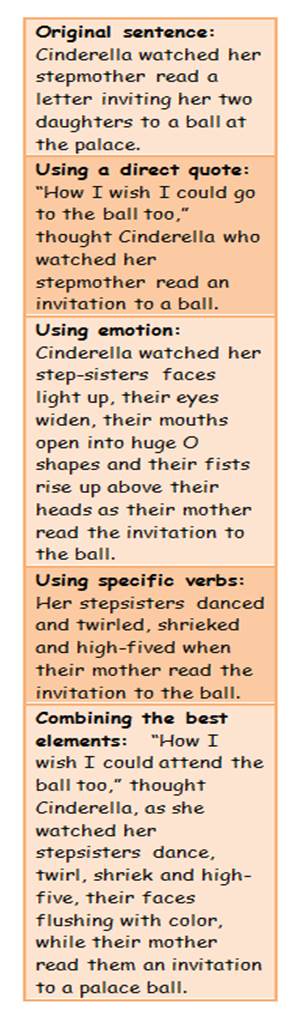
  • Show students a single drawing or photo in which some kind of human or animal action is going on. It could be the first page of a picture book (if so, cover up the words), a sports photo from a magazine, or something you’ve downloaded.  Try to find a picture which is clearly focused on one or two characters and without a lot of distracting background.Some creative sentence options.
  • Ask the students to write the first sentence of a story about the events in the picture. (No, you are not going to write the whole story.  No, I can’t offer any help.)  Let students muddle through how to approach the writing.  If they make a tentative suggestion, wanting your approval, affirm their suggestion, however good or bad you think it is.
  • Next, tell them to write another first sentence for the same picture, but this time they are to start the sentence with a direct quote. It could be someone speaking aloud or someone musing.
  • Next, tell them to write another first sentence for the same picture, this time focusing on descriptive detail. The weather, clothing, posture, the look on someone’s face—any details which seem noteworthy are okay to write about.
  • Now tell them to write still another first sentence, focusing on the emotions of a person or animal in the picture.
  • Now write a sentence focusing on using specific vocabulary, especially specific verbs.

That gives you and the students several sentences to evaluate.

  • Ask the students to read aloud each of their sentences.
  • Ask which one seems the weakest or least alluring. If there are two somewhat bad sentences, that is fine.  Ask the students to identify why those sentences seem not as good as the others.
  • Ask which sentence seems the best. If the students think one, two or three are superior, ask why.
  • Go slowly, offering the students plenty of time to consider and reconsider their choices and reasons. Evaluating takes time.  Accept all responses.
  • Now, ask the students to take the best elements of the good sentences and combine them into one final sentence.
  • Ask them to read that sentence aloud, and to explain why they chose particular elements to include.

Lastly, ask the students what they have learned about writing from this exercise.

Peer evaluation of writing

Is it worth taking time to let students evaluate others’ writing?

Recently I asked second graders to write stories based on the picture book, Flora and the Penguin by Molly Idle.  Since the book is wordless, the students were forced to write their own versions of the story relying not on the author’s words but rather on the illustrations for guidance.

Later, I selected portions of two students’ stories for comparison.  I typed and printed them side by side, so students could compare how the two students wrote the same parts of the story.

Here are some of the comments students (second through eighth grade) made:

  • I like Student One’s opening because it tells when the story happens.
  • I like Student Two’s opening because it names the girl.
  • I like the word “poked” by Student One because it shows exactly how the penguin acted.
  • I like all the ways Student Two shows what Flora and the penguin did. They skated, danced, jumped, twirled and slid.  You can see it happening.
  • I like the dialog that Student Two uses when Flora asks, “What are you doing?”
  • I like Student One’s word, “outraged.”  That is a strong word.
  • I like Student Two’s word, word “disgusted” because it shows how Flora felt.
  • I like Student One’s writing where it says that Flora feels sorry because it shows that Flora cares.
  • I like when Student Two says “just like a fishing net.” I can see it.
  • I like when Student Two says “they tugged and tugged,” but maybe there are too many “tugs.”
  • I like Student One’s ending because it says Flora and the Penguin are happy.

After their blow-by-blow analyses, I asked my students what they learned from evaluating other students’ writing.  They said:

  • Use details, lots of details.
  • Use dialog or thoughts.
  • Use names.
  • Show emotions of the characters.
  • Verbs are really important to show action.
  • Use good vocabulary words.

One second grader, who rushes through her writing, compared her  plain version with the two shown here and said, “I’m starting over.”

A seventh grader who read the two versions, said, “Second graders?  Really?  I didn’t think I could learn good ideas about how to write from second graders.”

Is peer evaluation of writing a good idea?  You decide.