Category Archives: writing problems

Should students use AI in English classrooms?

Suppose you assign your high school students to write an essay on transgender athletes.  It’s a topic to which the regulatory bodies of various sports have responded differently (or not at all). It’s controversial, current and abounding in opinions—a good topic for an essay.

Should you allow your student to use AI to write this essay?  If so, at what point in the writing process?

The writing process begins with narrowing down the topic into a main idea or thesis.  A good way for a student to do this is to read widely on the topic until a position emerges in the student’s mind.  Then the student should narrow this position further, list three or four supporting ideas and identify details and examples to explain these supporting ideas.

This kind of thinking is what schools call critical thinking.  It involves understanding a topic by analyzing it, by evaluating various parts of the topic to see how they would support or undermine a position, and by synthesizing or bringing together ideas in a unique way.  Then students order the ideas, write sentences and paragraphs, and figure out what to put in the introduction and conclusion.  Last comes revising: polishing the writing by improving vocabulary and sentence structure, adding better information, deleting irrelevant information, and fixing grammar, spelling and punctuation problems.

But what if your student begins by asking AI for an essay thesis relating to transgender athletes.  In a nanosecond, a thesis appears.  Your student asks for three supporting ideas.  In another nanosecond, the supporting information appears.  Your student reads over AI’s suggestions and concurs.  Your student asks AI to write the essay in 350 to 400 words with a striking introduction, three body paragraphs and a humorous conclusion.  In another nanosecond, the essay appears.  Done.

Which way do you want students working–by thinking deeply about the topic or by asking AI to think for them?  Through which method do students learn?

If you want your students to do the work, one way to tell if they do and have learned from the process is to demand that the prewriting notes, organization graphic/chart/bullets, and the first drafts be turned in with the essay.  Another is to ask students to paraphrase their thesis and subtopic ideas.  If they can’t put their essay’s ideas in their own words, do they really understand what “they” wrote?  Another is to ask students what positions they declined to take and why.  If students have a full understanding of the topic, they will be able to explain why they took a certain position as well as why they didn’t take another.

For most high school students I have worked with—maybe all—using AI would not be in their self-interest.  Making mistakes and learning from them is a far better approach to learning.  Students, like athletes, need to have skin in the game.  If students have allowed AI to make the choices in their essays, students have no stake in the assignment.  It’s like having a robot run the 200 meter or swim the 400 IM.  For students to achieve, they have to do the work.

* * * *

Are you looking for a writing tutor for your student for the coming school year?  Contact me through this blog, and let’s discuss how I can help with online writing classes for grades 4 through 12, and for college admissions essays.


5 ways to figure out if your source is any good

With so much information on the Internet, students need to learn how to distinguish good from bad sources for their research projects.  One way to do this is to apply the CRAAP test to source material to determine if the information is sound.

The CRAAP test?  What’s that?  It’s five criteria you can use to judge if your information is good or is crap.  Here are the five criteria:

Current: Is the information current or is it dated?  If it is out-of-date, does that matter?  If you are writing about the life of John F. Kennedy, books sixty years old written by people who knew him–primary sources–might be excellent sources.  Has the information been updated since it was published?  If you are writing about the SAT, including that the test will be offered online only starting in 2024 is important, timely information to include.

Relevant: Is the source directly related to your topic? If you are writing about the Trump White House, then perhaps testimony made to the January Sixth Committee of Congress by people who worked at the White House would be as pertinent as interviews with staff who did not testify.  What audience are you writing for? If you are writing a biography intended for elementary school age children, the facts you include might be different from facts you would include for an adult audience.

Authoritative: What makes the author of the source material you are using an authority on the subject?  Is the source a relative?  A scientist in the same field?  A collaborator?  Are you using that source’s primary information or secondary information?  Is the source qualified about the topic? What are his or her credentials?  Is the data published in a peered-reviewed  journal?

Accurate: Is the source fact or opinion?  What evidence collaborates the source material?  Have the facts been fact-tested by any reliable source?  If the information is old–say records of the Battle of Hastings in 1066 in Britain–does the author explain that the “facts” differ depending on whether the winning or losing side reported them?

Purpose: What purpose has the information been used for–to inform, persuade, entertain, advertise, editorialize,  provide testimony, or something else? Is opinion presented as fact?  Can you distinguish between fact and opinion?  Has the author been clear about his or her ability to understand the data?

When children are young, they pretty much accept what adults say as the truth.  But as they mature, children learn that not every source can be trusted.  That includes sources used for research.  Applying these criteria systematically helps students better analyze the truthfulness and usefulness of their sources.

Six writing problems—and solutions—for children with ADHD

Writing, like reading, is really many skills used together to produce a product.  These skills include:

prewriting skills (deciding on a topic, narrowing it down to one main idea, gathering information, and sequencing it),

composition skills (figuring out how to begin, sticking to the plan, concluding, writing in complete sentences, including details, and using good vocabulary, grammar, spelling and punctuation),

revising skills (adding missing information, reordering ideas or sentences, deleting off-topic information, and confining or expanding information to the desired length),

editing skills (checking for grammar, spelling and punctuation),

handwriting legibly, and

finishing by the deadline.

For children without ADHD, integrating all these skills produces anxiety.  But for children with ADHD, writing might produce tears, temper tantrums, and shut-downs.  Yet there are ways to mitigate the fear of writing, and with time, to overcome it.

Some of the most noticeable problems ADHD students face when writing and some solutions to those problems include

Staying focused long enough to remember what to say. One solution is demanding that students create a written organizer.  It can start as a list of ideas/details related to the topic.  Then students can group the related details, using colored highlighters to identify what ideas go together.  Lastly the student can number the colors in the order in which he/she wants to use them in the writing passage.  Teachers need to model how to create such organizers and how to implement them, over and over, until students realize organizing before they begin is as much a part of writing as is using a pencil.  Later, as students advance, writing a thesis and subtopic sentences can become part of the prewriting organizer.

Figuring out how to start and how to conclude. Looking at that blank piece of paper can be daunting.  One solution is for a teacher or parent to brainstorm various ways to begin and end with the student, and to write those beginning sentences and ending sentences as options.  You might think, but the student is supposed to do the work himself.  Eventually, yes, but not when the student begins.  When you learned to walk, didn’t you have an adult right there to catch you when you stumbled, and to lift you up again?  When you learned to ride a bike, didn’t you have an adult running at your side to keep you balanced and to “launch” you?  Students need adults “launching” them in the writing process too.  With enough practice, students will gain the skills to start writing and to conclude on their own.  But at first, they need an adult to provide models of good writing.

Sticking to one main idea. Following organizers will keep students on course.  An adult should ask the student to read aloud his in-process work, and the adult should match the sentences with the organizer.  Students might not realize they have drifted off-course.  It’s important to discover off-topic information quickly, before students have invested too much time and too many sentences into information that needs to be deleted.

Using correct grammar, spelling and punctuation. One method to deal with these kinds of errors is to allow students to write without regard to them.  Then, after the compositions are finished, go back and help students fix some of them.  One time, focus on run-on sentences.  Another time focus on apostrophes.  If the student is expected to fix all his errors as he goes along, he will lose the flow of his writing and might never finish.  Another method to deal with grammar, spelling and punctuation errors is to give two grades—one for composition and one for conventions.  Or give one grade for composition only.

Taking time to revise and edit.  ADHD students are impulsive.  They tire quickly of activities where they need to sit still and focus.  Yet revising and editing are necessary steps to produce good writing.  One solution is to separate the revising process from the composing process.  Do composing today and revising tomorrow.  Do twenty minutes before recess and twenty minutes after.  Write post-it notes to students, identifying one problem for each student.   If Jimmy can’t identify run-ons, underline the run-ons he needs to fix and ignore the other problems.  If Mary can’t figure out when or how to use apostrophes, underline the words which might need them.  Help them start on the revision process so they needn’t start from scratch.  Not every piece of writing needs to be perfect.

Writing legibly. Allow students to use computers, laptops, iPads or other electronic devices to write school assignments.  Not only allow them, but teach students how to use these devices during writing classes.  Show them how to swipe a sentence and move it to a better location.  Show them how to look up spelling or synonyms.  Show them how to indent or double space or to do whatever helps them to write better.

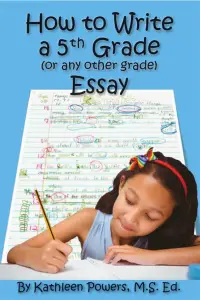
Like all skill-based activities, writing well depends on practice.  If a teacher assigns one writing assignment a month or a semester, the student will not improve.  Yet, this is often the case since reading and marking student writing is time-consuming.  If your child is not assigned writing weekly, then you, as the parent, can assign it.  If you think you are not qualified, may I suggest you buy my writing instruction book, How to Write a 5th Grade (or Any Other Grade) Essay, available on Amazon.  Everything I’ve talked about here is included there but in more detail.

If you hope your child will attend college or professional school, he or she will need to be able to write.   Reading and writing are two of the most basic skills your child needs to do well in life.  Don’t let fear of writing (his or yours) handicap your child.


Three wrong ways to introduce a citation

Suppose you are researching how the novel To Kill a Mockingbird was reviewed when it first was published.  You find the July 13, 1960, review by Herbert Mitgang in The New York Times. In the review you find words worth citing.  How do you introduce the citation?  Let’s look at some examples, returning to the image of the hamburger and bun.

[First, you introduce your source, the top bun of the hamburger:]  The New York Times reviewed To Kill a Mockingbird when the book came out.  [Second, you introduce the citation, the hamburger:]  It says Mockingbird is “a winning first novel by a fresh writer with something significant to say.”  [Third, you give your opinion why this citation is significant, the bottom bun of the hamburger:]  The Times writer singles out both the novel’s writer and its message.

Now, let’s leave out the bracketed information:  The New York Times reviewed To Kill a Mockingbird when the book came out.  It says Mockingbird is “a winning first novel by a fresh writer with something significant to say.”  The Times writer singles out both the novel’s writer and its message.

What’s wrong?  Several things.  First, did The New York Times review Mockingbird or did a person?  If it was a person, the name of that person should be identified.  Second, can you, the research paper writer, identify the date when the review was published?  If so, including that specific information increases the credibility of your source.  And third, since a pronoun needs to have an antecedent, what is the antecedent to “It,” the first word of the second sentence?  There is none.

Better:  The New York Times published a book review by Herbert Mitgang of To Kill a Mockingbird on July 13, 1960, when the novel was published.  Mitgang says Mockingbird is “a winning first novel by a fresh writer with something significant to say.”  Mitgang singles out both the novel’s writer and its message for praise.

Suppose we keep the “better” citation with one change:  The New York Times published a book review by Herbert Mitgang of To Kill a Mockingbird on July 13, 1960, when the novel was published.  Here it is.  Mockingbird is “a winning first novel by a fresh writer with something significant to say.”  Mitgang singles out both the novel’s writer and its message for praise.

Here what is?  The last noun in the previous sentence is “novel.”  Yet “Here it is” does not refer to the novel.  “Here it is” refers to the review.  “Here it is” is a poor transition from the upper bun of the hamburger to the hamburger itself.

Let’s try again with another change.  The New York Times published a book review by Herbert Mitgang of To Kill a Mockingbird on July 13, 1960, when the novel was published.  The quote is “a winning first novel by a fresh writer with something significant to say.”  Mitgang singles out both the novel’s writer and its message for praise.

The word “The” before the word “quote” indicates a particular quotation.  Yet no particular quotation is mentioned in the previous sentence.  “The quote” refers back to nothing.  An improvement would be, “A quote from that review” but even that improvement is not as good as naming the person doing the quoting.

When you are introducing a direct quote,

  • Introduce the quotation with the name of the person or organization responsible for the quote. For example, The US Congress passed an act which says, “. . .”
  • Identify additional details to put the quote in context. Such details could be a date, a place, or the context (a war, an election, a first novel, after the passage of 30 years).
  • Don’t use “It says” unless “it” has been identified and “it” identifies who is responsible for the quote. Even then, your writing is better if you remove the pronoun “it” and use the noun.
  • Don’t use “The quote is” unless you have already identified the quote in some way. Even then, use more specific language, usually naming the source of the quote, for a better transition.

Nine tips I’ve learned from teaching the writing parts of the SAT and ACT

  1. A rewritten phrase or clause with the word “being” in it is almost always wrong. Perplexed student writing
  2. Shorter versions of rewritten grammar are usually the correct answers.  If in doubt, choose the shortest or second shortest answer.
  3. Hard to spot run-on sentences often have a comma in the middle of the sentence followed by a subject pronoun.   The comma needs to be  a period, or a semicolon.  Or you need to put a coordinating conjunction after the comma.
  4. If you have one dash, you need two dashes unless the sentence ends where the second dash would be.
  5. In lists or series, the important words must be the same part of speech such as all nouns, all verbs, all infinitives, or all gerunds.
  6. “It’s” means it is. “Its” means something belongs to it.  Its’ is not a word.
  7. “They’re” means they are. “Their” means something belongs to them.  “There” means over there or that something exists.  All three begin with “the.”  Thier is not a word.
  8. Commas come before coordinating conjunctions, not after unless what follows the conjunction is nonessential information.
  9. Third person singular verbs (the kind you use with “he,” “she,” or “it” as the subject) in the present tense end in an “s.”