Category Archives: narrative writing

Find a topic for a student to write about by using picture books

Many children hem and haw about choosing a writing topic.  I ask for their suggestions and they shrug.  I give them options.  They object.  It’s possible to waste so much time during a writing lesson settling on a topic.
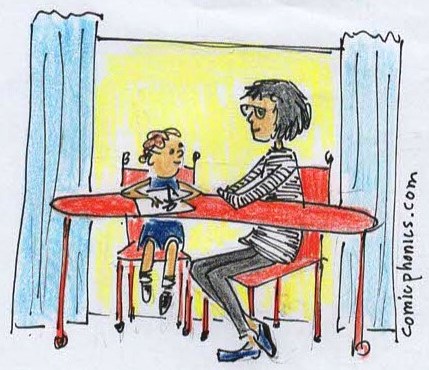
EPSON MFP imageI’ve figured out a way to end students’ angst and to start the writing lesson quickly.  I bring a children’s picture book to the lesson.  The student reads the book aloud.  Then I tell the student he is going to write a book patterned after the book he has just read.

“You can redo the same story, or you can use that story as a starting point for a different story,” I say.  This way the student has choices.

Let me show you two results.

One second grade girl read Alexander and the Terrible, Horrible, No Good, Very Bad Day by Judith Viorst as her prompt.  It concerns a boy for whom everything goes wrong one day.  Here is my student’s result.

Terrible Very Bad Day

Nick woke up in the morning and he fell out of his bed.  At breakfast his brothers ate all the cereal.  I think I’ll move to Washington, D.C.  In the bus he had to sit next to girls that he liked and everybody laughed at him even the girls.  In class Jackson said he was not his best friend.  At lunch everybody had desserts like cupcakes except him.  After school his mother took him to get shoes but he did not get what he wanted which was blue with red stripes.  At dinner his mom had spinach and he does not like spinach.  When his brothers got to watch TV he had to sleep.  Tomorrow is going to be a good day, he said.

That same second grader read Jack’s Worry by Sam Zuppardi as her prompt.  It is about a boy who fears playing his trumpet in a school concert.  Here is what she wrote this time (with names changed).

Sue loved making friends.  For weeks she had been looking forward to meeting the new girl in her school.  On the day she was meeting the new kid, she had a worry and it became bigger and bigger.  She was worried that the girl wouldn’t like her or that she would say something mean to her.  When it was time to go to school, she did not want to go.  Her mother said, “Is something wrong?”  She said, “Yes.  I am worried that the new girl will not like me.”  Mother said, “She will like you even if you make a mistake and I will love you.”  Sue’s worry was gone.  When she was at school, she met the new kid, Annie, and they became best friends.  Sue learned worrying is silly.

Some tips for using this technique:

  • Choose a book that the student can read in five to ten minutes so that most of the lesson is devoted to writing.
  • Beginnings are hard. Let the student see how the author started the novel.  Then suggest alternatives.
  • You might show the student the illustrations as she writes, but cover the words. Encourage her to write her own words.
  • Endings are hard. Suggest she write a moral if that makes sense.  Or suggest she reread her first two or three sentences and see if the character she is writing about has solved the problem presented.  Let the ending be a comment on the solution.  Or let the ending look to the future in light of what the student has written about.
  • Incorporate some particular aspect of writing into the lesson. In the first example I asked the student to keep going because I know she wants to finish quickly.  In the second example, I asked her to use direct quotes, and we talked about how to punctuate them.

How to use vocabulary workbooks as the basis for writing lessons

Teachers and tutors, do you want to save time and get double or triple use from the same source?  Use your students’ vocabulary workbook to teach writing.

EPSON MFP imageMany of my  students use the Wordly Wise 3000 series (which I recommend).  It has 20 lessons per booklet, one booklet per grade, first through twelfth.  In each lesson is an annotated list of new vocabulary words plus exercises using the words.

Like other vocabulary building series, each lesson also has a reading selection in which each new vocabulary word is used.  These reading selections are followed by many questions asking the student to use one of the new vocabulary words in a complete sentence answer.

But other ways to use the vocabulary and reading selections augment their original purpose and make them valuable as writing tools.  Here are some I have used.

  • Summarizing.  I teach students to underline the most important or key words in each paragraph.  Next, I show how to analyze each paragraph and to write an identification in the margin next to the paragraph.  Those phrases might be “dodo bird’s appearance,” “raising $ for Statue of Liberty base,” or “Renaissance dates and definition.”  Then, using the underlines and margin information, I teach the student to write a summary of each paragraph in about one or two sentences.  When he is done, he has a good summary of the reading selection.
  • Paraphrasing.  Taking one sentence at a time, I ask students to rewrite the sentence, keeping the meaning but changing the sentence structure and, where possible, the vocabulary.
  • Writing RACE responses.  I write a question based on the article.  Then I ask the student to respond using the RACE format (Repeat the question, Answer the question, Cite part of the article used as evidence, and Elaborate on that evidence with more evidence).
  • Writing sentences using new vocabulary words.  So many times students can define a word but they cannot use it properly in a sentence. I ask them to write sentences using vocabulary words. This shows their weakness in understanding certain words and helps me to explain the words better to them.
  •  Writing paragraphs using new vocabulary words.  I ask students to write each new word in a coherent paragraph or two. Writing a paragraph takes more skill than writing independent sentences.  Not only does the student need to know how to use the word, but he needs to know its noun, adjective and verb forms and whether it is the best word in a given situation.  Forming a coherent whole takes imagination and hard work.
  • Writing narratives.  Put a person or animal into the nonfiction situation in the reading passage and write about it. What if you were a dodo bird encountering your first human being?  What if you were a Cherokee forced to say good-bye to your land in North Carolina and trek toward the unknown?  What if you were Leonardo’s apprentice, entrusted to carry the rolled up canvas of the Mona Lisa from Florence to France?

If you are teaching children to write, you know that coming up with a writing topic is tedious.  But by using the reading selections from the vocabulary workbooks, the subject matter is identified, the student has prior knowledge, and the vocabulary words are identified.

There is no need to reinvent the wheel.

Teach children how to think and write like reporters

Reporters are taught to begin news stories with the most important facts first—the who, what, when, where and how.  Less important facts go later in the story.  That way, if the story needs to be cut to fit a space, all the important facts remain.

Writing this way can be a worthwhile exercise for children.  It forces them to use higher level thinking skills:  to analyze a situation and rank facts in a hierarchical order, most important to less important.

news reports JFK's death

A good time to teach this kind of writing is during a social studies class.  Suppose the students have just finished studying the assassination of JFK.  What if they are reporters in Dallas and the assassination has just happened?  How would they write the story?

First, discuss with the students what the important facts are.  Then ask students to consider in what order the facts should be reported.

  • Would the story’s lead sentence start with the time or date? “At 12:30 p.m. central time on Friday, November 22, 1963. . .”
  • Would the sentence start with the place? “At Dealey Plaza in Dallas, Texas. . .”
  • Would the sentence start with the how? “With gunshots. . .”
  • Would the sentence start with who? “President John F. Kennedy. . .”
  • Would the sentence start with what? “An assassination. . .”

In this case, the news story would start with the who since the most important fact is the President of the US.  The next most important fact is that that the President died.  How and where probably rank next.  The least important fact is the date and time it happened.  “President JFK died from gunshot wounds in Dallas, Texas at 12:30 today” might be a good first sentence.

News stories don’t always begin with the who.  Suppose Hurricane Katrina is approaching Louisiana and Mississippi but has not struck yet.

  • Would the lead sentence start with the time or the date: “Sometime tomorrow, Monday, August 29. . .”
  • Would the lead start with the where: “The coast of Louisiana and Mississippi. . .”
  • Would the lead start with the who: “Millions of Americans. . .”
  • Would the lead start with the what: “A category four hurricane. . .”
  • Would the lead start with the how: “With a storm surge expected to surpass 12 feet and winds of more than 130 m.p.h. . . .”

In this case the what and the where are most important, followed by the when.  “A category 4 hurricane is expected to slam the coast of Louisiana and Mississippi in the early hours of Monday” would be a good lead sentence.  How many people could be in harm’s way and the details of what a cat 4 hurricane can do are important, but they are less important than the fact of a strong hurricane threatening a particular area.

Writing like a reporter combines critical thinking skills with writing skills.  If the children report on a breaking news event, they can match their efforts with the stories of real reporters.  Or they can report on real happenings in the classroom–a spelling bee, a field day, a class visitor.  Connecting writing activities to real life events is a sure way to engage students.

Would you read—or discard—a book based on its first paragraph?

I do it all the time.  I figure if a writer hasn’t put enough thought into hooking me, then maybe the writer hasn’t put enough thought into maintaining my interest over 200 or more pages.

These days first paragraphs and first pages of a story need to attract.

Table first paragraphs of books

To prove this to my students, I read to them the first paragraphs of a dozen or so novels, histories and biographies.  I asked the students to record why they would or would not continue reading.  Only after they had written their comments did I tell them the names of the books.

Under “I wouldn’t continue reading” the students wrote

  • No action
  • Boring
  • Not interested in topic
  • I don’t get it

Under “I would continue reading” the students wrote

  • Action, adventure
  • Humor
  • I want to find out more about something

Rejected books include The Great Gatsby, Hatchet, Johnny Tremain, Bridge to Terabithia, Anna Karenina, North to the Orient, Little House in the Big Woods, Stuart Little, Walden, and For Whom the Bell Tolls.

 Books which hooked my fourth through seventh grade students include Superfudge (“I want to know what the big news is.”), John Adams (“I like the description of the winter.  I want to know why those men were out on such a cold day.”), To Kill a Mockingbird (“I want to know why Jem’s arm got broken.”), Ronald Reagan (“It’s funny.  Why does it help to be a dummy?”) and Angela’s Ashes (“Why did Margaret die?”)

Only one book sparked keen interest by every single student, and that was Juliet by Anne Fortier.  Its first paragraph is four words:  “They say I died.”  “Why do they say she died?”  “She must not have died or how could she be telling the story?”  “How did she almost die?”  “I want to know more.”

Juliet is the most recently published book (2010) of all the ones I read, and John Adams and Ronald Reagan, two others which attracted, were published in the past 20 years.  Most of the rejected books were published some time ago.

So what?  I can tell students how important a beginning is—to a story, to an essay, to any kind of writing.  But now they know from their own experience.  Their homework assignment is to write a compelling first paragraph.  Stay tuned.

Try adding words to comic book art to lure young writers

Looking for a lure to get younger kids to write?

I’ve found something that works great for kindergarteners through third graders:  retelling comic book stories.

In the back of an old comic book, I found three pages telling the story of Aesop’s Fable “The Lion and the Mouse.”  I photocopied the three pages and cut out the words, taping blank paper over the cut-out sections.  I labeled each frame with a letter.

Aesop Lion and Mouse cartoon

Then I told my student writer the story, pointing to each frame as I went along.  The last frame contains a moral, so we discussed what a moral is, and what might be appropriate for this story.

On notebook paper, the child wrote his own version of the story, labeling each sentence or group of sentences with a letter corresponding to a frame from the comic book.

Next, we revised, substituting better verbs and making sure sentences began with variety.  One third grader was learning figures of speech, so to her version, we added alliteration, simile, metaphor, onomatopoeia, rhyme and hyperbole.

When the words were ready, I typed them to fit in the blanks, printed them, and taped them to the photocopy.  My students were dazzled by their own work, and set right to work on the next comic book story “The Tortoise and the Hare.”

Try it.  Page through some old comic books or the Sunday funny pages for appropriate stories.  I recommend stories which are two or three pages long, with no more than five frames per page, or a total of ten to 12 frames.  Writing words for that many frames can be done in a half hour to an hour—not long enough for a child to get discouraged.  And once done, the rewritten story plus art can be displayed easily on your refrigerator, or copied and emailed to Grandma.