Category Archives: English Writing Instruction

Writing well takes study and practice.

Writing a second grade essay

In elementary school, children need to compose four kinds of passages:

  • Short responses to questions (one or two sentences),
  • Long responses to questions (about five sentences or one paragraph),
  • Narratives (stories of varying lengths), and
  • Essays (single paragraphs to five paragraphs).

The other night I received a call from a father whose second-grade son needed to write an essay on his favorite animal.  The child didn’t know what to do.  I asked the boy on the phone what his favorite animal is.  “Dogs,” he said, not a surprising answer since the boy has grown up with pet dogs.  I asked him why, and he identified several reasons.  I told him he needed to explain his reasons.  He told me that without problem.

I told him that to write the essay he needed to

  • First, write a sentence saying that dogs are his favorite animal.
  • Second, tell why dogs are his favorite animal, one sentence for each reason. Then he needed to add other sentences explaining why.  The best detail is one that begins with “for example,” I told him.
  • Last, end the essay by repeating that dogs are his favorite animal and name the reasons without the details.

Do you understand? I asked.  The boy grumbled in the background, but his father told me that he understood.  We ended the phone conversation.

The next morning, the father texted me the essay below.
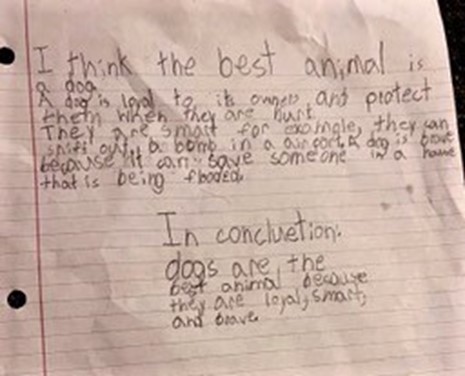
 

I don’t know how much direction the classroom teacher gave this boy.  It seemed like this was one of the first times the student was required to write an essay.  Did the teacher take the students through the organizational process?  Did she show organizational boxes for the student to fill in?  Did she model writing an essay or two or three in class?  Did she explain what information belonged in the first sentence or in the middle sentences or in the conclusion?  I suspect she didn’t since the boy—an A+ student—had no idea when I talked to him.  Yet after a five-minute phone call, he wrote a classic essay (for a second grader).

To be fair, I don’t know the circumstances surrounding this assignment.  Was the teacher a substitute?  Was there a fire drill taking up the time that the teacher wanted to use to preview this assignment?  Was the boy pulled out of class when the teacher  explained the assignment to the class?

I am left to wonder what training this boy’s teacher received to teach writing.  Perhaps, like all too many teachers, not enough.


Four shapes of stories, according to Kurt Vonnegut

Have you seen the video of Kurt Vonnegut explaining the shape of stories?  It’s short and funny, and I recommend you watch it.  Here is the gist of what he says.

Detective with a magnifying glass inspecting a newspaper.The most popular story type starts with a happy person.  Think the three little pigs building their homes.  Then the person gets into trouble.  The wolf huffs and puffs and blows two houses down.  At the end of the story, the person gets out of trouble—the big bad wolf dies—and the person is a bit happier than when the story began.  The three pigs live together in a brick house.  The shape of this story is a U with the right side of the U a bit higher than the left side.  (The example is mine.)

Another popular story type starts on an ordinary day.  Something happens to make the person think, wow, this is my lucky day.  Think boy meets girl.  But then something else happens to take the luck away.  Girl rebuffs boy.  The person is unhappier than at the beginning of the story until—serendipity—the person gets luck back.  Girl realizes her mistake and returns to the boy.  The shape of this story is an N.  (The example is mine.)

Still another story starts out with an unhappy person.  Think Cinderella.  But then something happens to make the person gloriously happy—going to the ball, dancing with the prince—until, abruptly, the cause of happiness is taken away—the clocks strikes midnight—and the person’s spirits plummet.  The person stays sad for a while, but then amazingly, something happens—the glass slipper fits—to make the person off-the-charts happy.  The shape of this story is something like an N but with an extended horizontal line leading up to the beginning of the N and another extended horizontal line connecting the downward slope to the final upward slope of the N.  (The example is Vonnegut’s.)

Notice that all three of these popular shapes for stories end with a line moving upward toward happiness.

An unpopular shape for a story is a straight horizontal line.  Think Hamlet, suggests Vonnegut.  A person starts out sad.  Events happen.  The person remains sad.  The person dies.  Not many stories show this pattern, says Vonnegut, because most readers want happy endings and most writers give them what they want—or because writers, like everyone else, don’t recognize true happiness. 

We pretend to know good news, but we cannot be sure, says Vonnegut.  Maybe this is because true happiness is mundane, like sitting under an apple tree with a friend on a sunny day.

It’s a thought-provoking video in the guise of a humorous monolog.  Key words like “Vonnegut” and  “shapes of stories video”, will show you numerous versions of the video, some with translations.

Six ways to improve writing anything

Here are six writing practices to make your writing better:

  • Make your sentences clear during a first read, so the reader doesn’t say, “Huh?”  A reader shouldn’t need to backtrack to figure out what you’re trying to say.
  • Use varied sentence structure.  Subject—verb—direct object.  Prepositional phrase—adjective—subject—verb—adverb.  Gerund—prepositional phrase—verb—adjective.  Subject—verb—direct object—appositive.  So many combinations exist.  Why bore readers with the same old same old?
  • Keep subjects and verbs near each other.  A thought which is interrupted by prepositional phrases, clauses and other grammatical constructions leads to unclear reading.  (The previous sentence’s subject is “thought.” Its verb comes twelve words later.  This is an example of what not to do.)
  • Eliminate most adverbs, especially those ending with -ly.  Instead, choose strong verbs, so an adverb is not needed.
  • Eliminate repeated words unless you are using them for emphasis.  Some repeated words I see my students use are “start,” “then,” “so,” “like,” and “really.”  Identify your repeated words, and see if you need them.
  • Use good grammar, but don’t strive for perfect grammar.  Writing today is more conversational than in the past.  And more informal.  (Did you notice that that last “sentence” is not a sentence at all but a fragment?)  You can begin sentences with “and” and “but.”  You can use “you” instead of “he” or “she” or “one.”

What’s a constructed response?

Constructed responses, like so many other terms, have become standard with the spread of the Common Core Curriculum.  But what are they?

They are written answers—not multiple choice answers or matching answers or fill in the blank answers, but written answers, usually one paragraph long.  To give a constructed response means students need to respond to a question or prompt with an answer they have “constructed” or built from information in their head, or in a text, or from research.

For example, for a second grader answering the question “Who is President of the United States?” a constructed response could be “Joe Biden is President of the United States.”

Rarely though is a constructed response so simple.  A prompt might ask students to explain the water cycle.  A student would need to write several sentences using the words “evaporation,” “condensation,” and “precipitation” to construct an acceptable answer.

Some teachers give detailed instructions for the responses they will accept.  For example, students might be required to respond to a text in four sentences.  The first sentence would need to name the text, author, and other significant information.  The second sentence would need to contain an assertion by the student concerning the text.  The third sentence would need to quote or paraphrase evidence from the text which supports the assertion in the previous sentence.  The fourth sentence would need to explain how the quoted text supports the assertion.

Constructed responses are required across the curriculum—in social studies, science and even math courses.  In the years prior to the introduction of the Common Core, many non-ELA teachers did not require written responses from their students.  They relied on the English teachers for that.  I worked with several social studies teachers who tested only using multiple choice tests.  A whole class’s answers, on Scantron cards, could be scored in two minutes.

Constructed responses take time to grade.  Teachers don’t like to grade them.  Yet the careers of students, especially college graduates, may require written responses.  This past weekend I edited a two-page constructed response of a phone app developer who needed to explain a project from start to finish—in sentences, using proper grammar.  Another time I edited part of a book on data mining by a mathematician.  It’s not just English teachers who need to write.

Constructed response is a new term for an old idea:  responding in writing.

Applying to college? Use this 14-point checklist before submitting your essays

Checklist for college application essays

  • Identify when you need to submit your essay.   Write the due date on a Post-it Note and paste it to each application.  Write the dates on your calendars. 
  • Don’t wait until the last minute to write your essay or to submit it.  Internet service conks out.  You get sick.  Submitting early gives admission people more time to consider your application.  It also shows you are organized and punctual.
  • Understand the prompts.  Read and reread them until you are sure what is required of you.
  • Choose topics or incidents that are personal, that only you can write about.  The admissions people want to learn about you, not some generic high school senior.
  • Use specific verbs.  Your main verbs (not helping verbs) should be vivid.  Avoid these verbs as main verbs:  be, have, do, go, make, take, come, get, and see.  Replace them with specific verbs.
  • Write beginnings, middles and ends.  Treat these short essays as narratives and apply the characteristics of narratives.
  • Use details.  Use direct quotes.  Use colors, smells, sounds and textures.  Use names, dates, and places—not “my friend” but “my friend, Jenny.”
  • Vary your vocabulary, sentence structure, sentence openings.   Check the words you start sentences with.  Vary them.  Check the lengths of your sentences.  Check the kinds of sentences you use.  Vary them.  Check your vocabulary.  If you needlessly repeat words, vary them.
  • Revise, revise, revise.  Okay writing becomes great by rewriting.  Walk away from your essay and then come back an hour later, or better yet, three days later.
  • Read your essay aloud.  You will hear mistakes that you don’t see.
  • If something sounds odd, search for a grammar mistake.  Common grammar mistakes are run-on sentences, unintentional fragments, lack of parallel structure, improper use of pronouns, redundancy, lack of subject-verb agreement, and verb tense problems.
  • Be concise.  Good writing is short writing.  Every word and every sentence should be needed. 
  • Use proper postage and ask the Post Office clerk to stamp the date on the stamps.  If you post online, ask for confirmation.
  • Now move on to the next application. 

The application process can be arduous.  If you feel stressed, then exercise, sleep more and work on a distracting hobby.  Millions of adults have survived their senior years, and you will too.