Category Archives: editing

Should students focus on spelling, word order and capitalization when composing?

A reader asks:  Why do students not need to focus on spelling, word order, or capitalization when composing on electronic devices?
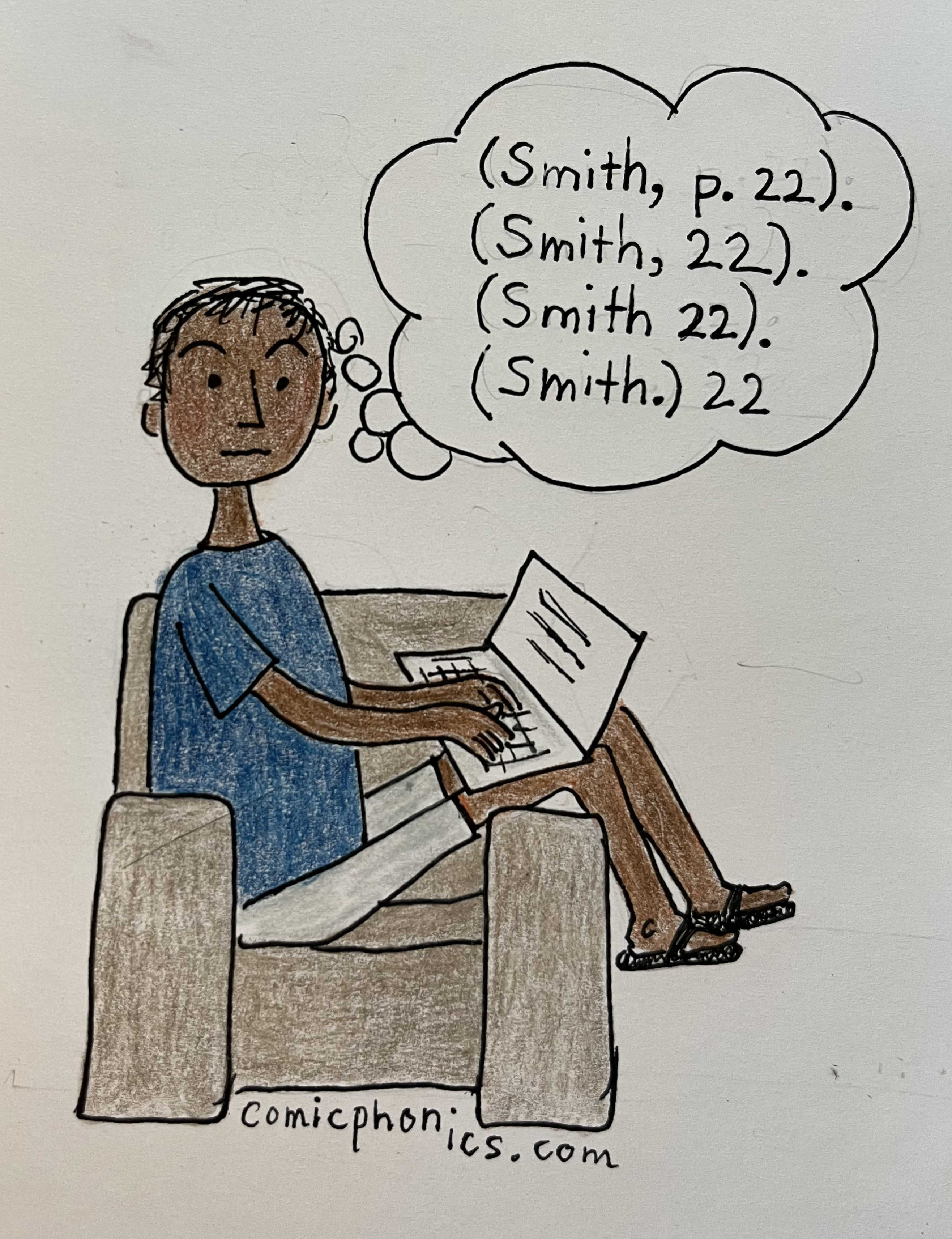
There are several reasons, but the most important reason is the same reason students don’t need to focus on those things when they are writing in long hand.  Continuing the flow of your ideas is what is most important while composing.

If a writer stops to check citation style or any other detail  while composing, the writer loses the flow of his or her ideas.  It’s better to keep writing while you know what you are going to say next and focus on details or fix mistakes later.

Another reason is that composing is a much harder task than editing.  Composing involves many higher level thinking skills—applying information, analyzing in a clear order, evaluating choices while you write, and bringing together ideas.  These skills are more difficult than fixing a spelling mistake.  So it is better to work on harder composing skills without interrupting your flow with editing details.

Still another reason is that electronic equipment fixes many mistakes when a writer reaches the end of a sentence.  The “fix” might not be correct or what you want, but again, you can make needed changes when you have finished composing.  Many writers compose during their most alert hours, during quiet hours when their minds work best.  They save their editing for times when flow is less important.

Polishing writing is important.  It is during revising that so-so writing becomes great.  Revising means analyzing whether everything you need to say is said, whether your information is in the correct order, whether you need to delete or insert material, whether you have named your sources.  Revising is not as hard as composing, but it is easier than editing for English conventions.  Some writers revise as they compose and others might wait until the end of a composing session.

Eventually, students do need to focus on spelling, word order, and capitalization, but not while they are composing.
How to mark a student’s writing

A reader has asked me, when I mark a student’s writing, why do I put light boxes or highlights around the text rather than crossing it out?

Here’s why:  I try to put myself in my student’s shoes.  If 12-year-old me saw parts of my writing crossed out by my teacher, how would I feel?  Pretty down, I suspect.  And on the defensive.

But if I saw my writing with a box around it, the words still visible, I might wonder why the teacher did that.  Maybe it was great writing!  Maybe not, but maybe something about the writing needed to be discussed.  I would feel open to hearing what the teacher would say  about my writing.  I wouldn’t be on the defensive as I might if the writing were crossed out.

When a student’s text is highlighted or boxed (because I think it should be deleted), I usually suggest it be moved to the end of the passage where it stays intact.  The student can read the passage without the boxed part.  If the student disagrees with my judgment, he or she can always put the boxed part back or can put part of it back or put it elsewhere.

As a longtime writer, I have had many editors and first readers suggest deleting phrases, sentences, and paragraphs.  Once a first reader I respected suggested I delete the first 37 pages of a story I was writing.  I know such suggestions are meant to improve my writing, so I listen and consider carefully what my readers suggest.

But student writers haven’t had years of feedback.  They might not trust my opinion.  So I want my markings to be as benign as possible to encourage students to listen with open minds to my revision suggestions.

Write first, revise second, third, fourth, and edit last

Revising and editing are distinct actions.

Revising means changing text in significant ways, such as adding or deleting words, sentences, paragraphs or even whole scenes.  Revising means changing weak verbs to stronger, specific verbs.  Revising means changing sentence order or sentence beginnings or combining sentences or separating too many ideas in one sentence.  Revising means making big changes and should be done before editing.

Editing means polishing text in subtle ways, such as changing punctuation, spelling, and choice of synonyms and antonyms.  Editing means deleting most -ly adverbs, many adjectives, and obvious information.  Editing means making small changes, sometimes stylistic changes, and should be done after revising.

Which are revising and which are editing?

revising editing
Deleting backstory from the beginning of text
Using simple Anglo-Saxon vocabulary instead of longer, more complicated words
Replacing abstract nouns with concrete verbs
Deleting vague, qualifying words (e.g. some, never)
Deleting “that” except when needed for clarity
Combining sentences to delete unnecessary words
Adding information for clarity
Using “said” instead of “told,” “related,” “cried,” and other words saying how a person spoke
Replacing forms of the verb “to be” with specific verbs, action verbs if possible
Rewriting sentence beginnings for variety
Replacing most compound sentences or compound predicates with complicated simple sentences
Deleting overused words like “so,” “then,” “just” and “like”
Rewriting conclusions to add meatier ideas
In dialog between two people, not identifying who is speaking for each line of dialog
Writing direct dialog rather than indirect dialog.
Calculating words per sentence to keep within 15 to 20 words on average.
Looking for the kind of grammar mistakes you often make, such as run-ons, and fixing them.
Showing, not telling.

A mistake student writers make is to edit as they write, losing the flow of their thoughts.  It’s better to keep going, even though you know you spelled a word wrong and are tempted to look it up.  Writing is harder than editing which is why writers are tempted to edit as they go.  This is particularly true of perfectionists.

Editing before revising is a waste of time.  Good revising will delete many early edits.  Write first, revise second and third and forth, and edit last.

How to begin a novel

Q:  How should a good novel begin, according to writing experts today?

  1. With backstory
  2. With an inciting event

A:  b.  With an inciting event, with action of some kind to grab the reader into the story.  Two hundred, one hundred, even fifty years ago this wasn’t the way writers started novels.  But times have changed, and so have readers who expect writers to grab them into their stories in the opening paragraphs.

Q:  If that’s true, then how should a novel introduce backstory?

  1.  By getting the story underway, pausing to fill in background details, and then resuming the forward action of the story.
  2. By weaving background details into a story as needed without ever pausing.

A:  b.  By weaving background details into a story as they are needed, without stopping or even slowing down the forward action, is the recommended way to include backstory today.

And yet,

This past week I read a novel which received high praise from a news source I respect.  As I turned from page 3 to page 4 to page 13 to page 24, I thought, C’mon, c’mon. When is this story going to take off?  It did around page 35, or so I thought for a couple of pages.  But I was wrong.  The scene described there turned out to be more backstory.  It wasn’t until about page 70 that the action really started.

70 unnecessary pages.  Or at least 70 pages which could have been reduced to two or three pages and tucked into the forward action part of the novel.  If not for the four-star review, I would have stopped reading by page 10. 

Q:  So how did this novel get published with such a laborious beginning?

A:  The author is an established writer with several best sellers, some of which have been turned into TV miniseries.  Editors are reluctant to ask such a writer to cut 35 pages, no matter how slowly they move the novel along.

Q:  What can we learn from this?

  1.  If you are a best-selling author, anything goes.
  2. Even if you are a best-selling author, some reviewers will pan your book if it has a slow, wordy start.
  3. Listen to writing experts and start with an inciting event until you become a best-selling author.

A:  a.  Yes.  b.  Yes.  I went online and found reviewers who liked the book and others who said it could have been improved by eliminating several dozen pages at the beginning.  c.  Yes.  Jump right in if you want to hook your readers.

Do you read like an editor?

I do, and I wish sometimes I could turn off my editing instinct.

For instance, last week I  reread Pride and Prejudice.  Everything was fine until I reached chapter 10.  There, the heroine, Elizabeth, is sparring verbally with Mr. Darcy, a stranger to whom she has taken a dislike, when the author reveals that “Darcy had never been so bewitched by any woman as he was by her.”

Now, had I been Jane Austen’s editor, I would have told her to leave out this line and all future lines alluding to Mr. Darcy’s falling in love with Elizabeth Bennett.  Instead, let us, the readers, discover that Darcy is in love with Elizabeth the same way Elizabeth does, with his abrupt proposal of marriage.  To Elizabeth, this proposal comes out of nowhere, but not to us.  Since we, the readers, are identifying with Elizabeth as we read, let us feel the same profound shock she does at this startling announcement.

Another book I edit as I read is War and Peace.  Near its end, two of the main characters, Pierre and Natasha, meet up again after years separated by the Napoleonic Wars.  That is where the book should end (spoiler alert) with them falling in love.  Tolstoy should not have included the anticlimatical scene which occurs several years past that time.

Even Shakespeare doesn’t get a pass with me.  Every time I reread  Romeo and Juliet, I find Mercutio more fascinating than Romeo.  But what does Shakespeare do?  He kills off Mercutio in Act III.  Ugg!  What Shakespeare should have done was to recognize that he had created a mesmerizing minor character and made him the major character.  He should have rewritten the play to have the man-of-the-world, Mercutio, fall for innocent Juliet.  What a contrast!

But alas, Austen, Tolstoy and Shakespeare didn’t consult with me.