
Many children hem and haw about choosing a writing topic. I ask for their suggestions and they shrug. I give them options. They object. It’s possible to waste so much time during a writing lesson settling on a topic.
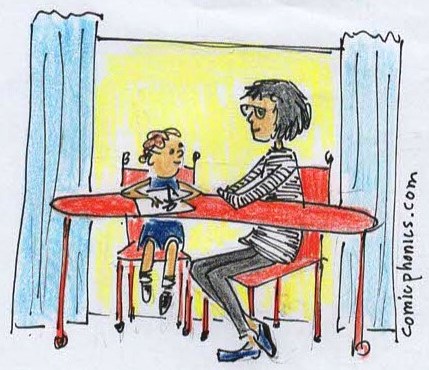 I’ve figured out a way to end students’ angst and to start the writing lesson quickly. I bring a children’s picture book to the lesson. The student reads the book aloud. Then I tell the student he is going to write a book patterned after the book he has just read.
“You can redo the same story, or you can use that story as a starting point for a different story,” I say. This way the student has choices.
Let me show you two results.
One second grade girl read Alexander and the Terrible, Horrible, No Good, Very Bad Day by Judith Viorst as her prompt. It concerns a boy for whom everything goes wrong one day. Here is my student’s result.
Terrible Very Bad Day
Nick woke up in the morning and he fell out of his bed. At breakfast his brothers ate all the cereal. I think I’ll move to Washington, D.C. In the bus he had to sit next to girls that he liked and everybody laughed at him even the girls. In class Jackson said he was not his best friend. At lunch everybody had desserts like cupcakes except him. After school his mother took him to get shoes but he did not get what he wanted which was blue with red stripes. At dinner his mom had spinach and he does not like spinach. When his brothers got to watch TV he had to sleep. Tomorrow is going to be a good day, he said.
That same second grader read Jack’s Worry by Sam Zuppardi as her prompt. It is about a boy who fears playing his trumpet in a school concert. Here is what she wrote this time (with names changed).
Sue loved making friends. For weeks she had been looking forward to meeting the new girl in her school. On the day she was meeting the new kid, she had a worry and it became bigger and bigger. She was worried that the girl wouldn’t like her or that she would say something mean to her. When it was time to go to school, she did not want to go. Her mother said, “Is something wrong?” She said, “Yes. I am worried that the new girl will not like me.” Mother said, “She will like you even if you make a mistake and I will love you.” Sue’s worry was gone. When she was at school, she met the new kid, Annie, and they became best friends. Sue learned worrying is silly.
Some tips for using this technique:
- Choose a book that the student can read in five to ten minutes so that most of the lesson is devoted to writing.
- Beginnings are hard. Let the student see how the author started the novel. Then suggest alternatives.
- You might show the student the illustrations as she writes, but cover the words. Encourage her to write her own words.
- Endings are hard. Suggest she write a moral if that makes sense. Or suggest she reread her first two or three sentences and see if the character she is writing about has solved the problem presented. Let the ending be a comment on the solution. Or let the ending look to the future in light of what the student has written about.
- Incorporate some particular aspect of writing into the lesson. In the first example I asked the student to keep going because I know she wants to finish quickly. In the second example, I asked her to use direct quotes, and we talked about how to punctuate them.
 Good writers make their endings strong, too. Good writers know how to make a reader smile or nod with satisfaction at the end of a piece of writing.
 Good writers organize their articles and stories so that readers can follow along without getting lost or confused. Good writers use topic sentences that tell the reader what to expect. They use transition words like “first,” “next,” and “finally.” Or they use chronological order, including time words such as “in the morning,” and “later that same day.” Notice how this first grader began a fairy tale using transitions.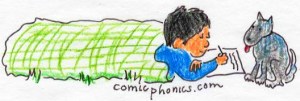
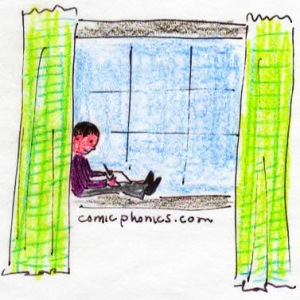 Good writers don’t just tell something, they show it. In informational essays, good writers give examples to show what they mean. In narratives, good writers show a character acting, such as his hand wiping away a tear, or his foot tapping, so that the reader can judge for herself if a character is sad or excited. Here is how a kindergartener showed a character.
 Good writers use sentences that are varied and interesting. They vary the verbs in sentences, begin sentences with different words and different parts of speech and write some long sentences and some short sentences. Notice how this sixth grader starts an essay with a 20-word sentence followed by a six-word sentence. He starts with a prepositional phrase but the next sentence begins with an adverb.
 Good writers write for the ear, not the eye. Good writers read their writing aloud and listen for ideas that are not clear. If characters are speaking, good writers make characters dialog sound different from one another. Since most people don’t talk in complete sentences, good writers have their characters speak naturally, even if that breaks rules of grammar. Notice how a second grader uses dialog to explain what a book is about.
 Good writers elaborate; they try to share a lot of information and detail. Good writers provide lots of detail—numbers, dates, seasons, days of the week, proper nouns, dialog, sensory information, and examples. Good writers put themselves in the shoes of the reader and provide the information that a reader needs even if the writer already understands it. See how that same second grader uses detail.
 Good writers get their facts right, even when they are writing fiction. In passages about science or social studies, good writers use the proper vocabulary. They check their facts online or by talking to experts. They go over their writing to be sure names are consistent and numbers are accurate. Read how a first grader uses scientific facts which she researched.
 Good writers should know when to quit. Good writing is concise writing. The writer needs to trust that the reader will understand the first time if the writing is clear enough, so repetition isn’t necessary. And that’s why I am going to stop now. –Mrs. K
 That teacher, Leilen Shelton, has also written a book, Banishing Boring Words, purchased, presumably, by people who don’t write for a living.

 English Writing Teacher