Should students focus on spelling, word order and capitalization when composing?

A reader asks:  Why do students not need to focus on spelling, word order, or capitalization when composing on electronic devices?

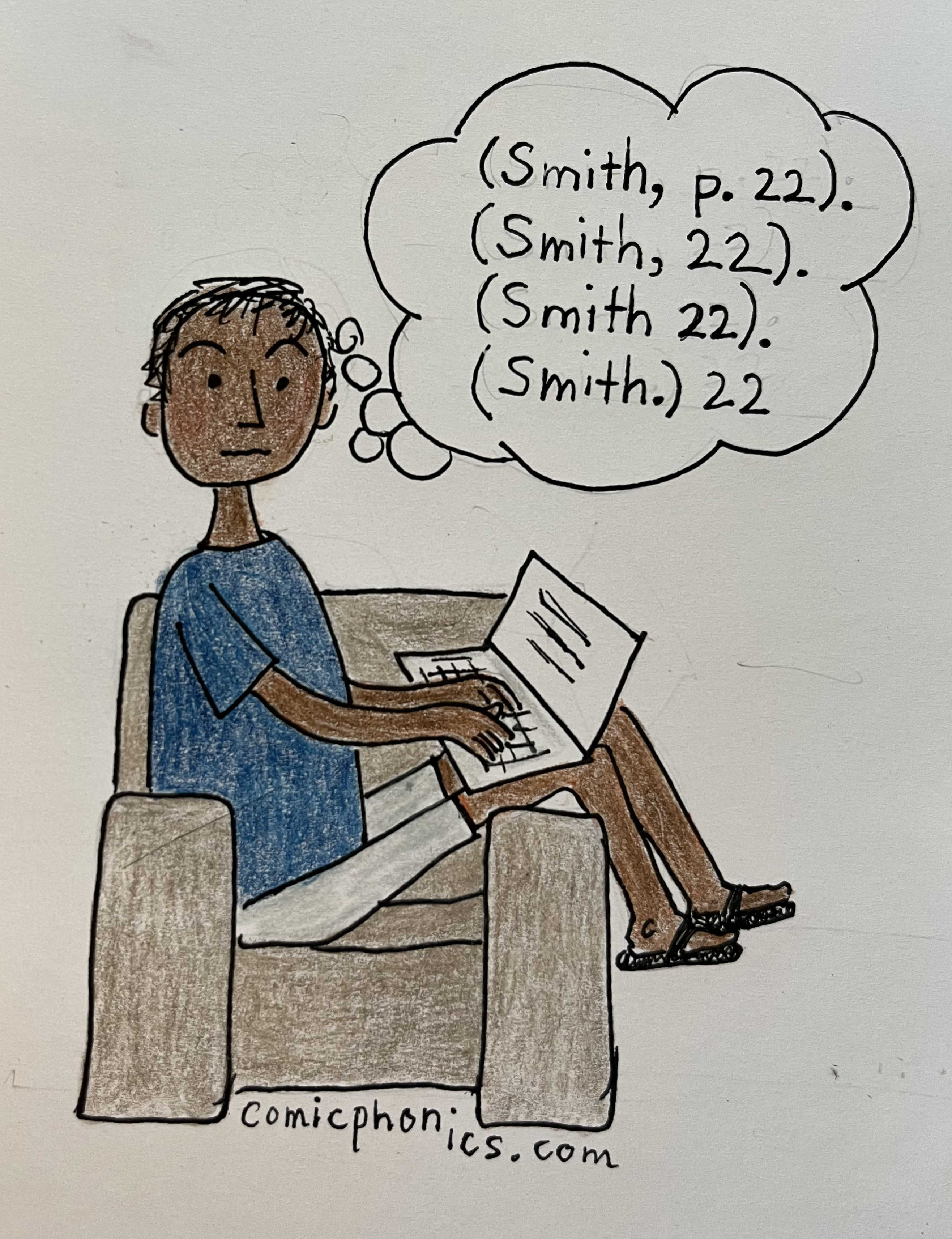
There are several reasons, but the most important reason is the same reason students don’t need to focus on those things when they are writing in long hand.  Continuing the flow of your ideas is what is most important while composing.

If a writer stops to check citation style or any other detail  while composing, the writer loses the flow of his or her ideas.  It’s better to keep writing while you know what you are going to say next and focus on details or fix mistakes later.

Another reason is that composing is a much harder task than editing.  Composing involves many higher level thinking skills—applying information, analyzing in a clear order, evaluating choices while you write, and bringing together ideas.  These skills are more difficult than fixing a spelling mistake.  So it is better to work on harder composing skills without interrupting your flow with editing details.

Still another reason is that electronic equipment fixes many mistakes when a writer reaches the end of a sentence.  The “fix” might not be correct or what you want, but again, you can make needed changes when you have finished composing.  Many writers compose during their most alert hours, during quiet hours when their minds work best.  They save their editing for times when flow is less important.

Polishing writing is important.  It is during revising that so-so writing becomes great.  Revising means analyzing whether everything you need to say is said, whether your information is in the correct order, whether you need to delete or insert material, whether you have named your sources.  Revising is not as hard as composing, but it is easier than editing for English conventions.  Some writers revise as they compose and others might wait until the end of a composing session.

Eventually, students do need to focus on spelling, word order, and capitalization, but not while they are composing.

How to mark a student’s writing

A reader has asked me, when I mark a student’s writing, why do I put light boxes or highlights around the text rather than crossing it out?

Here’s why:  I try to put myself in my student’s shoes.  If 12-year-old me saw parts of my writing crossed out by my teacher, how would I feel?  Pretty down, I suspect.  And on the defensive.

But if I saw my writing with a box around it, the words still visible, I might wonder why the teacher did that.  Maybe it was great writing!  Maybe not, but maybe something about the writing needed to be discussed.  I would feel open to hearing what the teacher would say  about my writing.  I wouldn’t be on the defensive as I might if the writing were crossed out.

When a student’s text is highlighted or boxed (because I think it should be deleted), I usually suggest it be moved to the end of the passage where it stays intact.  The student can read the passage without the boxed part.  If the student disagrees with my judgment, he or she can always put the boxed part back or can put part of it back or put it elsewhere.

As a longtime writer, I have had many editors and first readers suggest deleting phrases, sentences, and paragraphs.  Once a first reader I respected suggested I delete the first 37 pages of a story I was writing.  I know such suggestions are meant to improve my writing, so I listen and consider carefully what my readers suggest.

But student writers haven’t had years of feedback.  They might not trust my opinion.  So I want my markings to be as benign as possible to encourage students to listen with open minds to my revision suggestions.

Is it possible to express emotion in text without !!! ☹ lol ↓ ♥️ 👍🏿 ?

When Shakespeare wants to express strong emotion, he resorts to metaphors such as “What light through yonder window breaks?  It is the east, and Juliet is the sun. Arise, fair sun, and kill the envious moon.” Romeo expresses intense passion for Juliet by  comparing Juliet to the brilliant sun.  No !!! needed here.

Robert Frost also uses metaphors to express emotion when he says, “The woods are lovely, dark and deep, but I have promises to keep, and miles to go before I sleep.”  He contrasts the aching loveliness of woods filling up with snow with the weariness and duty of the narrator.   No unhappy emojis needed here.

When Jane Austin wants to show emotion between the mismatched Mr. and Mrs. Bennet, she does so using witty sarcasm.  When Mrs. Bennet complains to her husband, “You have no compassion on my poor nerves!”  Mr. Bennet responds, “I have a high respect for your nerves. They are my old friends; I have heard you mention them with consideration these twenty years at least.”  Mr. Bennet’s words are amusing but also show disappointment in his wife’s silly priorities.  No haha needed here.

These methods of showing emotion require thoughtfulness on the part of the writers.  Can you imagine Mr. Bennet rolling his eyes at his wife’s inanity and walking away without comment?  How easy that would have been for Jane Austen.  But what a two-hundred year loss of humor and gentle sarcasm.

Today’s writers of text messages—the medium which gave rise to the shortcut visual emotional responses—either haven’t the time, the desire, or the know-how to attract our minds with clever metaphors or retorts.  So they resort to !!! or 😉 to express feelings.  But how thin those feelings are compared to “My love is like a red, red rose.”  No ! needed here.


Don’t put the cart before the horse

What’s wrong with these sentences?

  • The rocket exploded shortly after takeoff.
  • Without warning, the town’s tornado siren blared.
  • A mosquito suddenly bit my arm.

Grammatically, all three are correct sentences.  Spelling, punctuation—both are okay.  Clarity?  No problem.  So what is wrong?

All three put the cart before the horse.

Suppose you are an onlooker at the rocket launch.  Which do you see first?  Does the rocket explode first or does the rocket take off first?  It takes off first, right?  So that information  should come first in the sentence, in chronological order.

Suppose you are in town when the tornado siren blares.  Which are you aware of first?  That a tornado is coming without warning, or that a tornado siren blares?  The blaring of the warning system, right?  So it should precede that it happened without warning.

Suppose you see a mosquito bite my arm.  If you saw the mosquito fly over my arm and then move on without biting, would you use the word “suddenly”?  No.  It’s because the bite is unexpected that we use the word “suddenly.”  “Suddenly” should come at the end of the sentence—or maybe not at all.

Is “At first, I saw nothing” an okay sentence?  For technical reasons, yes.  But would you use words like “at first” if nothing happens?  Shouldn’t what happens—or in this case what doesn’t happen—come first in the sentence?  When you say “at first,” you are alerting the reader that something else will happen, and probably it will be better or worse than what happens first.

Try to put yourself in the shoes of the character you are writing about.  Write about events in the same order that the character experiences them without clues to the outcomes.  Let the reader find out what happens in the same chronological order as the character in the writing.

5 steps to nail a two-sentence fiction summary

Is it possible to summarize a novel in two sentences?  Yes, and here’s how.

Identify the five elements below to create a two sentence synopsis. They elements are

  1. A Hero/protagonist—Who is the main character?  Don’t confuse narrator with main character.  Dr. Watson is the narrator, but Sherlock Holmes is the main character.
  2. A Situation the protagonist faces—What problem does the protagonist need to overcome?
  3. A Goal the protagonist needs to achieve—What would mean victory for the protagonist? Usually it means returning life to the way it was before the inciting incident of the story.
  4. A Villain opposing the protagonist’s goal—Who or what is blocking the hero?  If the villain is personified, all the better.
  5. A Disaster happening if the villain succeeds—What disaster will follow if the protagonist does not succeed and the villain thwarts the protagonist’s goal?

The first three elements are written as a one-sentence statement, and the second two are written as a one-sentence question.

Here are two examples from To Kill a Mockingbird accompanied by an explanation of how the five elements apply to that fictional story.  (I use Mockingbird as an example in my blog often because most American middle school students are required to read this novel.)

Example one: In a small town in Alabama in the 1930s (part of the situation), a girl (the protagonist) and her brother try to lure their reclusive neighbor into the open (another part of the situation and the goal).  But can they overcome his extreme shyness and his brother’s violent control (villains) or will he remain a prisoner of his brother forever (disaster)?

Example two: A small town attorney (protagonist) must convince (goal) an all-white jury in 1934 Alabama that a black man did not attack a white woman (situation).  Can the attorney overcome the racial prejudice of his neighbors and the testimony of the woman and her father (villains) to paccused (disaster)?

Some tips on how to write this kind of summary:

Follow the story arc during the first third of the novel to find the information to include.

Write concisely.  Rarely use names, dates, locations or other details.  They will muddle the summary and confuse the reader.

Focus on action.  Skip themes.

For more on this kind of writing, see Techniques of the Selling Writer by Dwight V. Swain.