To revise, replace weak or overused verbs with strong, specific verbs.

overused verbs list

When revising, I ask students to encircle each main verb (not helping verbs).  Then, on a separate paper, students make a list of the verbs, using tally marks to show how many times each verb is used.  Usually I help them to write the first list.  Present, past, future—all forms of a verb are treated as the same verb.  Many students are not aware that “is,” “are,” “was,” “were,” “be,” and “been” are the same verb, so I often write those words together at the top of the paper, as well as “have,” “has” and “had”; “do,” “does,” “did;” “go” and “went.”

After the list with its tally marks is complete, I review the first draft, looking for verbs the student has not found.  Younger students sometimes don’t know what verbs are, so this is a learning experience for them.  Older students often miss identifying the verb “to be.”  I encourage independence, but I step in when the student doesn’t know what to do.

With the students looking at their completed list of verbs, I ask, “What do you notice?”  I hope they say something like, “Well, I used an awful lot of get and got, and also is and are.”  The point is for the students to recognize that they have overused some verbs.

How many is too many?  In a typical piece of student writing of two, three or four double spaced pages, three or more uses of the same verb is too many for my purposes, but there are exceptions.

  • I point out that we are stuck with repeating some verbs which haven’t many synonyms. “Play” is such a verb.  How do you say, “I play the piano” or “I play soccer” without using the word play?
  • Other weak verbs should be replaced even if there is only one of them. “Get,” “take,” “make,” “come,” “go,” “have,” and “do” are vague in meaning and can usually be replaced with more specific verbs.
  • When a verb is used as part of an idiom, it can be hard to replace, and I often allow such verbs for younger children. For older kids, I ask if there is another way to say the thought without using an idiom.

Now comes the most important work of revising:  replacing weak verbs with strong ones.  More on that in the next blog.
Start revising by reading the essay aloud

Professionals writers read their writing aloud.When I ask students to read their essays aloud for the first time, and to listen for mistakes, they often feel foolish and skip this step.  Then I ask them to read the essay aloud to me, and whoa!  Mistake after mistake becomes apparent.

When we read with our eyes, we read what we want to be there, not noticing some mistakes which are obvious when we read aloud.  I haven’t taught a student yet who hasn’t found mistakes when reading his essay aloud.  I instruct the student to read only the words that are there.  When they do, they stop when something sounds funny.  Usually it’s a grammar mistake.

But there are all kinds of errors that a student can find when reading his work aloud.

  • Is something missing—a word, a word ending, a sentence? Is a whole idea missing?  If so, add the missing parts now.
  • Is a word or an idea duplicated needlessly? Sometimes a student will write the word “the” at the end of a line and then write the word “the” at the beginning of the next line.  Cross one of the words out.  Or a student repeats phrases from one sentence to the next, such as, “ Let me tell you about my brother.  My brother. . .”  Those two sentences can be easily combined to eliminate the duplication.
  • Are ideas out of order? Whole paragraphs can be numbered to rearrange them.  Sentences can be circled and marked with arrows to move somewhere else.  Words can be transposed.
  • Is a sentence unclear, or even if it is clear, could it be said with fewer words?
  • Are ideas incomplete? Complete them in the margins or on the back of the paper.
  • Every subtopic sentence should support the main idea of the essay. This is the time to check to see that it does.  If a subtopic sentence is off-topic, does it belong in this essay?  Students are dismayed to X out a whole paragraph, but sometimes that is necessary to stick to the one main idea.
  • Are certain words overused? Such words might be “then,” “just,” “so,” “really,” “like” and “because.”  If they are overused, eliminate most of them.

In our next blog we will look at revising verbs, the most important words in writing.

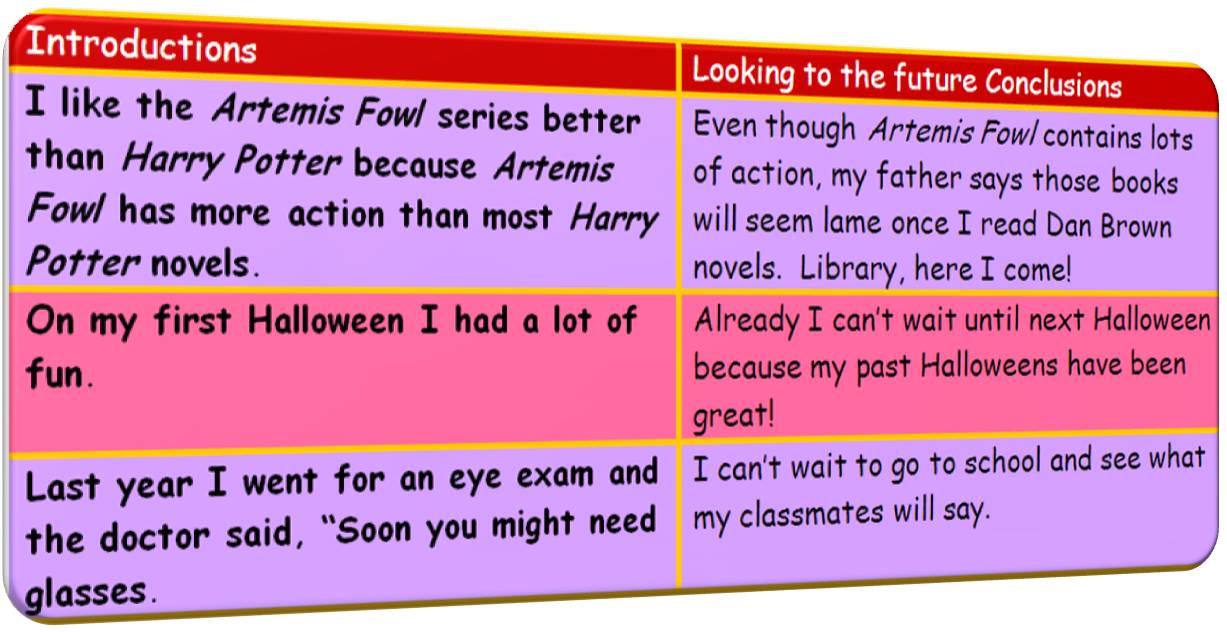
Looking to the future is another useful kind of conclusion

In addition to going “full circle,” another good kind of conclusion is one which focuses on the future of the topic.Future conclusions

Suppose the student is writing about what he wants to be when he grows up, and he writes about three or four different careers (an engineer, a computer programmer, a math teacher and an accountant).  In his conclusion he could say that he doesn’t know what his future holds, but he believes it will have something to do with math since all his career choices need a strong background in math.

Or suppose the student is writing about different kinds of stars.  She could end by mentioning future research or discoveries to be made in the field of astronomy, or a recent discovery and how exciting that is for her.

If a student is reviewing changes being introduced for the SAT tests, she could conclude that current changes will not be the end of the changes, that as the skills students need change, so will the skills tested by the SAT.  She might predict what other kinds of skills might be evaluated by the test, such as computing skills.  She could suggest that future tests might be taken on smart phones or tablets since fluency in those technologies is becoming so important.

Next we will look at revising.  It’s a big topic, so it will take many blogs to explain.

Use the “full circle” approach for an essay conclusion

The introduction and the conclusion are usually the two most difficult parts of the essay for a student to write.  When it is time to write the conclusion, I always suggest rereading the introduction because the introduction and conclusion should support one another.  “Going full circle” is a common idea in writing—starting with one main idea, developing many subtopics, and returning to the main ideas to end.

Here are some ways to do that, using the “when I lost a tooth” topic from a previous blog.  If you can include humor in your conclusion, and leave your reader with a smile, that is the best ending possible.


Anecdote introduction:

My Grandpa says he doesn’t remember when his first teeth fell out but he remembers when his last one did.  It was after he cracked a walnut with his teeth, and a back tooth broke apart.  He had to go to Dr. Taylor’s office to have the rest of the tooth pulled out.

Anecdote conclusion:

Grandpa says I should bite into a walnut with my wiggly tooth.  And I’m tempted after seeing Grandpa’s teeth in a glass on his nightstand.  What if I lost all my teeth and not just the wiggly one? Imagine all the money the tooth fairy would bring me!


Dialog introduction:

“Hey, Mom, how much did the tooth fairy bring when your teeth fell out?”
“A nickel a tooth.”
“A nickel a tooth!  That’s all?”
“That’s all.”
“Didn’t they invent quarters back then?”

Dialog conclusion:

My mother got a nickel, my older cousin got a dime, and my big sister got a quarter.
“Mom, what’s the chance of me getting a half dollar for my loose tooth?”
“Pretty good, honey.”
Sometimes it’s great to be the youngest.


Statistics introduction:

When I was in first grade, every single kid lost a tooth, and most of us lost more than one.  Billy Emsing was the champion though.  He lost seven teeth that year.  I remember because we kept track with a bar graph on the bulletin board.

Statistics conclusion:

Now that I’m starting fifth grade, no one is losing their teeth any more.  But some kids, like me, are starting to sprout up.  Maybe I could get my teacher to post a bar graph of the number of inches we grow this year.  With my dad being six feet two inches, I have a chance of winning that contest!


Startling claim introduction:

Suppose you brush your teeth for a minute in the morning and a minute in the evening every day this year.  That’s 730 minutes, or more than 12 hours standing in front of a sink brushing your teeth.

Startling claim conclusion:

Twelve hours brushing teeth in one year times 80 years is about 960 hours in a lifetime.  That’s 40 days of our lives spent brushing our teeth.  Yikes!  I better buy a strong toothbrush.

In the next blog we’ll look at some other kinds of conclusions.

Use a prewriting organizer to write the first draft

After helping students create a good prewriting organizer, I sometimes see students begin their first drafts with no prewriting organizer in sight.  “Where is it?” I ask.  They dig through their writing binder and find it, hidden somewhere.

This is a graphic representation of a third grade student's handwritten mind web.

The best prewriting organizers for expository and persuasive essays are mind webs (click the graphic for more information).

This tells me that those students are not used to writing an essay with a prewriting organizer.  They don’t know how to use it.  I can’t assume that “If they write it, they will use it.”  They need to be taught how to use it.

I insist that the prewriting organizer be situated to the side of the notebook paper on which the student is writing his first draft.  To show me that he is using the prewriting organizer, I ask him to cross out lightly the ideas as he includes them in his essay.  By the time the essay is done, all the ideas on the prewriting organizer should be crossed out.

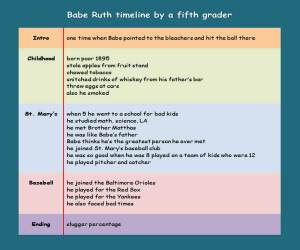
An example of a modified timeline organizer on Babe Ruth's life--childhood, school years, and baseball career.

Use a modified time line as a prewriting organizer for narratives (click the graphic for more information).

If a student is coming in cold after creating a prewriting organizer the day or the week before, I ask her to read the prewriting organizer to herself in the order in which she has numbered the subtopics.  This warms up her brain and reminds her of the details and the scope of her essay.

While she is writing the first draft, I usually allow the student space, looking over her shoulder occasionally.  If she is making progress, I leave her alone, but if she seems stuck, I intervene.  The most common problem is how to start body paragraphs.

Use a chart for comparison and contrast essays.

For comparison and contrast essays, use a chart or a Venn diagram as a prewriting organizer (Click on the graphic for more information).

We reread the information planned for the paragraph and see how it relates to the essay topic, and from this we write a topic sentence.  If a student has not written an essay before, I offer more help than I do for experienced writers.

Sometimes students recognize that they should change the order of their subtopics.  Before beginning the rough draft is a good time to do that.  Just cross out the numbers on the organizer and write new ones.  Sometimes students recognize that they have little to say about one subtopic, but they can think of another one with greater detail.  This is a good time to make that change.

Sometimes the student has lost interest in the topic of the essay completely and wants to change topics before he begins the first draft.  Usually I let him discard the completed organizer and start over.  You might think that creating that organizer was a waste of time, but no.  The student has practiced organizing an essay, an essential skill of a good writer.  Not every planned essay needs to be written.

In our next blog, we will talk about the conclusion, another difficult part of the essay for many students to write.