Use expanded sentences to add informality to writing

An expanded sentence is one that begins as a simple, compound or complex sentence but then adds additional information, sometimes with phrases and sometimes with clauses, mimicking the way we speak. Here are some examples.three examples of expanded sentences

In the past, writing was more formal than spoken language, and to a degree it still is, even in the US. While we say, “It’s me,” in formal writing we are expected to write, “It is I.” Most of us say “who” when we mean “whom” and say “hafta go” when we would write “have to go.” But in the late 20th century, writing became more informal. One example is that today the word “you” is allowed in essays.

What is happening? Modern-day writing is following the lead of spoken language, becoming more like it. When we speak, we often start with a simple idea (Gershwin wrote many songs), but then we add to those words as we are thinking (Gershwin wrote many songs, such as Summertime, I’ve Got Rhythm and Swanee, becoming the best song writer of the 1920’s—although Cole Porter fans might disagree).

The effect of expanded sentences is to create informal writing. The sentences sound friendly, not academic. These sentences are often easier to understand than complex sentences of the past with many subordinate ideas. They have an easy-going, relaxed quality to them which puts us at ease.

One way to practice writing these kinds of sentences is to type them on your computer and one by one change the words, keeping the grammar and flow but changing the meaning.expanded sentence practice

A caution:  An expanded sentence is not a compound sentence with several independent thought sadded on. (I went to the store, and I bought a candy bar, and I ate the candy bar, and it was delicious.)  It can include a compound sentence, the but add-ons vary in type.

It’s spring. Update your writing with some bright, extended sentences.

How to use the present perfect verb tense correctly

The present perfect verb tense is often not used by student writers.  Or if it  is used, it is often used incorrectly. Yet it is an important verb tense to master in speaking and in writing.

What is the present perfect? It is the verb tense which combines the helping verb “have” or “has” with the past participle of a verb: I have eaten; she has slept; you have written.

Many times there is a double problem in using this tense, and that is choosing the proper past participle. Regular verbs in English use the past tense as the past participle and create no problems for students: I have jumped; he has watched; they have learned. But the verbs we use the most in English—be, do, have, go, come and hundreds more—use an irregular past participle: I was but I have been; you gave but you have given; it did but it has done.

Another problem is knowing when to use this verb tense. It has three uses:

  • To describe something that began (or didn’t begin) in the past but is still going on
    o Jack has pitched since the first inning.
    o My friends have studied for the test for many hours.
    o I have not slept since 6 a.m.
  • To describe something that happened many times (or didn’t happen at all) in the past.
    o She has eaten there many times.
    o They have not studied in the library all semester.
    o We have always followed his advice.
  • To describe something that happened (or didn’t happen) in the past when it is not important to know exactly when it happened.
    o Yes, I have traveled to Seoul.
    o No, I have not eaten baklava.
    o Aunt Marie has made many quilts.

Children born to well-educated English speaking parents learn to use this verb tense correctly the way they learn everything else about English—by listening to and mimicking their parents. For English speaking children whose parents do not use this verb tense, learning it is hard, as it is for ESL students.

One almost painless way to learn the present perfect is to read, read, read. Good writers use this verb tense correctly unless they are mimicking the dialog of a character who is poorly educated. With enough reading, students will pick up subconsciously how this verb tense is formed and might discern when to use it. However, most children will need this verb tense explained, and will need to practice it over and over, year after year, in school.

Although grammar is less stressed in schools today, a good teacher or tutor will notice if her students speak or write with the past tense when they should be using the present perfect tense. That teacher will offer a lesson on this verb tense. One or two lessons usually isn’t enough. The present perfect needs to be reinforced with practice. You can find practice activities online and in grammar handbooks.

Why is it important to master the present perfect verb tense? After all, some languages have existed hundreds of years without such a verb tense. Can’t a student write, “Yes, I went there several times,” instead of writing, “Yes, I have gone there”? The meaning is clear both ways.

As I tell my students, people you want to impress as you get older—the person who interviews you for college acceptance, or the person who reads your admissions essays, or your professors, or the person who interviews you for a professional job, and the parents of your future spouse—might judge you by how you use English verb tenses. These people are not reading or listening to hear if you use certain verb tenses, but they will know immediately when you use a verb tense incorrectly, and your status might drop in their eyes. Not fair, you say.  Maybe, but that’s the way of the world.

Correct use of the present perfect verb tense is a sign of a well-educated English-speaking person.

How many kinds of prewriting organizers does a student need to use?

Some students to whom I have tutored writing tell me their teachers suggest a different kind of prewriting organizer for every kind of essay essay.

That’s ridiculous.

Most children can rely on three types of prewriting organizers for the kind of writing they are expected to do in elementary and middle school.

This is a graphic representation of a third grade student's handwritten mind web.A mind web (sometimes called a spider web) works great for most expository and persuasive essays. The topic goes in the middle of the notebook paper, and, like spokes of a wheel, two, three or four spokes go out to subtopics. Each subtopic is further subdivided into many more details.

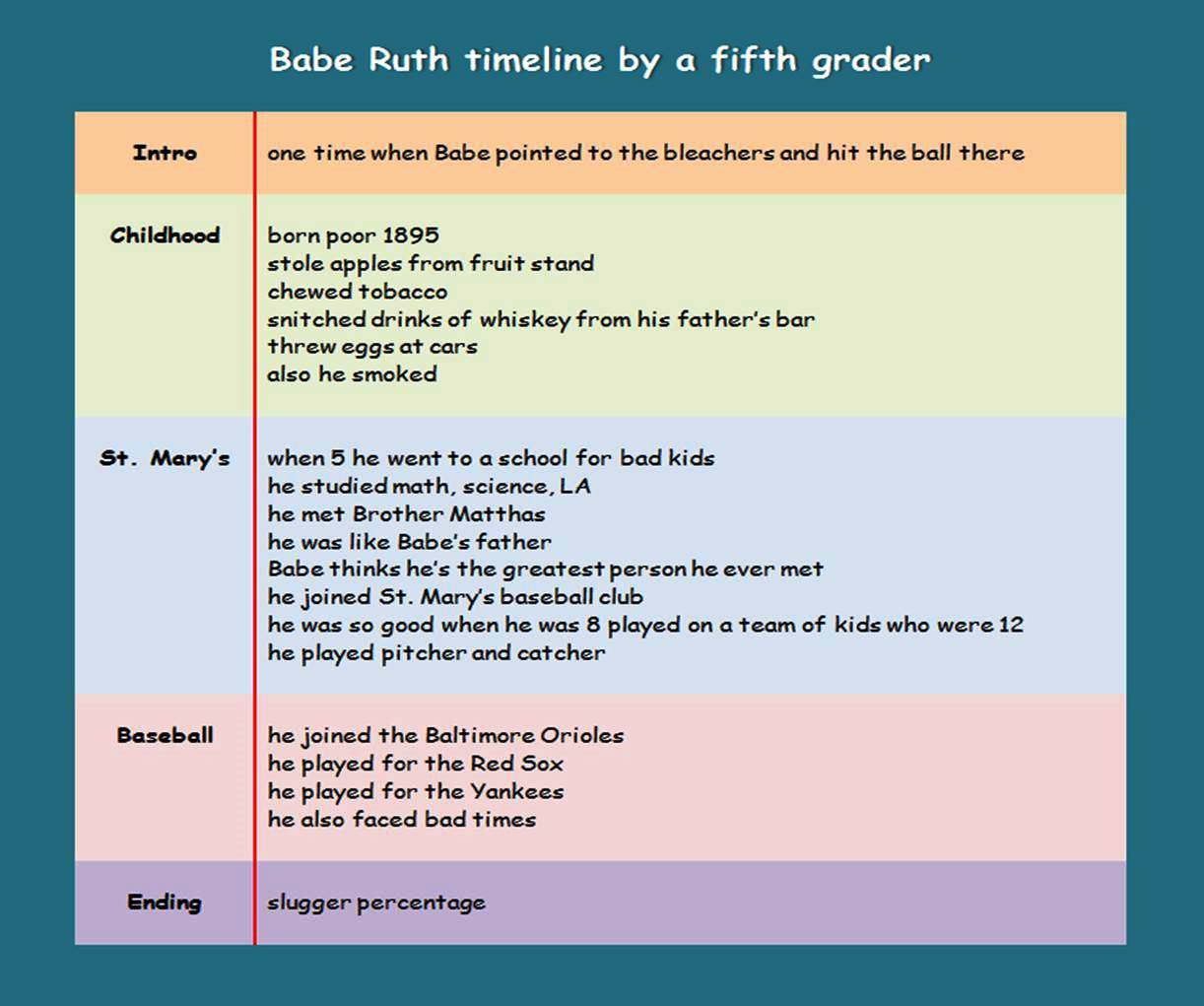
An example of a modified timeline organizer on Babe Ruth's life--childhood, school years, and baseball career.A modified timeline works great for most narratives. At the top left of a notebook page goes the word “beginning.” Branching off from it are the words “setting” (divided into “time” and “place”), “characters,” “problem to be solved,” and “how it begins.” A little farther down the page on the left is the word “middle” and next to it and covering most of the page is a sequence of actions (the plot). At the bottom are the words “climax” and “resolution” where are listed the high point of the drama and how the story ends.

Use a chart for comparison and contrast essays.For comparison or contrast essays, either a chart with three or four vertical sections or a Venn diagram works well. I prefer the chart because the overlapping section of a Venn diagram is often too small (the way children draw it) to allow much detail to be written there. But either can work.

For reluctant writers or for young writers I break this rule of three and use as many kinds of prewriting organizers that encourage the child to write. One time I taught a third-grader who was going through a transformer phase. Each week I would draw the outline of a different transformer which he delighted in filling in with details of his planned paragraph.

As a professional writer and tutor who knows a lot about writing, I face the problem of contradicting a teacher who seems to know little about writing. (I have a masters degree in middle grades education and for that degree I was not required to take a single course in how to teach writing. Many grade level teachers haven’t taken a how-to-teach-writing course either.) If a teacher is suggesting a different type of prewriting organizer for every writing situation, the child can becme overwhelmed in remembering what kind to use in what situation. I suggest that he follow his teacher’s instructions when he is writing a school essay, but when he is with me, I suggest he rely on just three choices: the mind web, the modified time line and either the chart or Venn diagram.

I have paged through various writing workbooks meant for children and find numerous prewriting organizer styles when only three are needed. Why would a workbook publisher suggest so many? The reason is simple: to make money. The publisher thinks unsuspecting parents will decide knowing many kinds of prewriting organizers is necessary.

The fewer choices there are to remember, the more likely a student will remember and will use those choices. Stick to three prewriting organizers—a mind web, a modified time line and either a chart or Venn diagram.

Is a focal character the same thing as a point of view character?

Sometimes yes, sometimes no.  A focal character is the central character in a narrative. A point of view character is the character through whose eyes or mind we are learning about the story and the central character. Usually they are the same, but not always.
original cover of Sherlock HolmesIn the stories of Sherlock Holmes, Holmes is the focal character. We learn about his habits, such as his violin playing, his drug taking, and his disdain for people whom he considers his intellectual inferiors. More importantly we learn how his mind works—how he identifies subtle clues that others miss and how he uses them to solve difficult crimes.

But how do we learn all this? It’s though the eyes and ears of Dr. Watson. As Watson learns about Holmes, we learn about Holmes. As Watson is awed and appalled by Holmes’ behavior, we are awed and appalled. Dr. Watson is the point of view character.

Original cover of Huckleberry FinnIf a story is written in the first person, then the person telling the story is the point of view character. In To Kill a Mockingbird, Scout tells the story of her father’s legal defense of an innocent man. In that part of the story, Scout is the narrator but her father, Atticus, is the focal character. In Huckleberry Finn, Huck is both the focal character and the point of view character for the whole novel.

If a story is written in the third person, then the focal character can still be the point of view character. Hatchet is the story of teenager Brian Robeson who becomes stranded in the Canadian woods for a summer. It is written in the third person, but we hear the thoughts of Brian. “I have to get motivated, he thought, remembering Perpich. Right now I’m all I’ve got. I have to do something.”  Brian is both the focal character and the point of view character.

A few novels switch back and forth between point of view characters, both of whom are the focal characters. The first chapter focuses on Character One, giving the reader his emotions, thoughts and behavior, while the second chapter focuses on Character Two, giving the reader that character’s emotions, thoughts, and behavior. That there exist few books like this indicates that most authors—and maybe most readers—prefer a single point of view. Why? Perhaps two points of view are confusing. Or perhaps two points of view water down the impact of a story.

I recommend that if you are teaching children how to write narratives, that you explain the difference between focal characters and point of view characters by comparing versions of fairy tales. Read a traditional version of a fairy tale and then compare it to a “fractured” fairy tale. Use picture books to entice the students. Even high school kids will love this kind of lesson, but more importantly, they will remember the difference between focal character and point of view character.
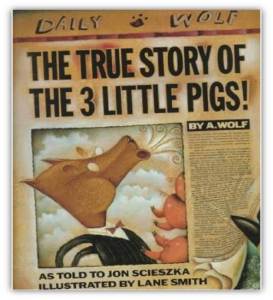
Cover of "The True Story of the 3 Little Pigs!"Read a traditional version of “The Three Little Pigs,” for example. Ask who the focal characters are. (Who is the story about? Often in fairy tales, the title gives it away.) From whose point of view is the story told? Usually in fairy tales it is from an unknown, god-like narrator. Then read a “fractured” fairy tale about the same story, such as Jon Scieszka’s The True Story of the 3 Little Pigs. This version is told from the point of view of the Wolf, who of course, is the focal character.

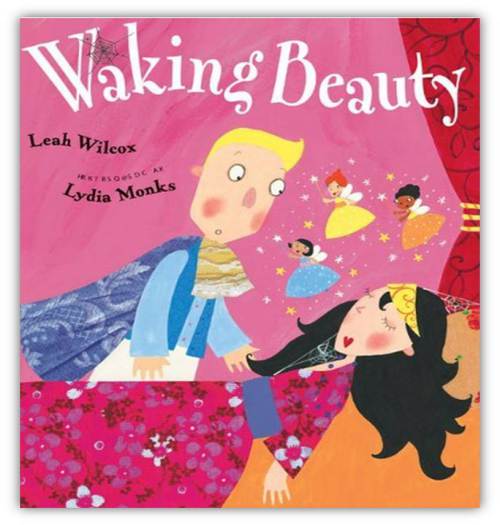
sleeping_beautyAnother good example is reading a traditional version of “Sleeping Beauty.” The focal character is the princess and usually the point of view is the “god-like” third person narrator. Then read Leah Wilcox’s Waking Beauty, which focuses on a prince who will do almost anything not to kiss the snoring Beauty—hollering, jumping on her bed, throwing water at her, even shooting her from a canon. The focal character and the point of view are the prince, certainly not Sleeping Beauty.

(The Common Core State Standards include a writing standard—ELAW1—which requires students to use an appropriate point of view. Also, a literature standard—ELARI6—requires students to understand an author’s point of view.)

In a dialog, don’t identify the speakers over and over. Trust your readers.

What do you notice about this dialog?

“Can I go with you?” the child asked her father.
“No, not this time,” her father said.
“Why not?” the child asked.
“Because,” the father said.
“Because why?” the child said.
“Because I’m going on a business trip,” the father said.

Beginning writers often identify the speaker in every line of dialog in narrative writing.  This slows down the action and needlessly irritates the reader. If there are just two characters talking, it is unnecessary to identify someone on every line. Compare the above dialog with this one:

“Can I go with you?” the child asked her father.
“No, not this time, hon.”
“Why not?”
“Because.”
“Because why?” She pouted her lip.
“Because I’m going on a business trip.”

Did you have any trouble keeping track of who was speaking?

Suppose the above dialog continued for another six or more lines? You might need to write “he said or “she said,” one more time to keep the speakers clear. But maybe not.

“Why can’t I go, Daddy?”
“Because you’re five years old.”
“So—” The child folded her arms over her chest.
“So when you are grown up, you’ll go on lots of business trips.”
“Really?
“Really.”
“Daddy?”
“Yes, angel.”
“Will you bring me a present?”

Did you notice there were no he saids or she saids?

How can you avoid over-identifying the speaker in a dialog, yet keep the speaker clear?

  • Make sure that the first one or two lines clearly show who is talking. Often both identifications can go on the first line, if the relationship between the speakers is made clear, as above.
  • Use the “voice” of the speakers, so their way of speaking—their grammar, their vocabulary, and their pronunciation—identifies them. “Because why?” is the way a child would talk.
  • Use details that identify who is talking. “Because I’m going on a business trip” would be said by a father, not by a child. “She pouted her lip” identifies that the child said the previous words without using “she said.” “Yes, angel” would be said by a father. A child would ask for a gift.
  • Make sure each character’s line of dialog becomes a separate paragraph, and the person speaking—if identified—is identified in the same paragraph with his spoken words.
  • Instead of using “he said” or “she said,” write words to let the reader “see” the speaker. “He snapped his suitcase closed. She hugged her Teddy bear.”