Adding numbers enhances student writing

When I help students revise essays, we are always adding details. On their own, children rarely add enough details to their writing. They think that being general is adequate (“We flew up north” as opposed to “Mom, Dad, Lily and I flew to New York”). Sometimes the student is lazy and wants to get the writing done quickly. Sometimes the student is unwilling to hold a pencil and writes the shortest sentences possible. Sometimes the student is in a hurry to play with friends or to watch video games.  Students need to be taught that adding details is important because it makes writing far more interesting.

One kind of detail that is usually easy to add is numbers. But a  common problem with using numbers is that the child may not be sure of the exact number, so he says “some” or “a few” or “lots of.” Children want to be honest, and they think saying “twelve” students attended the party when maybe only “ten” did is dishonest. They need to be taught that it is more important to use an estimated number than it is to be absolutely accurate in student writing.

Here is a fourth grader’s description of a woven basket containing coasters. Notice how the numbers he uses add truth to the essay.

This short artistic cylinder is made from five rows connected by knots. The lid has a woven spiral with holes in between. It is 4 ½ inches tall with a diameter of 5 ½ inches. The circumference is 16.5 inches and the depth is 3.5 inches. The interesting lid is a woven spiral with five small, tan and orange shells in the middle. On the bottom of each smooth shell two rows of tiny rough teeth show. The teeth are also shiny, and the shape of the shell resembles a football.

Here is a sixth grader’s introduction to an essay about starting middle school. Notice the variety of ways this student uses numbers: to describe grades, to name a date, and to count buses, teachers and classmates.

Daniel and I have passed fifth grade and now we are starting sixth grade at Duluth Middle School which opened on August tenth, 2015, welcoming three loads of buses on a mild summer morning. On the first day I greeted my five teachers and hundreds of classmates and learned about my schedule.

Here is a first grader’s description of how to play hopscotch. She uses numbers to describe the hopscotch board.

You need chalk, pebbles, a driveway, and one kid or more for hopscotch. First, you draw a board with chalk on the driveway. It has ten boxes. The first box is a square by itself. It has the number 1 in the box. Next, the 2 and the 3 squares are right beside each other like partners. You keep repeating the boxes but the numbers go from 1 to 10. One kid goes first and throws the pebble anywhere on the hopscotch board. Then, the first player hops on one foot on the 1. And then the player hops on the 2 and the 3 at the same time. Then the player keeps going. But do not forget to pick up the pebble. When the player reaches 10 the player gets off the 10 and goes to the back of the line. Nobody wins but everybody has fun.

And lastly, here is the introduction to an essay in which a fifth grader describes himself. His bravura writing style attracts the reader, but notice how he uses numbers to enhance that style.

In 34 more days, I, Robert Sir Awesome the Third, am going to turn eleven. Bha ha ha! I will tell you about the life of a boy in the twenty-first century, or shall I say, about my life, including my sister, being the oldest child and school.

Don’t you agree that numbers increase reader interest in these student writings?

Writing topics for bored students

Do you have students who read over a list of writing topics and then set it down, bored? I have found topics that are sure to interest them.

high heel shoes made of wireOne group of topics concerns weird, unusual or unbelievable images.  If you use any of these topic suggestions, make sure you share the images from the internet with the student. It’s the images which will bring a smile and a flicker of interest. Then together you can come up with ways to work one or more images into writing.  If access to the internet is not available, then make a photocopy of some of the images for the student to look at.

These topics work well in the fall as Halloween approaches.

  • Search “ugly haircuts pictures” or “ugly haircuts images.”
  • Search “ugly dog pictures” or “ugly dog photos.”
  • Search “weird faces pictures” or “weird faces photos.”
  • Search “unusual jack o lanterns.”
  • Search “unusual shoes.”
  • Search “scary photos of people.”
  • Search “longest fingernails photos.”
  • Search “smiling horse pictures.”
  • Search “expensive car images.”
  • Search “twins images.”

shoes with ladder heelsAnother group of writing topics of interest to kids is the games that they play.  I allow students to add hand drawn diagrams to their writing to encourage them to use these topics, but I make sure they explain everything in words too.  Some ideas you might try are

  • How to solve a Rubics cube.
  • How to checkmate a king in four steps.
  • How to get down to one marble in a solitaire game.
  • What properties to buy in “Monopoly” in order to win.
  • How to win at “Clue.”

What about video games?  I find they don’t work.  When I let kids write about them in the past, the essays would go on for eight or ten pages with no end in sight.  I wound up writing “to be continued” at the end of a page so the student could move on to revising and editing.  Also, the writing is tough to understand even if it is done well because of the strange way vocabulary is used in the games.  Beware.

Strategies for highlighting a text when summarizing

Highlighting a reading selection can be helpful for a student learning to summarize. But many students are not taught what to highlight. May I suggest an approach?

  • First, make a photocopy of the selection so that the student can highlight freely. Even if a student owns a text, making a photocopy of a reading selection when the student is learning how to highlight allows the student to make mistakes without damaging the text.
example of a text to be summarized plus a summary of it

Click on the information above about Ancient Greece to enlarge it.

  • Next, have the student read the selection without marking it in any way. If you suspect he might not understand the selection, question him about it until you are sure he understands it.
  • Third, ask him to find the topic. The topic is a word or a phrase identifying what the reading selection is about. Many times the topic is the title or headline, or it can be found in the first paragraph of a nonfiction reading selection. For a fiction selection, the student might need to infer from the details what the topic is, but usually it is stated. The student should underline or highlight the topic and write the word topic near that word or phrase. Identifying the topic reminds the student what the reading selection is about.
  • Now the student should identify the main idea. The main idea is not the same as the topic. A topic is a word or phrase; a main idea is a statement. From Charlotte’s Web, an early chapter’s main idea might be “Wilbur is lonely so he searches for a friend.” Or from an article about insects, a main idea might be, “An insect’s body has three parts.” The main idea might be found in the introduction of a nonfiction reading selection. Or the student might need to infer the main idea from the facts given. The student should highlight it and mark “main idea” next to it. Identifying the main idea often offers the student a sentence to write to begin the summary.
  • Next, the student should divide the reading selection into sections. This is not the same thing as dividing a selection into paragraphs, but it might turn out that each section is an individual paragraph. However, some sections, or subtopics, extend over more than one paragraph. The paragraphs of Wilbur asking the rat to play would be one section and the paragraphs of Wilbur asking the goose to play would be another section. The student could bracket a section in the margins or encircle all the paragraphs of one section with a single circle. In the margin of each section the student should name it with a word or phrase, such as “rat” and “goose.”
  • If there are important details, they should be highlighted or underlined. For example, if the reading selection’s topic is “Ancient Greece,” and it’s main idea is “Greece gave many contributions to world culture,” then the student should highlight categories of contributions such as poetry, statues, buildings, amphitheaters, democracy, trade routes, wine and plays. If a particular example is outstanding, such as the Parthenon or The Iliad and The Odyssey, they should be highlighted also.
  • Whole sentences should not be highlighted, just important categories or details. Depending on how long the summary should be, most details can be skipped.
  • Sometimes it helps to use arrows from the main idea to the supporting information that will be in the summary. Have the student draw arrows on the photocopy, including the points that should be in the summary.
  • Now the student is ready to write the summary. Start with the main idea, paraphrasing the original if possible. Have the student write it on his paper. Next, add one or more sentences fleshing out this main idea, using the highlighted categories and important details. If the student has done the preparation work, the summary writing should take just a few minutes.

Filter out filter words for better writing

“Show, don’t tell”Child writing is the golden rule of writing. Good writers know that writing, for example, “My little brother is talented,” is not an effective approach.  Instead they should show the boy displaying his talent. “My seven-year-old brother gets asked all the time by teenagers to perform skateboarding tricks. He’s the only kid in his first grade who has permission to roam the library and check out anything he wants because his Lexile score is so high. And you should see the Lego space ships he makes without directions.” The reader thinks, wow, that kid is talented.

Another less obvious way writers tell instead of showing is by filtering experiences through a character’s or a narrator’s senses rather than letting the reader see, hear, touch and think for herself. Take, this sentence, for example: “Mei-mei wondered if she should cross the busy street.” The writer of this sentence has told the reader that the street is busy. But the writer has also presented this information not as a verifiable fact, but as Mei-mei’s opinion. Here’s what the writer could have written to eliminate both problems:

“Mei-Mei halted at the intersection. Two lanes of bumper-to-bumper cars and trucks breezed by in each direction. A woman with a baby carriage out in the median searched from left to right over and over. A dump truck bellowed and then braked with a skid when a yellow cab cut ahead of it.” What does the reader think at this point? I suspect she thinks tht Mei-mei is deciding whether to cross a busy intersection. But the reader wasn’t told this; she came to this conclusion based on facts which the writer presented.

In the two examples above, the reader can decide for herself what is happening. She doesn’t need a character or a narrator to tell her what is happening. The reader is there, using her own senses to evaluate the information the writer gives in order to draw conclusions.

Certain verbs lead the writer into filtering situations. If writers know the most commonly used words to initiate a filtering situation, they can attach little red flags to those words (in their minds) to alert them to a likely filtering situation. What are those words?

• to decide
• to feel or to feel like
• to hear
• to know
• to look
• to realize
• to see
• to seem
• to sound (or to sound like)
• to think (or synonyms)
• to touch
• to watch
• to wonder

If you want to be a better writer, pay attention to filtered situations in your writing. Remove the filters to force your readers to interpret situations for themselves. This reader involvement will make the reader part of the story and will increase his or her pleasure.

For more information, read Janet Burroway’s On Writing.

Use the cube to add detail to children’s writing

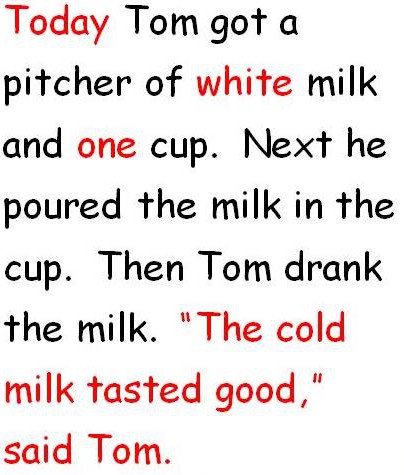
Today I worked with an eager kindergartener on writing a short paragraph. She wrote three sentences describing a sequence of events (a child standing at a table with a pitcher of milk and an empty glass, the child pouring the milk into the glass, and the child drinking the milk). Then I introduced the cube to her.

paragraph showing kindergartener's writing with details addedI had created a cube from a tissue box covered with paper. On the faces of the box I had pasted reminder words for kinds of details to add to writing. The words and phrases were “proper nouns,” “numbers,” “date, day, time, season,” “examples,” “direct quotes” and “sights, sounds, tastes, smells.”

After my student finished her paragraph, we tossed the cube. “Numbers” turned up on top. We looked for a place in her writing where she could add a number. She took out the word “a” and replaced it with the number “one.” This change was insignificant but easy for her to accomplish.

We tossed the cube again. This time “dates, days, time of day, seasons” came up. I explained what the words meant, and immediately she said, “Today.” Without my help she found a place to add “Today,” making it the first word of her paragraph.

detail suggestion cubeNext, “sights, sounds, tastes, smells” came up. We talked about the word, “milk.” I asked her if milk has a smell. “Not really,” she said. “How about a color?” “White,” she said. We found several places to put “white,” and she picked the easiest.

For the fourth and last toss of the cube, “direct quote” turned up. We had previously talked about adding how the boy felt about the milk, but she had balked at writing another sentence. However, when the cube directed her to add a direct quote, she added another sentence to the end of her writing.

This was my first time using the cube to encourage a student to add detail. It worked because the child found the cube fun to use. My experience in tutoring children to read and write is that the younger the child, the more games or gimmicks need to be incorporated into the work. Also, lessons need to be short and end before enthusiasm wanes. That is why we stopped after four throws of the cube. She was still engaged, and we needed to move on to the phonics part of her lesson.