How to end a scene with style

Some student writers reach an exhaustion point when writing a narrative.  They are too tired to continue.  They want to stop—mid-sentence, if I’d let them—and write “To be continued,” as if that would solve their problem.
“You can do better than that,” I tell them, and together we brainstorm better breaks which will lure readers back to the next section of their narratives.

Point of view shifts. If all the action has been told from one character’s perspective, add a final sentence to show that someone else is watching.  “And so Little Red Riding Hood kissed her mother goodbye, waved and skipped through the dark forest, unaware that a big, bad wolf was watching and licking his lips.”  When the student resumes writing this piece, it can be from the wolf’s point of view.

To use a cliffhanger effectively, something must happen just before the end of the chapter, something that leaves the reader wondering.  “Mia crumpled up the test paper with the low grade and pouted.  She had studied so hard for that test.  She had—She felt a tap on her elbow from Ben, who sat behind her.  He passed his cell phone out of sight of their teacher, Mrs. Miller.  Mia read the text message.  “Are you all right?  For god’s sake, tell me you’re all right!”

Traveling or going to sleep. A scene can easily end with a character getting in the back seat of the car or on a spaceship.  When the next scene starts, the character can have arrived at her destination, a new location.  The actual traveling can be skipped over.  Or a character can go to bed for the night or take a nap, and when he awakens, a new scene begins without any explanation of how he slept or what he dreamed about.

Dialog.  If Hermione says to Harry Potter, “You better be extra careful, Harry,” and the scene ends, we, the readers, are led to believe Hermione’s words are important.  We suspect Harry will find himself in trouble soon.  For dialog to be an effective scene ender, the dialog needs to seem significant.  If one character says, “Bye,” and the other character says, “Bye,” that is not significant.

Foreshadowing.  A toddler is running around willy-nilly, and nearby a pregnant woman puts her hand on her abdomen, feeling an active baby kicking.  She smiles.  Or Cinderella hops into the carriage that will take her to the ball when one of her slippers falls off.  She laughs and slips it back on, waving to her fairy godmother.

None of these scene endings takes many words, just a sentence or two.  But they are far more elegant than slapping “To be continued” at the end of a sentence in the middle of a thought.  With a good scene ending, the writer lures the reader back.  The reader wants to continue reading.

What if teachers write along with students?

Many times when I ask students to respond to short answer questions, to write summaries or even to write essays, I write too.  This “me too” approach has advantages.

I can test whether the assignment is doable. Recently I gave my fifth grade students a reading passage with a follow-up question requiring that the students supply two details from the passage to answer the question.  I could easily find one detail, but two?  The students had problems too.  Together we discussed this problem and figured out how to write an answer.  I recognized that their frustration was genuine, acknowledged that, and worked as a partner to solve the writing problem.  Sometimes I chuck the assignment altogether and give a different one.

If I suspect students might be struggling with a particular aspect of the writing—how to start, for example—I can offer several possibilities, and I can read my possibilities aloud, asking for students for advice as to which one I should choose. We can discuss the merits of each.  Or a student could say, “Here’s how I did it,” and read her solution aloud.  I am seen as more of a collaborator than a know-it-all teacher.  For some students, this can make me more approachable when they struggle with writing problems.  When I was in high school, I was assigned homework which would take two hours nightly in just one subject. By my doing the writing assignment with my students, I can judge how much time the assignment takes, and break the assignment into parts.

Students can listen to my vocabulary and sentence openings. They can listen for sentences of various lengths.  They can decide whether my “hook” hooks and whether my conclusion picks up on the introduction.  They can see how I use transitions, dialog, details and examples.  They can see how I incorporate the writing concepts which we talk about all the time.  And all this I do on a piece of writing which they are working on.  I give them a model which they can aspire to.

Of course, with some students my time is better spent discussing each sentence as they write it, making reminders as they go along, and praising attempts which flop.

But sometimes my example speaks louder than words.

Dialectical journals

If you are a high school English teacher, you might know about dialectical journals.  But elementary and lower grade teachers—and parents of younger children—might never have heard of them.  That’s too bad because they are a great alternative to a book report.

Quote word-for-word the text you are analyzing Citation

Q = question

C = Connect

CL = Clarify

P = Predict

R = Reflect

E = Evaluate

Write your response


A dialectical journal is a method of recording information about a book as you read the book.  It requires three types of information:

  • A direct quote of a passage which is worthy of consideration.
  • A one- or two-letter identification of the kind of response the student will make plus the page number or the act, scene and line.
  • The student response.

The response can take many forms.  Suppose the students are reading Lord of the Flies.  A response can ask a question about the text:  Why did Ralph decide on a conch shell to call the children to order?  Why not just whistle?  A response can notice a problem:  All the boys survive the plane crash without injuries while the pilot dies.  That seems unusual.  And items from the plane, like clothes, are not recovered.  A response can draw attention to the plot:  The naval officer arrives just as the boys are about to kill Ralph.  That timing seems unreal.

In using dialectical journals, students should strive to use higher level thinking skills such as analysis and evaluation so that the information can be used to spark class discussions.  Sometimes a response by one student can open the eyes of another without the adult intervening.  If no students are mentioning a concept that the adult thinks is important, the adult can suggest that they keep “tone” or “figures of speech” in mind when they do the next few pages of reading and responding.

By the kinds of responses students make, teachers can gauge what interests or perplexes students about a text and can provide supplementary materials.  If students can write, they can use dialectical journals.   They can be appropriate for students as young as third grade.

Evaluating student writing

When I work with student writers, I ask them to evaluate their own writing.  The process I use is simple and works no matter what type writing the students do.

After the student has revised a piece of writing, I draw a large “T” which creates two columns.  I label the first “Did well” and the second “Needs improvement.”  I ask the student to identify what was done well and what needs work.

We start with the “Did well” column.  If the student is stumped, I ask questions about things which the student obviously did well.  “Did you have a beginning, middle and end?”  If he says yes, I ask him to write “B-M-E” under “Did well.” “Did you spell correctly?”  He writes “spelling” under “Did well.”

I try to list at least three things the student did well, no matter how basic his writing is.  Handwriting, starting sentences with capitals, writing periods and commas that look like periods and commas—I search for positives.  The more the better.

Then we move to the “Needs improvement” column.  Usually the student will mention errors we have just corrected during revision.  He might say “run-ons” and using a word like “so” or “just” over and over.  With practice he will identify the conceptual errors, such as organization problems or not writing a topic sentence.  I  bring up one of these larger issues and go back to the paper to show an example of that problem.

I limit “Needs improvement” to three so the student doesn’t get discouraged and so he can keep those three in mind the next time he writes.

After we do this many times, the student realizes he is making the same kinds of mistakes over and over.  When this happens and a student is about to write a  new draft, I ask him what mistake he is likely to make.  He says, “run-ons” or “a hook that doesn’t hook.”  This helps him focus on how to improve his writing while he is writing, long before we evaluate it.

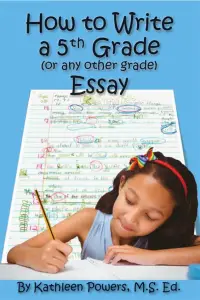
How to Write a 5th Grade (or any other grade) Essay published

Do you know elementary and middle school students who want to write better?  Do you know ELL or older students who want simple, how-to steps for writing essays?

How to Write a 5th Grade (or any other grade) Essay brings together essay writing ideas from EnglishWritingTeacher.com into a single source.  This book shows kids how to organize their ideas, overcome their fear of a blank page, write a good hook, connect their introduction to their conclusion, use transitions and figurative language, vary sentence types, use good vocabulary and revise, revise, revise.

How to Write a 5th Grade (or any other grade) Essay starts where kids start, thinking up an idea, and takes kids through the whole writing process.  This book offers a baby-step by baby-step process which kids can follow to write any kind of essay.  Plus examples from my real students show how other kids have succeeded using these same approaches to writing.

In particular, How to Write a 5th Grade (or any other grade) Essay takes kids through the revising process, crucial to good writing.  Revising is rewriting—moving ideas around, adding details, replacing weak verbs with powerful verbs, varying sentence openings and lengths, adding figurative language and leaving readers with a smile.  This book tells how.

For twenty years, I have been helping kids write.  How to Write a 5th Grade (or any other grade) Essay collects my practical tips gained from working with hundreds of students. It can be used as a home school text, teaching kids the writing process from beginning to end.  Or it can be used to look up writing problems, like how to replace the verb “to be” with strong, specific verbs.

Directed at elementary and middle grade readers, How to Write a 5th Grade (or any other grade) Essay  works for English Language Learners too because of its short sections (usually a page long) and numerous illustrations.   Parents and teachers will find the book a useful teaching tool.

How to Write a 5th Grade (or any other grade) Essay is available from Amazon for $12.99 as of February 15.