Writing “keyboards” of the near future

I learned to print capital letters in kindergarten and lower case letters in first grade.  I learned to write cursive in third grade.  In high school I learned to type—QWERTY—on a manual typewriter and on an electric, reaching 55 wpm.  Later I learned to use a keyboard, then an ergonomically curved keyboard, then a touch pad, a stylus, and most recently, an iPhone touch screen.

But soon I might be writing the great American novel on one of these:

A thin, almost see-through key pad to which a device (about the size of a pack of cigarettes) sends lasers which pick up the movement of fingers and sends signals to an electronic device, such as an iPad.  It’s available now for $119.99 from Brookstone.

If you find keying into phone’s tiny keyboards hard, you could attach a strap over each hand and type on any surface you want, with or without a keyboard.  Air Type detects the movements of your fingers and turns them into electronic signals to your phone or other device.

Then there is the roll up keyboard called the Qii which rolls to the size of a roll of coins.  Via Bluetooth it connects to your electronic device.

The Celluon Magic Cube projects a laser onto a flat surface creating a virtual full-size keyboard which connects to electronic devices via Bluetooth.

All of these keyboards use the QWERTY arrangement of letters.  But what if you want a different arrangement?  Then you can use the Puzzle Keyboard which enables you to connect letters in almost any arrangement you like.

For people with physical disabilities there is the one-handed keyboard, a roundish mouse-like device with several buttons.  Pressing various combinations of buttons creates various letters and punctuation.

If you like the look and feel of an old-fashioned typewriter, you could get Qwerkywriter, a keyboard which looks like a 1950’s era typewriter.  It uses Bluetooth to connect to electronic devices.

One odd-looking innovation already available is a one-handed wearable keyboard called Tap made by Tap Systems.  While wearing rubbery finger bracelets, tap your index finger and get an “E.”  Tap two fingers together and get other letters.  Tapping the middle finger and the pinky produces a “Z.”

Another innovation is Leap Motion’s digital menu which can attach to the palm of one hand, allowing you to tap on it with your other hand.  The signals are picked up by an electronic device.

On the horizon are vision controlled devices which would allow you to stare at particular letters, inputting those letters into an electronic device.

Perhaps most futuristic is the technology of Openwater, which is figuring out how to track your thought waves.  Think “water” and w-a-t-e-r appears on your electronic device.

Cursive has been eliminated, and from what I see, so has keyboard instruction. Maybe in a few years we will need no pens, keyboards or smart phones.  Instead maybe we’ll send messages one brain to the next with no intermediary technology?

But will the writing be any better?


Types of writing: Mystery genre

A mystery (sometimes called a detective or crime novel) focuses on an individual, usually a detective, who solves a crime, often a murder.  Edgar Allen Poe was one of the first to write such stories, and from his first name comes the Edgar Awards, given annually to the best examples of this genre.  This genre has several common elements.

Detective with a magnifying glass inspecting a newspaper.Often the crime happens before the novel opens.  In The Cuckoo’s Calling by J.K. Rowling (using the pen name of Robert Galbraith), the murder (or is it a suicide?) happens minutes before the opening scene in which the police and medical examiner investigate the corpse.  In Agatha Christie’s And Then There Were None, the murders happen as the book progresses, after characters and setting are established in the readers’ minds.  Either way, we readers do not usually develop an emotional connection to the victim.

If the crime begins the story, the next chapter introduces the detective, interrupted while living his usual life.  Agatha Christie’s Miss Marple might be knitting with a friend, or Raymond Chandler’s Philip Marlow might be drinking in a favorite bar.  Elizabeth George’s Thomas Lynley might be heading to his estate for a family gathering.

The detective-protagonist is proactive:  looking for clues, meeting with suspects, talking to the police, and facing danger.  He often reaches a low point well into the story from which he emerges a better person.  Sherlock Holmes is a damaged protagonist—a drug addict.  Philip Marlow is an undiagnosed alcoholic and chain smoker.  Such character flaws make the detective more realistic.

Sometimes the detective has a side kick.  Dr. Watson is Holmes’.  Sergeant Barbara Havers is Lynley’s.  But many detectives, like Hercule Poirot, work alone.

The antagonist is the killer, but since we don’t know who he/she is, almost all the characters are antagonists whose alibis, means and motives need to be studied.  Sometimes a character whom we assume to be innocent turns out to be the killer, making for a clever twist at the end.  The antagonist must be cunning, resourceful, and indefatigable—the same characteristics as the detective, so their battle of wits, like Holmes’ and Moriarty’s, seems matched.

Suspense is important to sustain reader interest.  So is foreshadowing and surprise.  Many times the detective finds himself or herself in danger.  Evidence is revealed little by little, asking the reader to infer what each clue might mean.  Some true clues are brushed over while red herrings are traced to their dead ends.

Many mysteries put a cast of characters in a closed off situation—on a train or on an island—so we know one of them has to be the murderer.  P.D. James used this strategy as did Agatha Christie.  Other writers, like Raymond Chandler, don’t close off characters physically, but motive or opportunity limits the likely suspects.  Picturing the setting is important, and writers describe in great detail where rooms or items within rooms are located.

The fun of this genre is trying to solve the murder before the detective identifies the murderer.  Satisfaction also comes from appreciating the fine mind of the detective as he explains how he (or she) solved the crime.

Perfectionism

Every good writer knows that during revising writing becomes really good—not in planning (though that is important), not in composing the first draft (though you must start somewhere), and not in copy-editing (though pesky commas and apostrophes must be set right).

But what if a student never gets to the point of revising because of perfectionism?

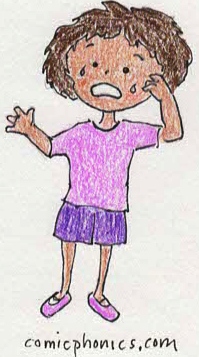
Third grader, “Anna,” can’t bear an erasure to show on her papers.  She starts a paragraph and before the first sentence is done, she erases.  Then she tries to erase the erasure marks and in so doing rips her paper.  Anna starts over on a pristine piece of notebook paper.  But she erases again, maybe because a word extends too far into the right margin or because an “a” looks like an “o” to her.  She starts over again.  But another flaw happens.  I have told her that two start-overs are all she can do.  She begs to start a fourth sheet of paper.  She cries.  She freezes, and refuses to go on.  After an hour, Anna has nothing to show for her time.

I worked with a girl like Anna for several months.  In that time, she completed nothing.  Nothing.

Sixth grader, “Kyla,” reads a selection and writes responses to questions.  She gets most of her responses correct.  When I tell her one is not correct, she goes back into the text and orally defends her written answer with more evidence.  But it is the wrong evidence, or it is wrongly interpreted.  Still she argues that her answer is correct.  She will not accept that her response can be wrong.

I worked with a girl like Kyla.  She could not learn from her mistakes because she could not admit she made mistakes.  She exhausted me.

Suppose eighth grader, Sam, is assigned to write a narrative about what he did on his spring break.  He writes and then reads to me a four page single spaced narrative.  He describes packing his suitcase, driving to the airport, flying for hours and watching films.  At the end he has written not a word about what he did once he arrived at his destination.

We discuss how his response does not fulfill the assignment despite exquisite sentence structure and not a single grammatical error.  I ask Sam to rewrite.  We discuss what is required.  But the next week,  his mother cancels the lesson.  Sam cannot face me.

When you add one plus one, the perfect answer is two.  When you write, there is no perfect answer.  There are good ways to say something and better ways, but rarely is there a best way.  Extreme perfectionists seem to think there is one and only one best way to express something, or to hand-write something, and any way other than that one way is no good.  They see their writing as black or white with no shades of grey allowed.

Revising is the stage where writing becomes great.  If, like Anna, a student never finishes, there is nothing to revise.  If, like Kyla, a student defends less than great writing and refuses to listen to ways to improve it, there is nothing to revise.  If, like Sam, a student walks away from an opportunity to revise because he can’t accept that his first draft is less than perfect, there is nothing to revise.

For most perfectionists I have taught, the light bulb goes on when they realize that good writing becomes great through revising.  They want better writing and better grades.  They are willing to endure the cross-outs, erasures, arrows, and words between the lines and in the margins to improve their writing.

But for  a few students like Anna, Kyla and Sam, I do not have  words to make them recognize that perfectionism is making their writing worse, not better.  I suspect there are underlying issues which have led to perfectionism, and until those issues are addressed, I am spinning my wheels working with a perfectionist.

Words to eliminate from your writing

Yesterday I helped a third grader revise her writing.  After the third time “so” appeared as a sentence opener, she recognized the repetition and went back to the beginning, crossing out that word.  “I use too many so’s,” she said without prompting from me.

We all have words like “so” in our writing.  What are some words you should be wary of overusing, or using at all?

Very.  Your writing is stronger without “very.”  Mark Twain suggested substituting “damn” when you write “very.” He said, if you need “damn,” use it, but if not, don’t use “very.”  “Very” is intended to strengthen the verb it modifies, but in fact, the verb is stronger without this modifier.

Really and almost all adverbs which end in –ly.  Think of these adverbs as crutches holding up the verbs they modify.  Take away the crutches and strengthen the verbs.

Then.  When we write about events happening in sequence, we might need to use “then” to keep the ordering clear to us.  But readers know you are telling events in chronological order.  They don’t need “then.”  So eliminate the “thens” when you are done.

Just.  So.  Like.  Rather.  Actually.  Figure out which words you overuse and eliminate them.

Words which mean “said.”  Use “said” if you need to identify who is speaking, but skip its synonyms unless you want the reader to focus on how something is said.  “Hollered,” “whispered,” and “choked” focus the reader on the way something is said.  Usually you want to focus on the meaning of words, not on how they are said.

Said.  Most of the time it’s obvious who is speaking, and “said” isn’t needed.  (But sometimes it is.)

Start and Begin.  Everything starts or begins.  Unless you are focusing on the beginning of something, skip these words.

Up, down.  He fell down.  Can he fall up?  She reached up into the overhead luggage compartment.  Can she reach down into such a compartment?

That.  When “that” introduces a dependent clause, it might not be needed.  Read what you’ve written with and without “that.”  If it reads fine without, take out “that.”

840 New Words Added to Dictionary

Do you remember the first time you heard the word “email”?  How about “booting”?  Or “text” as it relates to sending messages on phones?  Or, speaking of text, “OMG”?

Our language is always changing.  Lately, that change is propelled by words related to technology and the work of technology, such as texting.  But there are other sources for new words or phrases, such as foreign foods and immigrants.

Merriam-Webster added more than 800 new words to its dictionary this month.  Some I am familiar with; others are totally new. If you want your writing to be up-to-the-minute, try slipping in some of these.

Hophead:  someone who likes beer.

Generation Z:  people born in the late 1990s and early 2000s.

Latinx:  a gender-neutral version of Latino or Latina.

Portmanteau words:  blended words such as mocktail:  a nonalcoholic drink.

Iftar:  the after-sundown meal taken by Muslims during Ramaden.

Avo:  avocado.

Guac:  guacamole.

Airplane mode:  the setting of an electronic device during flight.

For more information, go to https://www.merriam-webster.com/words-at-play/new-words-in-the-dictionary-september-2018.