The last word

When I was a newspaper editor years ago, one of my jobs was to read the competing newspapers on deadline to be sure my paper was covering every story important to our readers.  If we  missed something that our competition had covered,  a reporter would make a few calls and write a story — usually the same facts as in the other papers — but updated.Detective with a magnifying glass inspecting a newspaper.

Our obligation to our readers wasn’t to provide the end-all and be-all of news stories.  No, our obligation was to provide the facts as we knew them on deadline, realizing that later editions would have more facts or updated facts.  We rarely had the last word on an important story because there would always be later information.

Some writers become stymied by the infinite amount of information available on a given topic. The topic could be nonfiction such as what I did on my summer vacation or the best putters on the market today.   How can I cover it all ? (You can’t.)  The topic could be fiction such as flying to India or life in a boarding school.  How can I cover it all?  (You can’t.)

In children, I find this desire to cover everything is almost universal.  When they pick topics, they pick huge topics:  World War II, global warming, or the solar system.  When I tell them to limit the topic to say one moon of Saturn, fear fills their eyes as if there isn’t nearly enough information about one measly moon.

This same desire to say all that can be said confounds adults too.  Maybe you want to write the definitive book on war.  It can’t be done.  You need to reduce the scope of your topic to a particular battle or the development of a particular bomber or the role of a particular soldier.

With children, the teacher says, “Do it!,” and the essay gets written, good, bad or ugly.  With adults, the book might never materialize because there is always another interview to conduct, more data to collect, another book to read.

What should you do if you are overwhelmed by information?  First, think small.  Think minute.  Decide on one teeny, tiny aspect of your topic.  Second, research it well but within the confines of a deadline.  Third, write, but stick to a deadline to finish your first draft.  And last, celebrate a job well done.  Not perfectly done, but done.

One of the great rewards of working for a newspaper is a daily product.   At a certain time the first edition rolls off the presses, and reporters and editors bask in a job done.  Not perfectly done, but done.  Done well enough with the facts at hand on deadline.

An hour later, somewhere across town, in a competing newsroom, another editor would be searching through my newspaper to be sure her reporters were covering all the news her readers would want to know about.  And her reporters would be making calls to update stories, knowing that they, too, would not have the last word.
Gender and number distinctions in English

Some languages force distinctions which other languages ignore.  And some languages drop distinctions which other languages find useful.

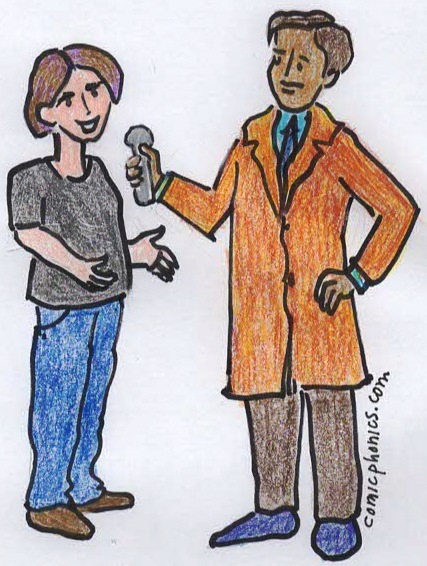
“Call me ‘they’ please.”

For example, the French say “tu”  for “you” when they mean an intimate friend or family member.  For strangers or for formal situations, the French say “vous.”

In English, we say “you” for everyone—friend, stranger, sister—and for singular and plural.  Whereas the French need two words—“tu” and “vous”—English-speakers need only one.

This can bring both a pain and pleasure.  For English speakers learning French, needing to remember when to use “tu” and “vous” can seem a needless distinction.  If one word suffices in English, then why can’t one word suffice in French?

For French speakers learning English, the ease of learning one word, “you,” is a pleasure.  But they might think something is lost—that fine distinction between “tu” and “vous.”  Sometimes “you” might seem too impersonal.

Something of this same forced distinction applies to the new use of “they” to mean the singular as well as the plural.  I get the reasoning and feel sympathy for people for whom gender is not clear cut.  But for me, after a lifetime of “they” meaning the plural, I find it strange that “they” now should include “he” or “she.”

I feel like the French must feel when asked to include everyone in “you.”  Or like Iranians—who have three or four words for “love”—when asked to fit those shades of meaning into one English word.  Or like English speakers with at least nine verb tenses plus modal verb tenses—when asked to express all that nuance into a single Chinese verb.

I wish English had a singular personal pronoun unrelated to gender, something like “it” which could apply to people.  How about “ye”? Or “thee”?  It seems easier to wrap my mind around a new pronoun than to expand and confuse the meaning of a traditional word.

Yet, English, like all languages, changes as new needs arise.  And English speakers, like me, adapt.

“My”—such an innocuous little pronoun—or is it?

Usually we think of “my” as meaning “having a relationship to me” as in “my hometown” or “my homework.”

But it can also mean “having an affectionate relationship to me, a term of endearment” as in “That’s my boy!” or as in the Smokey Robinson song, “My girl (my girl, my girl) Talkin’ ’bout my girl (my girl).”

Now a third meaning  is being used by President Trump as in “ownership and control.” Trump said ,“Where’s my favorite dictator?” when referring to Egyptian President Abdel Fatah al-Sissi).  He has also referred to the US military as “my generals” or “my military.”

According to The Washington Post on September 17, Trump’s use of the word “my” can be viewed  by many as inappropriate.   Is Trump merely saying that he has a particular relationship (my military, not Canada’s military or China’s military)?  Or is he saying that the military is in his pocket and beholden to him?  The intent is in the mind of the speaker but the interpretation is in the mind of the listener.

One time Trump used “my” to single out an African American attending one of his rallies, calling that person “my African American.”  In that case the use of “my” could seem not only inappropriate but paternalistic and demeaning.

One can assume that Trump is well aware of the connotations of his words, even tiny two-letter words like “my.”

15 signs your child could benefit from a writing tutor

Does your child have poor grades in writing?

Does your child hide his writing or “forget” to show you it?

Does your child leave writing homework until the last moment?

Does your child not finish his writing homework?

Does your child’s school writing consist of a word or a phrase, not sentences or paragraphs?

Does your child balk at writing complete sentences?

Does your child’s teacher seldom require long written responses?

Are almost all tests multiple choice answers only?

Does your child show frustration, uncertainty or fear when writing?

Does your child’s teacher check only that the writing is done without offering feedback on the contents and execution?

Are your child’s writing assignments really grammar or editing assignments?

When your child writes, are the ideas illogical or incoherent?

When your child writes, are there many punctuation, grammar or word usage mistakes?

When your child writes, does he use general, vague vocabulary, not specific vocabulary?

When your child writes, do many sentences contain a single subject and a compound predicate?

All of these are signs of a weak writer, a student who is not practicing writing enough to become a proficient writer.  If this is your child, he or she could benefit from one-on-one instruction from a qualified writing tutor.

Why use dashes?

Dashes are used to separate groups of words (My three brothers—Mike, Tom and Pat—live in different states), not to separate parts of words the way a hyphen does (merry-go-round).

According to William Strunk Jr. and E.B. White in “The Elements of Style,”

“A dash is a mark of separation stronger than a comma, less formal than a colon, and more relaxed than parentheses.”

Two kinds of dashes exist, the em dash and the en dash.  The em dash, like the letter “m,” is twice as long as the “en” dash.  An em dash is created by typing a hyphen twice and then immediately typing (no space) a word.  This omits the space between the two hyphens and creates a single horizontal line.  An en dash is technically longer than a hyphen, but a hyphen is commonly used as an en dash.

Use an em dash:

To highlight words interrupting the middle of an independent clause. For example,  I take my three favorite courses—algebra, biology and world history—before lunch.  Or , Sorry, but I can’t meet you—I’m flying to Virginia in the morning—but I’d love to see you when I return.

To indicate interrupted speech in dialogue. For example,
“Suppose we—”
“Hey, it’s my turn to decide.”

To emphasize a sentence. For example,  I will bring the chocolate cookies to the shower—if only Bill would stop snacking on them!

To end a dateline in a news story. For example,    Orlando—Hurricane Dorian stayed out to sea east of central Florida.

Use an en dash to show a range of numbers and to connect items of equal meaning.  For example,

Please annotate pages 1–22 before our next class.

I work from 8 a.m.–5 p.m.

Notice the difference between the male–female brain size.