Use a template to write an essay introduction

Starting essays—writing introductions—is one of the hardest writing challenges for many students.  They look at white space on their notebook paper or on their laptop and wonder, “How do I begin?”

What if they had a template that worked?  Here’s one I have developed for students who need to write an essay about some feature of a novel, film or play.

  • First sentence: name the novel, name the author and identify the location of story and when the story takes place.


  • Second, write a two-sentence summary of the story.


  • Third, write a transition sentence to connect the summary to the main idea.


  • Fourth, write the main idea (thesis).

Let’s try it out.  Suppose a fourth-grader is writing about what a silly little brother Fudge is in Tales of a Fourth Grade Nothing.  How would that introduction begin?

  • Tales of a Fourth Grade Nothing by Judy Blume takes place in New York City in modern times.


  • A big brother, Peter, is bothered by his little brother, Fudge.  Some people who don’t know Fudge think Fudge is cute.


  • But even Fudge’s mother and father get mad at him.


  • In the book, Fudge does some really dangerous things like fall off a rock, lose his shoe on a subway, and eat a turtle.

Now, suppose an eighth grader needs to write about a theme in To Kill a Mockingbird. How might that introduction begin?

  • To Kill a Mockingbird by Harper Lee takes place in Alabama during the 1930s.


  • Two children, Scout and her big brother, Jem, are fascinated by a neighbor, Beau, whom they have never seen.  They think he must be a monster because he never goes outside.


  • But a few times Beau does come out without Scout and Jem knowing it.


  • Beau comes outside to show friendship when he places trinkets in a hole in a tree, when he puts a blanket on Scout, and when he saves Jem’s life.

How about one more.  A high school student needs to write about sonnets in Romeo and Juliet.  How would that introduction go?

  • Romeo and Juliet is a five-act play by William Shakespeare which occurs in Verona, Italy, around the year 1600 or a little earlier.


  • In the play, two star-crossed lovers meet, fall in love at first sight, and marry.  They are forced to separate, and their efforts to reunite fail.


  • Shakespeare tells this love story using puns, words with double meanings, and figures of speech.


  • But some of the play’s most clever lines are in sonnet form, and an example of this is the prologue of the play.

Each of these examples is five lines long, the length many teachers require.  Each names the title and author and summarizes the plot.  The fourth line connects the summary to the main idea which is the last sentence of the introduction.  Yet each essay is different because the summaries, transition sentence and thesis are different.

This template follows a pattern that students can use over and over to begin an essay about a novel, film or play.  This template works in most situations where a novel, play, or fictional film is the starting point of an essay.

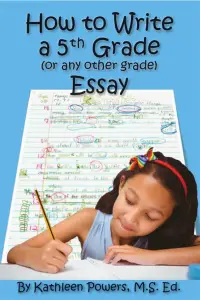
For more ideas on how to write, read my book How to Write a 5th Grade (or any other grade) Essay.  Or contact me for tutoring lessons.  I am now scheduling summer and fall classes.

15 tips for writing a good blog

That headline is one example of how to write a good blog.  Make your headline eye-catching and intriguing, so readers will check it out.  Starting with numbers attracts too.  Here are some more tips:

  • Use bullets when you list. Bullets help your readers’ eyes see your organization.  Not all blogs need bullets, but when you list, use them.  They add white space, making your writing more readable.
  • Add white space before and after paragraphs. White space makes writing look more readable.  The same information written in long paragraphs is less attractive than when it is written in short paragraphs.
  • Keep paragraphs short. Three or four sentences max.  Cut a longer paragraph into two or three.
  • Keep sentences short. If you use complex sentences (like this one), limit them to one dependent clause.  The more clauses, the harder to read.
  • Replace long words of Latin origin with one- or two-syllable words of Anglo-Saxon origin. Longer words are often abstract.  Shorter words are usually concrete and easier to understand.
  • Give each idea its own paragraph, even if that paragraph is short.
  • Use art. Photos, graphs, maps and cartoons attract.  They keep the reader engaged as they scroll down.
  • Stick to a format. You want to develop a recognizable style that you use in every blog.
  • Use subheads if you are writing paragraphs.
  • Use a sans serif typeface. Sans serif is quicker to read.
  • Use a big typeface—at least 12 point. It’s easier to read.
  • Avoid italics and ALL CAPS. People perceive italics as harder to read, so they don’t read them.  Words in capital letters seem to shout—not polite.
  • Use a plain light background. A graphic background cuts readability.
  • Keep your blogs short. Readers like to skim blogs.  Make yours skim-able.  Search engines pick up short blogs, too.

Use a cheat sheet to write better

Having a cheat sheet nearby when writing can, like a recipe, help students remember all the “ingredients” of good writing.  Here is a cheat sheet I recommend:

As the parent/teacher, you can reproduce this cheat sheet to be used as a check list each time a student writes.  You can go over the list together and compare the student’s writing to the check list.  Using such a list doesn’t guarantee great writing, but it guarantees improved writing for upper elementary grade, middle grade, and ESL students who are new to writing in English or are not confident about their skills.

2571 books banned in 2022, 40% more than in 2021

40% more books were challenged in the US in 2022 than in 2021, for a total of 2571 titles, according to the American Library Association (ALA).  Most of the challenged books have LGBTQIA themes or racial themes.

Here are titles and a brief description of the five most banned books plus whether they are available in my public library.  Most of them are.

Gender Queer, by Maia Kobabe.  This memoir told in the form of a graphic novel, traces Kobabe’s life as a nonbinary person.  In the past two years, Gender Queer has been banned more than any other book in the US.  According to the ALA, Gender Queer has been challenged for “LGBTQIA+ content, claimed to be sexually explicit.”  Not available at my public library.


All Boys Aren’t Blue, by George M. Johnson.  Another memoir, this one explores Johnson’s youth as a Black and queer person, including his sexual experiences.  According to the ALA, All Boys Aren’t Blue has been challenged for “LGBTQIA+ content, claimed to be sexually explicit.”  Available at my public library.


The Bluest Eye, by Toni Morrison.  Now more than 50 years old, this novel traces a Black girl who longs to have blue eyes.  According to the ALA, The Bluest Eye has been challenged for its “depiction of sexual abuse, EDI content, claimed to be sexually explicit.” Available at my public library.


Flamer, by Mike Curato.  This young adult graphic novel focuses on a 14-year-old Filipino boy at a Boy Scout camp where he accepts that he is gay.  According to the ALA, Flamer has been challenged for LGBTQIA+ content, claimed to be sexually explicit. Not available at my public library.


Looking For Alaska, by John Green, tied for fifth place.  This novel concerns a high school student in a boarding school who is captivated by a girl named Alaska.  According to the ALA, Looking for Alaska has been challenged for LGBTQIA+ content, claimed to be sexually explicit.  Available at my public library.


The Perks of Being a Wallflower, by Stephen Chbosky, tied for fifth place.  This novel, set in the 1990s, follows a shy high school freshman.  According to the ALA, The Perks of Being a Wallflower has been challenged for its depiction of sexual abuse, LGBTQIA+ content, drug use, profanity, claimed to be sexually explicit.  Available at my public library.


How many exclamation marks are enough?

Zero.  Or maybe one.  But zero is usually enough.

I hunted for exclamation marks in To Kill a Mockingbird, voted “America’s best-loved novel” in PBS’s Great American Read and winner of the Pulitzer Prize.  I reached page 15 before I found one, the only one in the first chapter.  “My stars, Dill!” said Jem.

In the first chapter of For Whom the Bell Tolls by Ernest Hemingway, I could not find a single exclamation mark.  In the first 20 pages of a book nominated unanimously for the Pulitzer Prize (though denied because the head of the Pulitzer board found the book offensive) and written by an author who eventually won the Nobel Prize for literature, not a single exclamation mark.

Let’s try one more, a biography this time, David McCullough’s John Adams, another winner of the Pulitzer Prize.  The text begins on page 17 of my edition, and the first exclamation mark I found is on page 28.  “Oh, that I was a soldier!” Adams wrote to his wife.

When might you use exclamation marks?  They are used to show strong reactions or commands.  But use them sparingly.  They show the subtlety of a sledge hammer.  And exclamation marks can make writing seem juvenile.

Don’t use exclamation marks adjacent to other sentence punctuation.  ?! is wrong.  .! is wrong.  ,! is wrong.  So is !!!!!  One exclamation is sufficient, or more likely, superfluous.

If you tend to write using exclamation marks, go back and delete half of them.  Then go back and delete half again.  For the remaining exclamation marks, justify using each one.  Try using stronger verbs rather than depending on exclamation marks for emphasis.