Category Archives: summarizing

5 steps to nail a two-sentence fiction summary

Is it possible to summarize a novel in two sentences?  Yes, and here’s how.

Identify the five elements below to create a two sentence synopsis. They elements are
  1. A Hero/protagonist—Who is the main character?  Don’t confuse narrator with main character.  Dr. Watson is the narrator, but Sherlock Holmes is the main character.
  2. A Situation the protagonist faces—What problem does the protagonist need to overcome?
  3. A Goal the protagonist needs to achieve—What would mean victory for the protagonist? Usually it means returning life to the way it was before the inciting incident of the story.
  4. A Villain opposing the protagonist’s goal—Who or what is blocking the hero?  If the villain is personified, all the better.
  5. A Disaster happening if the villain succeeds—What disaster will follow if the protagonist does not succeed and the villain thwarts the protagonist’s goal?

The first three elements are written as a one-sentence statement, and the second two are written as a one-sentence question.

Here are two examples from To Kill a Mockingbird accompanied by an explanation of how the five elements apply to that fictional story.  (I use Mockingbird as an example in my blog often because most American middle school students are required to read this novel.)

Example one: In a small town in Alabama in the 1930s (part of the situation), a girl (the protagonist) and her brother try to lure their reclusive neighbor into the open (another part of the situation and the goal).  But can they overcome his extreme shyness and his brother’s violent control (villains) or will he remain a prisoner of his brother forever (disaster)?

Example two: A small town attorney (protagonist) must convince (goal) an all-white jury in 1934 Alabama that a black man did not attack a white woman (situation).  Can the attorney overcome the racial prejudice of his neighbors and the testimony of the woman and her father (villains) to paccused (disaster)?

Some tips on how to write this kind of summary:

Follow the story arc during the first third of the novel to find the information to include.

Write concisely.  Rarely use names, dates, locations or other details.  They will muddle the summary and confuse the reader.

Focus on action.  Skip themes.

For more on this kind of writing, see Techniques of the Selling Writer by Dwight V. Swain.

How to summarize a work of fiction

First, read the short story, novel, play, poem or other form completely, from beginning to end.  If you don’t understand parts, get help.

Longer works of fiction are usually divided into chapters or acts.  To Kill a Mockingbird, for example, is divided into 31 chapters.  To summarize the whole book, summarize important actions in each chapter.  For example, in chapter 1 of Mockingbird, the narrator, Scout Finch, introduces readers to the setting:  her hometown, Macomb, Alabama, during the early 1930s.  She introduces her father, Atticus, an attorney; her older brother, Jem; and their friend, Dill.  She also introduces the children’s obsession with teasing their reclusive neighbor, Boo Radley.

Some chapters are more important than others, and those chapters should take up more space in a summary.  Less important chapter contents can be either omitted or lumped together with other chapters.  For example, many chapters in Mockingbird concern various ways the children tease Boo.  You don’t need to write a chapter summary of each prank.

A summary should be written in the same order as the book is written (usually in chronological order).  If the book is not strictly chronological, you can say that in a flashback, a particular action happens.  A summary should use words like exposition, inciting event, rising action, climax, falling action, and resolution to label parts of the story.  A summary should name the important characters and identify the way the main character changes.  If certain themes or moods are important (for example, racism or suspense), those should be identified as they appear.

A summary is not a conclusion.  You want to identify what happens to whom, and who grows or changes throughout the novel.  If the ending is a cliffhanger, you can say that, telling what the reader is left wondering.  Or if the ending leaves the reader wondering about a moral decision a character has made, you can say that.  But you can’t say that the ending is good or bad.

How long should a summary be?  For a book of 300 pages, it is possible to write a terse, two or three-sentence summary.  Take, for example, Romeo and Juliet.  “After Romeo and Juliet fall in love and secretly marry, violence breaks out in Verona, and Romeo is forced to flee; distraught, Juliet takes a potion leading to a deep sleep.  Romeo thinks she is dead, and kills himself.  Juliet awakens, finds Romeo dead, and kills herself.”  Most summaries are not this short, but summary means a short version with unimportant details and characters left out.  If you are writing for a school assignment, your teacher will tell you how long your summary should be.

A play can be summarized by summarizing each act or each scene.  For example, Act One of Romeo and Juliet can be summarized as “Romeo and Juliet meet and immediately fall in love.” If each of the five acts were summarized this way, the whole play could be summarized in one paragraph.  Or each scene can be summarized, leading to a more complete summary.  The first of the five scenes in Act One could be summarized as “In Verona, Italy, in the 1500s, two wealthy families and their servants continue an age-old feud.  They are threatened with death by the authorities if they continue.  Romeo, the son of one family, has just broken up with his girlfriend, and he is depressed.  His cousin, Benvolio, encourages him to date other girls.”  With 24 scenes, a summary of each scene might lead to a two-page summary.

A short story summary summarizes each scene, or if the story is really short, each paragraph.  In fiction, something happens to someone causing that someone to change.  What happens to whom and how that person changes should be the heart of any summary.


Two kinds of citation errors:  not citing paraphrases and summaries, and using the wrong punctuation

Students make several kinds of errors when using citations in their research papers.

One error is thinking that only direct quotations need to be cited.  Not so.  Direct quotations, paraphrases and summaries all need to be cited.

  • A direct quote is a reproduction of the precise words of a speaker or document. Shorter direct quotes of a phrase or a sentence are preferred to longer direct quotes of several sentences.  Direct quotes are used when the original words are iconic (Lincoln’s “of the people, by the people, and for the people”) and when the original words have a stronger impact than a paraphrase (Churchill’s “We shall never surrender.”)
  • A paraphrase is a “translation” of a direct quote into synonyms using different sentence structure from the original direct quotation. A paraphrase “translates” only a small portion of a speaker’s words or of a document.  Paraphrases are used to make difficult ideas easier to understand or to simplify long, complex thoughts.  Many teachers today prefer paraphrasing to quoting directly.
  • A summary is a straightforward repetition of the main ideas of a speaker or document. A summary presents longer amounts of information than a paraphrase and usually follows the same idea order as the original.

Direct quotations, paraphrases and summaries all need to be cited.  If the original source of  material you are using in your essay or research paper is not you, you need to give that source credit.  Not to do so is plagiarism, which I will discuss in a future blog.

Another error—the most common error—is to use improper punctuation in your essay or research paper.  In the United States, three commonly used documentation “styles” of citing information are the MLA, the APA, and the Chicago Manual (sometimes known as the Turabian).  If you are not familiar with “styles,” ask your teacher to explain the one you need to use.  You can find information online as well.  The MLA style is used in English courses and  in other language courses.  The APA style is used in the social sciences.  The Chicago style is used in history, social sciences and humanities courses.

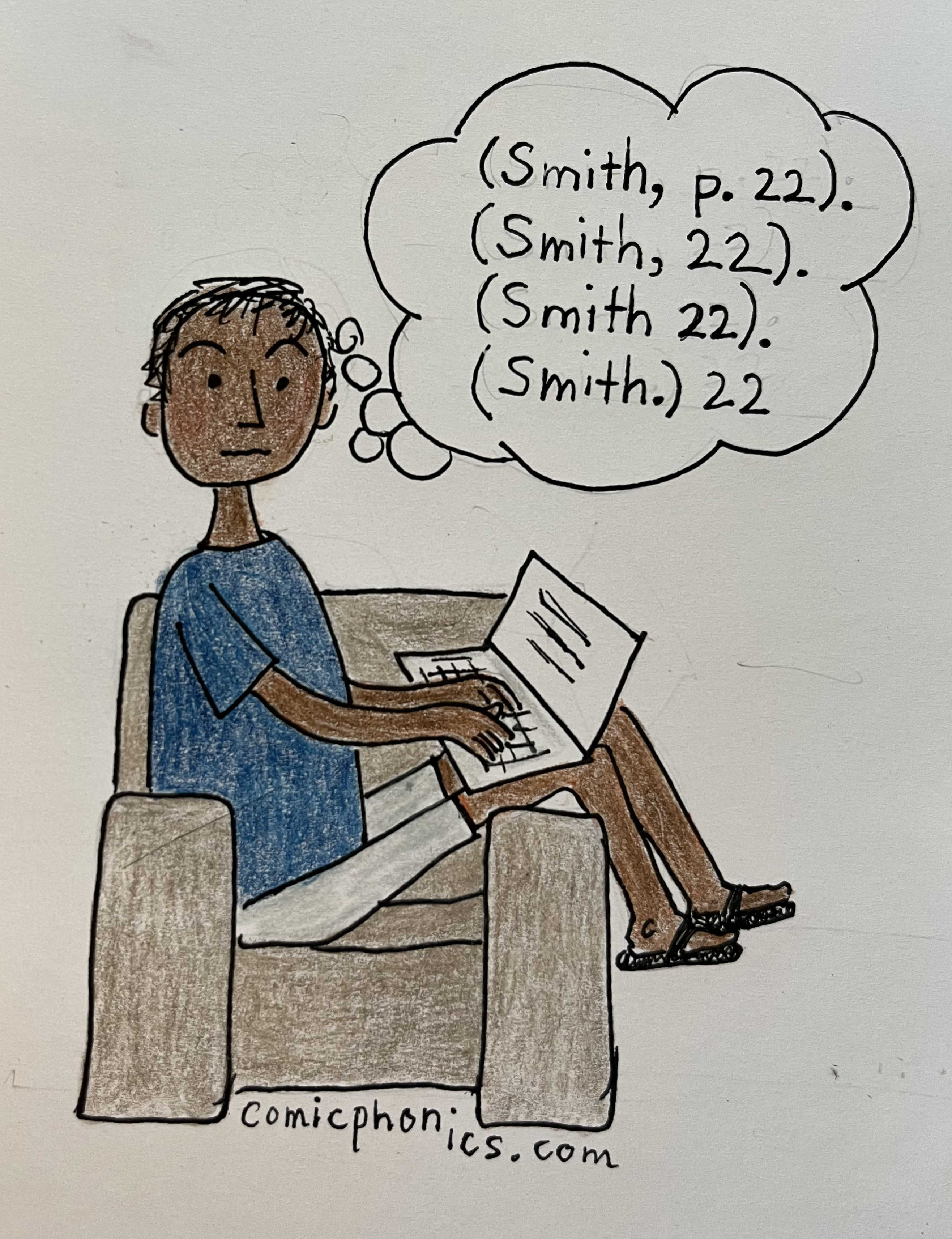
Whole books are written on each of these styles, so I will not attempt to explain them here.  But let me take one example so you know what I am talking about.  Suppose you quote the author of a book in the text of your paper.  How do you show that citation?  For the MLA style, immediately after the quotation, you key an introductory parentheses, the author’s surname, the page number from which the quote came, an ending parentheses, and a period to end the sentence (Smith 368).  For the APA style, after the quotation you key an introductory parentheses, the author’s surname, a comma, then the year the quotation was made, an ending parentheses, and a period if you are ending a sentence (Smith, 2007).  For the Chicago style, a numeral 1 is placed after the quote, and a footnote is written in a footnotes section of the paper to identify complete information about the quote’s source.

You may think, you gotta be kidding!  No.  As you go through middle grades, high school and certainly college, you need to become familiar with various styles and to use them correctly.  Fortunately, online sources exist where you can input your source’s information and the website will order and punctuate the information correctly.  Swipe, copy, and paste into your paper.

What is a rhetorical précis?

A précis is a highly structured summary of a text, focusing on the text’s argument and presentation.  It is a type of academic writing presenting factual information only, without opinions of the précis writer.

One way of organizing a précis is to write a four-sentence summary:

The opening sentence names the text, its author, genre and publication date followed by a clause naming the thesis of the work.

The second sentence explains how the author develops the thesis, with information usually presented in the same order as in the original text.

The third sentence explains why the text was written, often followed by an “in order to” phrase.

The fourth sentence either describes the intended audience or the tone of the text.

Let’s look at a précis I wrote about the Declaration of Independence:

In the Declaration of Independence (July 1776), Thomas Jefferson argues that because King George III usurped the liberties of British citizens in the North American colonies, those citizens were declaring their independence from Britain.  Jefferson divides the Declaration into four parts:  the preamble, a short paragraph explaining that the world has a right to know why the colonies are separating; second, the most quoted part, the philosophical justification for the separation; third, the longest section, the list of grievances against King George III; and fourth, another short paragraph declaring independence.  Jefferson’s purpose was to present a logical and legally sound justification for the separation in order to gain the support of all 13 colonies and of potential international allies.  The author’s tone is formal as befits the seriousness of the purpose.

Why are students asked to write a précis?  A précis demands summarizing, analyzing and culling a text into a concise format, eliminating opinion.  Writing a good précis proves whether a student understands a text and whether a student can write.

SAT essay: Should you write a separate summary or weave it together with the persuasive techniques?

Should you separate the summary from the analysis when you write your SAT essay?

I recommend you separate your summary and analysis.  Here’s why:  it’s easier.

You want to be sure to include a complete summary in your response as well as a complete analysis of the persuasive techniques used in the prompt.  If you write the summary as a separate paragraph, you are sure you have supplied a complete summary.  If you weave the summary and analysis together, you might leave part of your summary unsaid.

Weaving all the elements into your response in an integrated way might be possible.  But more likely, your summary or your analysis will suffer.  It will be clearer to you as you write that you are covering what you need to if you isolate the two important elements, the summary and the analysis.

Weaving everything together is a more elegant way to write, but it is also a more difficult way to write.  The exam is stressful enough without adding another layer of difficulty.  Unless you have received perfect scores on AP lang or AP lit, I would not attempt it.

There is not one perfect way of writing your response.  Rather, there are several good ways.  Focus your time on the analysis part of your response; that is the part whose score is usually lowest.  Focusing on that part of the essay can improve your score the most.