Category Archives: revising first drafts

How to edit an essay

Because my students’ first drafts are so messy, I sometimes ask them to rewrite them during the revising stage. Many students make clean drafts without my encouragement since they have no room left for changes or since they can hardly decipher their changes any more.

I have learned that when students try to edit using a sloppy, revised draft with cross-outs and insertions, they miss errors.  Even though they have skipped lines to leave room for changes, and have left margins so there is room for insertions, sometimes they need to write a clean draft or type and print  a clean draft for editing purposes.

student essay to be edited

This portion of a fifth grade student essay has been revised but is difficult to edit because of all the cross-outs, circles and insertions. A clean draft would help the student to edit well.

Once they have a clean almost-final draft, students edit. They read every word of their essays, looking for errors such as in spelling, capitalization, verb tenses, plurals, parallel structure, subject-verb agreement, pronoun antecedent agreement, possessive nouns, its and it’s; they’re, there, and their; to, two, and too; and punctuation. Students who overuse certain words (and, then, so, and just, for example) hunt for them and either eliminate them or replace them.

One trick I learned long ago when I was a copy editor is to read each sentence out of order, starting with the last sentence and ending with the first sentence. By listening to sentences out of order, mistakes are easier to hear. My students think this technique is silly until they try it, but then they realize its usefulness. Usually I wait until a student is in middle school to suggest this editing technique.

As students edit, I try to read along with them, to suggest grammar and usage problems they might not suspect. At this point I sometimes teach a grammar lesson on the particular problem the student has encountered, especially if this problem is recurring.

When the student finishes editing his final hand-written copy, the student or I type this draft on the computer, leaving any remaining errors as they are. At our next meeting, the student edits for a second time, usually finding a handful of errors he missed during the first edit. (It’s so much easier to find errors when the writing is printed rather than hand-written.) Sometimes the student will make significant changes at this point, but not usually. Since I am aware of what the errors are, I point out errors that the student has not found.

Next we’ll talk about the value of typing and printing a final version of a student’s essay.

A revised first draft showing cross outs, arrows, circles and erasures means the student has truly improved the essay

Every professional writer knows that the real work of writing happens during revision. But this is an idea that students—and parents—need to learn. If a student says she has finished revising and her copy seems little altered, then she has probably not done a good job at revision.

On the other hand, if a student looks at her copy, noticing cross outs, arrows to side margins or to the back of the paper, words squeezed in, circles to identify verbs and first words of sentences and perhaps even sections cut apart and taped together in a different order, the student has truly revised.

Below is an example of the first page of a fourth grader’s messy but revised essay.

draft showing revisions 001

Revising is not editing. Revising means making substantial changes in the writing in order to improve it. Editing means looking for finer details such as correct spelling, apostrophes in the right spaces, and hyphens used appropriately. Unfortunately, in many school classrooms, students don’t learn to revise; they learn to edit.

Parents can be dismayed if they see the writing of my students while revising is in progress. Parents expect me to make the student edit too early on in the writing process. “Shouldn’t he change the spelling now?” a parent might ask, looking over his child’s shoulder.

When I work with children of parents like this, I show them examples of other students’ work, including the final draft. I let them see that the tiny errors will be corrected eventually. Usually this suffices until they see their own child’s finished work. Then they are sold on this writing process.

Perfectionist students might never reach the stage of good revising unless they learn to tolerate a degree of mess. I worked with one student who needed to start over so many times that she never completed a single essay. I have worked with other perfectionists who learned that the mess increases their chances of a higher grade, and so they set their sights on the perfect grade and begrudgingly accepted the interim mess.

Next we will talk about flow and how to make it happen.

Identify the range of the sentence lengths to increase the variety of sentence lengths and reader interest

The range of sentences means the sentence with the largest number of words minus the sentence with the smallest number of words. That number is the range.

Knowing this number can be useful.

• If the range is in the single digits, that means most of the sentences in a piece of writing are about the same length. The reader will find the writing boring, though the reader might not know why.

• If the range is in the high teens or twenties, that means there are some longer sentences and some shorter sentences. This range shows the writer has used a variety of sentence lengths. The reader will find this kind of writing interesting, though again, the reader might not know why.

Most students need to increase the range of their writing. To do that, students need to be aware of sentence range and to force themselves to write sentences of varying lengths.

When elementary school-aged children write, most of their sentences are ten words or less unless they are writing a sentence that includes a series or they are compounding sentences. So the range for such children usually is a low number—maybe nine or less. Older students write longer sentences, but again, usually their range is a low number—maybe twelve. Experienced writers might have a range in the twenties. But in order to get such a high range, writers must have a sentence with 26, 27, or 28 words, and another sentence with just a handful of words.

Notice the following introduction to an essay written by a fifth grader:

Have you ever played Monopoly? If you have,
then you know all about it. If you have not,
then let me describe Monopoly to you.

The first sentence has 5 words, the second sentence has 9 words, and the third sentence has 11 words. 11 minus 5 gives a range of 6. If the rest of the sentences in this essay are about 5 to 10 words long, the range would be small and the essay would be stylistically unappealing.

Compare that to the beginning of a narrative written by a rising second grader:

Once when I woke up I found a baby unicorn in
my tiny bed. It looked as tall as me with a tail
and wings, a purple and pink horn, and a white
and yellow body. Right away I jumped on the
unicorn and flew to a castle that is made out of
glass. She said I owned the castle.

The first sentence has 14 words; the second has 22 words; the third has 18 words; and the fourth has 6 words. 22 minus 6 gives a range of 16, an excellent range for such a young writer. Notice also that all four sentences vary in length by 4 words or more. Analyzing only sentence lengths, the second selection is stylistically more interesting than the first.

By combining sentences or adding more detail, students usually bump up the number of words per sentence. For some students, increasing the number of words per sentence and eliminating all short sentences can become an obsession. This is a mistake. Including short sentences is essential to good writing.

Did you notice in the last paragraph that a nineteen-word sentence was followed by a four word sentence? Often, a really short sentence after a long sentence can add style to writing. Students need to see examples of this kind of writing to know that it is not only okay, but desirable. Below is an example of a 36-word sentence followed by a 9-word sentence (a range of 27) from Because of Winn-Dixie by Kate DiCamillo.

Me and Winn-Dixie got into a daily routine
where we would leave the trailer early in
the morning and get down to Gertrude’s
Pets in time to hear Otis play his guitar
music for the animals. Sometimes Sweetie
Pie snuck in for the concert, too.

When a student uses dialog, the number of words per sentence plummets since most characters, like most real people, speak in short sentences, phrases or single words. Dialog should sound natural. But students fixated on the number of words per sentence might want to eliminate dialog in order to maintain a high number of words per sentence. Again, this is a mistake. To counter this tendency, when I ask students to calculate the number of words per sentence, I allow them to eliminate any sentence with dialog in them. On the other hand, when students calculate the range, they should include short sentences with dialog.

In the next blog we will talk about the mess all this revising creates in a student’s draft.

Use dialog to begin sentences and paragraphs in order to add variety and life to writing

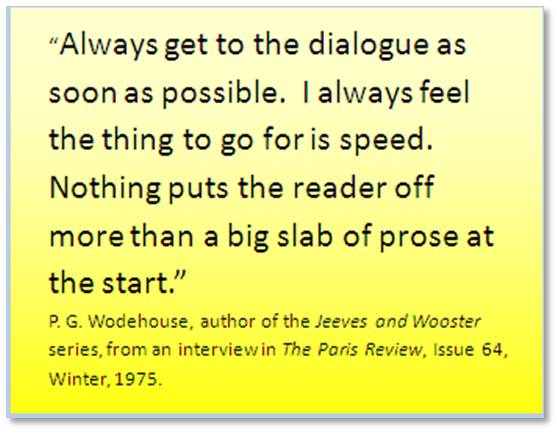
Author's Quote on adding dialogueHave you ever turned the page of a novel and come to long paragraphs of description or exposition?  And then the corner of your eye sees far down the next page a section of dialog?  What do you do?  Do you read the long paragraphs or do you jump to the dialog with its short sentences and friendly white space?

If you are like most people, you beeline to the dialog.

Dialog makes writing sparkle.  Once I read a novel in which there was no dialog, none whatsoever.  Over and over I wanted to quit.  This novel taught me the power of dialog in writing.

Children read chapter books like Junie B. Jones that are full of dialog, but children rarely think of adding dialog themselves.  However, once they add dialog they keep adding it, and their writing improves tremendously.

Why?  One of the easiest ways to get personality into writing is to introduce a character—even if it is the writer herself—whose unique way of thinking and saying attracts readers.  Charles Dickens was a master of this.  But so are some of my students.

dialog example

Notice how a third grade student uses dialog to show his personality and to hook the reader.

Adding dialog is like adding powerful verbs.  It has the same effect.

Sometimes when I read a student’s writing, I suggest, “This would be a good place for dialog.”  Often the student has people talking anyway, but using indirect speech.  I show the student how to turn the speech into direct quotes, and how to start a new paragraph when a different person speaks.

Dialog can also be a great hook in the introduction of an essay, providing that the person speaking says something worth hearing.

One caveat:  Sometimes, once students learn the power of dialog, they want to write only dialog, leaving out any sense of setting or nonverbal action.  In these cases the writing is confusing.  Help the student to see that some description of place, time and the emotional reactions of the people talking and listening are important for a well-rounded essay.

Next we’ll look at sentence types and how they impact writing.

Start revising by reading the essay aloud

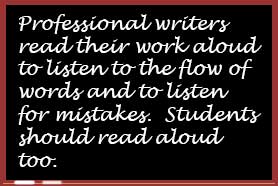
Professionals writers read their writing aloud.When I ask students to read their essays aloud for the first time, and to listen for mistakes, they often feel foolish and skip this step.  Then I ask them to read the essay aloud to me, and whoa!  Mistake after mistake becomes apparent.

When we read with our eyes, we read what we want to be there, not noticing some mistakes which are obvious when we read aloud.  I haven’t taught a student yet who hasn’t found mistakes when reading his essay aloud.  I instruct the student to read only the words that are there.  When they do, they stop when something sounds funny.  Usually it’s a grammar mistake.

But there are all kinds of errors that a student can find when reading his work aloud.

  • Is something missing—a word, a word ending, a sentence? Is a whole idea missing?  If so, add the missing parts now.
  • Is a word or an idea duplicated needlessly? Sometimes a student will write the word “the” at the end of a line and then write the word “the” at the beginning of the next line.  Cross one of the words out.  Or a student repeats phrases from one sentence to the next, such as, “ Let me tell you about my brother.  My brother. . .”  Those two sentences can be easily combined to eliminate the duplication.
  • Are ideas out of order? Whole paragraphs can be numbered to rearrange them.  Sentences can be circled and marked with arrows to move somewhere else.  Words can be transposed.
  • Is a sentence unclear, or even if it is clear, could it be said with fewer words?
  • Are ideas incomplete? Complete them in the margins or on the back of the paper.
  • Every subtopic sentence should support the main idea of the essay. This is the time to check to see that it does.  If a subtopic sentence is off-topic, does it belong in this essay?  Students are dismayed to X out a whole paragraph, but sometimes that is necessary to stick to the one main idea.
  • Are certain words overused? Such words might be “then,” “just,” “so,” “really,” “like” and “because.”  If they are overused, eliminate most of them.

In our next blog we will look at revising verbs, the most important words in writing.