Category Archives: English Writing Instruction

Writing well takes study and practice.

Why use simple sentences?

In English, we have three types of sentences: simple, compound and complex. Each trumps in particular situations.

A simple sentence is one containing one independent clause (one complete subject and one complete predicate). Almost an infinite variety of simple sentences can be formed, making them the bedrock of modern-day English.

Simple sentences can be just one word (Run!). They can be two or three words (The dog barked. He did?) They can have compound subjects (Jack and Jill went up a hill) or compound predicates (Marie plays softball and swims). They can start with prepositional phrases (On my bike I rode to Grandma’s), gerund phrases (Munching carrots is a healthy snack) or adjectives (Big snakes scare me). They can end with adverbs (I practice the piano daily), infinitive phrases (That’s a good place to fish) or verbs (Will you go?). They can be declarative (I see), interrogative (Would you buy me one too?) and exclamatory (I won the spelling bee!).

Why use simple sentences in your writing?

  • Simple sentences can express ideas clearly. ( “We the People of the United States, in Order to form a more perfect Union, establish Justice, insure domestic Tranquility, provide for the common defence, promote the general Welfare, and secure the Blessings of Liberty to ourselves and our Posterity, do ordain and establish this Constitution for the United States of America.”
  • Short, simple sentences can add punch after a long-winded sentence. (“Let every nation know, whether it wishes us well or ill, that we shall pay any price, bear any burden, meet any hardship, support any friend, oppose any foe, to assure the survival and the success of liberty. This much we pledge — and more.”)
  • Simple sentences can seem honest and to the point. (“Jesus wept.”)
  • Simple sentences can mimic uncomplicated and unadorned thought patterns. (I wasn’t sure what to do. It was so dark. The baby was sobbing. I needed help. So I phoned you.)
  • Simple sentences can be expanded by modifying subjects, verbs and objects with adjectives, adverbs, prepositional phrases, gerund phrases, infinitive phrases.
  • Simple sentences can seem more informal than complex sentences yet more sophisticated than certain types of compound sentences. (“All this will not be finished in the first one hundred days. Nor will it be finished in the first one thousand days; nor in the life of this Administration; nor even perhaps in our lifetime on this planet. But let us begin.”)

As little children learning to write, we start with simple sentences. Then teachers introduce compound and complex sentences, encouraging students to use those kinds. Yet some great writers have built their careers on writing simple sentences—Ernest Hemingway, for example.

(To show their versatility, I wrote every sentence in this blog as a simple sentence. Did you notice?)

How many kinds of prewriting organizers does a student need to use?

Some students to whom I have tutored writing tell me their teachers suggest a different kind of prewriting organizer for every kind of essay essay.

That’s ridiculous.

Most children can rely on three types of prewriting organizers for the kind of writing they are expected to do in elementary and middle school.

This is a graphic representation of a third grade student's handwritten mind web.A mind web (sometimes called a spider web) works great for most expository and persuasive essays. The topic goes in the middle of the notebook paper, and, like spokes of a wheel, two, three or four spokes go out to subtopics. Each subtopic is further subdivided into many more details.

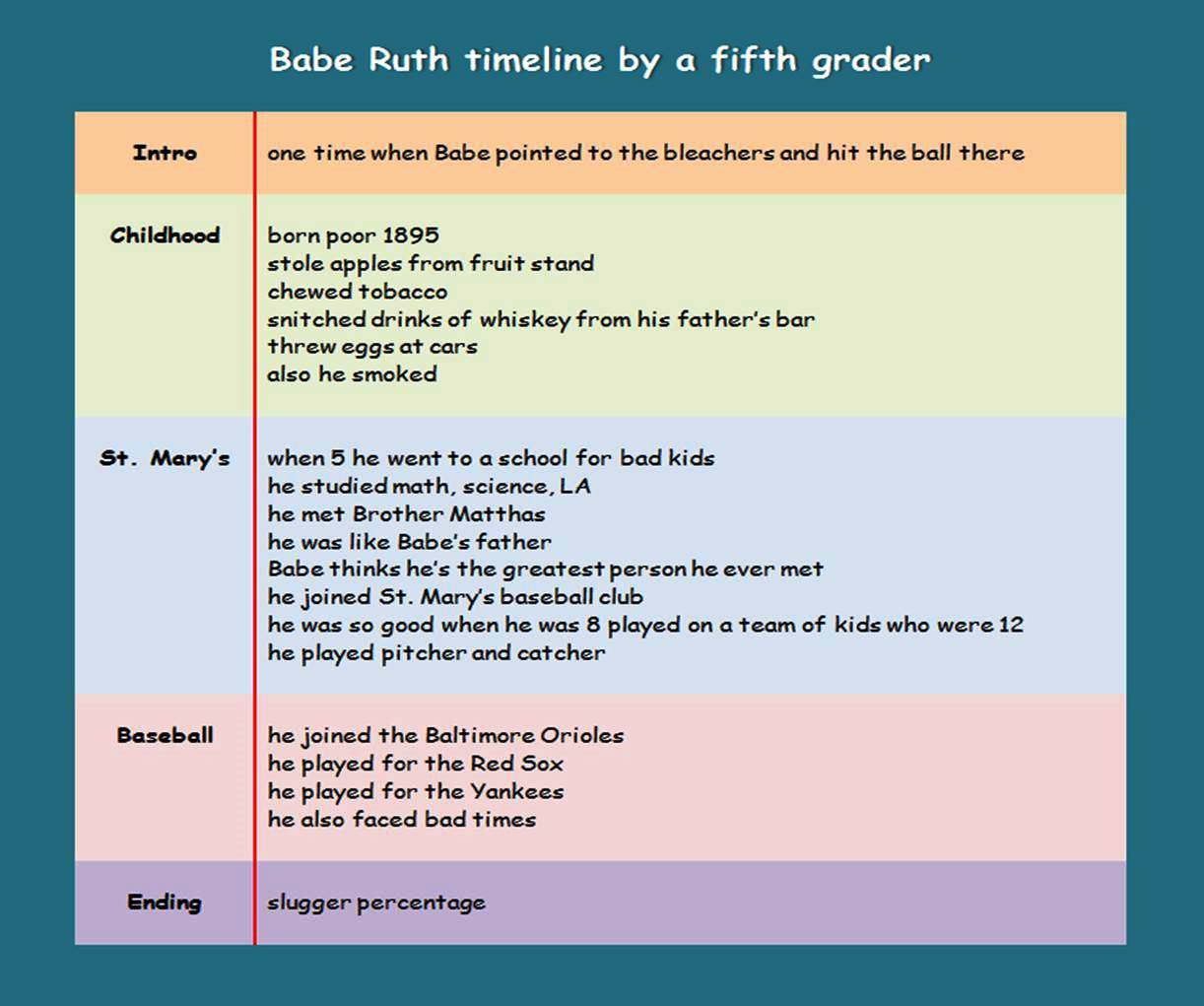
An example of a modified timeline organizer on Babe Ruth's life--childhood, school years, and baseball career.A modified timeline works great for most narratives. At the top left of a notebook page goes the word “beginning.” Branching off from it are the words “setting” (divided into “time” and “place”), “characters,” “problem to be solved,” and “how it begins.” A little farther down the page on the left is the word “middle” and next to it and covering most of the page is a sequence of actions (the plot). At the bottom are the words “climax” and “resolution” where are listed the high point of the drama and how the story ends.

Use a chart for comparison and contrast essays.For comparison or contrast essays, either a chart with three or four vertical sections or a Venn diagram works well. I prefer the chart because the overlapping section of a Venn diagram is often too small (the way children draw it) to allow much detail to be written there. But either can work.

For reluctant writers or for young writers I break this rule of three and use as many kinds of prewriting organizers that encourage the child to write. One time I taught a third-grader who was going through a transformer phase. Each week I would draw the outline of a different transformer which he delighted in filling in with details of his planned paragraph.

As a professional writer and tutor who knows a lot about writing, I face the problem of contradicting a teacher who seems to know little about writing. (I have a masters degree in middle grades education and for that degree I was not required to take a single course in how to teach writing. Many grade level teachers haven’t taken a how-to-teach-writing course either.) If a teacher is suggesting a different type of prewriting organizer for every writing situation, the child can becme overwhelmed in remembering what kind to use in what situation. I suggest that he follow his teacher’s instructions when he is writing a school essay, but when he is with me, I suggest he rely on just three choices: the mind web, the modified time line and either the chart or Venn diagram.

I have paged through various writing workbooks meant for children and find numerous prewriting organizer styles when only three are needed. Why would a workbook publisher suggest so many? The reason is simple: to make money. The publisher thinks unsuspecting parents will decide knowing many kinds of prewriting organizers is necessary.

The fewer choices there are to remember, the more likely a student will remember and will use those choices. Stick to three prewriting organizers—a mind web, a modified time line and either a chart or Venn diagram.

Use the word “said” instead of one of its many synonyms

Using the most specific vocabulary word usually is good advice in writing, but there is one exception: the word “said.”

Told, stated, remarked, revealed, whispered, shouted, spoke—the list of substitutes is practically endless. But most of the time, “said” is the best option.

When you write, “He said,” you are informing that a person spoke, but you are not informing how he spoke, so the focus goes on the words he said aloud. In the sentence, “Jack said, ‘I am soaking wet from that rain,’” the focus is on what Jack said aloud, as it should be. In the sentence, “Jack hollered, ‘I am soaking wet from that rain,’” the focus is split. Part of the focus is on what words Jack said aloud, and part is on his manner of speech—a holler.

We are so used to reading the word “said” that it virtually disappears, much like the article, “a.” That is what we want. We need to let our readers know who is speaking, but usually the manner of speech is not important. By using any word other than “said,” attention is drawn away from what is said to how it is said, which we don’t want.

A good rule of thumb is to use “said” if you want your reader to focus on the words which were said aloud. However, if you want your reader to focus on the manner of speaking, then use another word. But do so sparingly.  Click on the listing (graphic) below for a larger version.

synonyms for said

Synonyms for the word “said” as compiled by http://www.synonyms-antonyms.com

Avoid using adverbs for better writing

When we are in elementary school, teachers tell us to use adverbs. When we reach high school, teachers tell us not to use adverbs. What’s going on?

First of all, what are adverbs? Adverbs are parts of speech which describe verbs, adjectives, adverbs and whole clauses. Most of them end in –ly, such as quickly, obediently and awfully. (But not every –ly word is an adverb.) The most commonly used adverbs do not end in –ly and include words like not, seldom, never, today, very, more and less.The –ly adverbs are considered weak words by many writers because they tell, not show. For example,

  • Weak: The toddler walked quietly to bed.
  • Stronger: The toddler tiptoed to bed.
  • Weak: That baby is very tired.
  • Stronger: That baby could hibernate all winter.
  • Weak: The awfully pretty child looked at us flirtatiously.
  • Stronger: The dainty child beguiled us with her smile.

In each of these three examples, a weak adverb is replaced by a stronger, specific verb or adjective.

Another reason writing teachers say to avoid adverbs is because using them weakens ideas. The word “very” is a good example. In almost every sentence you can think of, when “very” is used as an adverb, the idea becomes weaker.

  • It’s very chilly out.
  • It’s freezing out.
  • That cake is very tasty.
  • That cake tastes delicious.
  • Rex is a very well-behaved dog.
  • Rex behaves well.

Some adverbs state the obvious. “The boy fell down.” Can a boy fall up? “Grandma hollered loudly.” Can Grandma holler softly?

We need some adverbs. We don’t have negative versions of most verbs, so the word “not” is the way to make most verbs negative. “Yesterday,” “today,” and “tomorrow” provide crucial time information, as does “now” and “then.”  When we are organizing an essay, sometimes it makes good sense to start paragraphs with words like “first,” “next,” and “finally.”

As a general rule of thumb, adverbs which end in –ly are less organic to writing and should be eliminated or rewritten with stronger verbs. Adverbs which don’t end in –ly are harder to dismiss and might be essential to good writing.

Use active verbs, not passive verbs, to improve your writing

What are active verbs? In a sentence with an active verb, the subject does the verb.

  • “The cat licked her paw.” In this sentence, the cat is the subject, and it is doing the licking.
  • “Lee ate a sandwich.” In this sentence, Lee is the subject, and Lee is doing the eating.
  • “The red car crashed into the blue car.” In this sentence, the red car is the subject, and it did the crashing.

What are passive verbs? In a sentence with a passive verb, the subject does not do the verb. In fact, we may not know who does the verb.

  • “I was followed home by a dirty dog.” In this sentence, I is the subject, but I does not do the following.
  • “By that time, the contract had been accepted.” In this sentence, the contract did not do the accepting. We don’t know who did the accepting.
  • “Homework was assigned by every teacher.” In this sentence, the homework did not do the assigning.

What are the advantages of active verbs?

  • Clarity—Active verbs make your writing easily understood the first time.
  • Brevity—Using active verbs is almost always the most concise way to write.
  • Action—Your writing zips along when you use active verbs.

Then, why do we have passive verbs?

  • To mask the doer of an action. Sometimes we don’t want to say who did the action of the verb because it might be more diplomatic not to identify who did the action. Or we might not know who did the action. For example, you could say, “Explosions were set off at the port.”
  • To obfuscate. Sometimes a writer deliberately wants to keep the reader confused or unsure.
  • To slow down the action in a narrative.

Henry James is a 19th century American novelist who wrote in the passive voice and often used the verb “to be.” Many readers find his writing ponderous because of its long sentences and lack of action. His writing demands that you reread a sentence to understand it. This kind of writing seems quaint and tedious to 21st century readers who want James to get to the point. But maybe the people he wrote for had leisure to appreciate a slower pace in fiction.