Category Archives: English Writing Instruction

Writing well takes study and practice.

Use active verbs, not passive verbs, to improve your writing

What are active verbs? In a sentence with an active verb, the subject does the verb.

  • “The cat licked her paw.” In this sentence, the cat is the subject, and it is doing the licking.
  • “Lee ate a sandwich.” In this sentence, Lee is the subject, and Lee is doing the eating.
  • “The red car crashed into the blue car.” In this sentence, the red car is the subject, and it did the crashing.

What are passive verbs? In a sentence with a passive verb, the subject does not do the verb. In fact, we may not know who does the verb.

  • “I was followed home by a dirty dog.” In this sentence, I is the subject, but I does not do the following.
  • “By that time, the contract had been accepted.” In this sentence, the contract did not do the accepting. We don’t know who did the accepting.
  • “Homework was assigned by every teacher.” In this sentence, the homework did not do the assigning.

What are the advantages of active verbs?

  • Clarity—Active verbs make your writing easily understood the first time.
  • Brevity—Using active verbs is almost always the most concise way to write.
  • Action—Your writing zips along when you use active verbs.

Then, why do we have passive verbs?

  • To mask the doer of an action. Sometimes we don’t want to say who did the action of the verb because it might be more diplomatic not to identify who did the action. Or we might not know who did the action. For example, you could say, “Explosions were set off at the port.”
  • To obfuscate. Sometimes a writer deliberately wants to keep the reader confused or unsure.
  • To slow down the action in a narrative.

Henry James is a 19th century American novelist who wrote in the passive voice and often used the verb “to be.” Many readers find his writing ponderous because of its long sentences and lack of action. His writing demands that you reread a sentence to understand it. This kind of writing seems quaint and tedious to 21st century readers who want James to get to the point. But maybe the people he wrote for had leisure to appreciate a slower pace in fiction.

How to write well, according to Swain

If you could boil down how to write well into just a few ideas, what would they be?

How about

  • Choose vivid, specific words, words that excite our senses. Avoid generalities by using concrete words that create pictures in the readers’ minds. If you write about groups of people, focus on an individual.
  • Choose active verbs, verbs that put action into those vivid pictures. Avoid the verb “to be.” Use the simple past tense whenever you can, not past progressive or the perfect tenses.
  • Rarely use adverbs. Instead, through action show what the adverb suggests.  If you must use an adverb, put it at the beginning or end of the sentence for the most impact.
  • Vary your sentence structures. Use long sentences, short sentences; simple, compound and complex sentences; sentences that start with prepositional phrases, dependent clauses and gerunds; and sentences that aren’t sentences at all.
  • Don’t try to cram too much information into a single sentence.
  • If you repeat words, repeat enough times and close enough together so those words create impact.
  • Concise is better than verbose.
  • And most important of all, write clearly. The reader should “get it” the first read.

These suggestions come from a single chapter in Techniques of the Selling Writer by Dwight V. Swain, 1965.

Publishing student essays is essential

Most writing that a student does is seen by two people only—himself and his teacher. Sometimes the writing goes home and parents see it. But rarely do fellow students or friends see student writing. Rarely is there a real world audience.

Professional writers write for an audience. It may be tightly focused—a blog for race car enthusiasts—or it might be more widespread—Reader’s Digest readers. For students to do their best—for them to want to produce the best writing possible—publishing is essential.

EPSON MFP imageWhat is considered publishing for a student?

  • Hanging a finished essay on the refrigerator at home.
  • Photocopying the finished essay and mailing it to Grandma.
  • Scanning the finished essay into the computer and emailing it to aunts and uncles or former teachers.
  • Using the finished essay as Mom’s screen saver.
  • Putting a finished copy in a three-ring binder in a classroom or tutoring center for other students and parents to read.
  • Putting the finished essay online in a student blog or teacher’s blog of student writing.
  • Putting it online in a “great essays” section of a teacher’s classroom work.
  • Entering it in writing in contests.

Publishing matters. Professional writers don’t write for a grade. They write to be read. Too few students have this opportunity. But when they do, it motivates them to write better. At a tutoring center where I teach writing, students crowd around the binder bursting with finished student work. They mention what they have read to each other, or sometimes they try their own hand at the same kind of writing as their friend has written. I point this out to the students whose work has inspired other students, and they grin ear to ear.

Parents, too, read the writing of students. They look for students in the same grade as their child to see what other children of that age are writing. They read with pride their child’s work among other children’s work. They also read for the sheer pleasure of reading good writing.

Printed essays make students feel like professional writers

Rarely do students see their own writing printed unless they type it up themselves. That is why I type and print final drafts for them. They compare their handwritten drafts to the printed drafts in wonder.

This is the moment when they realize they are writers.

Smile, page 1, written draft 001

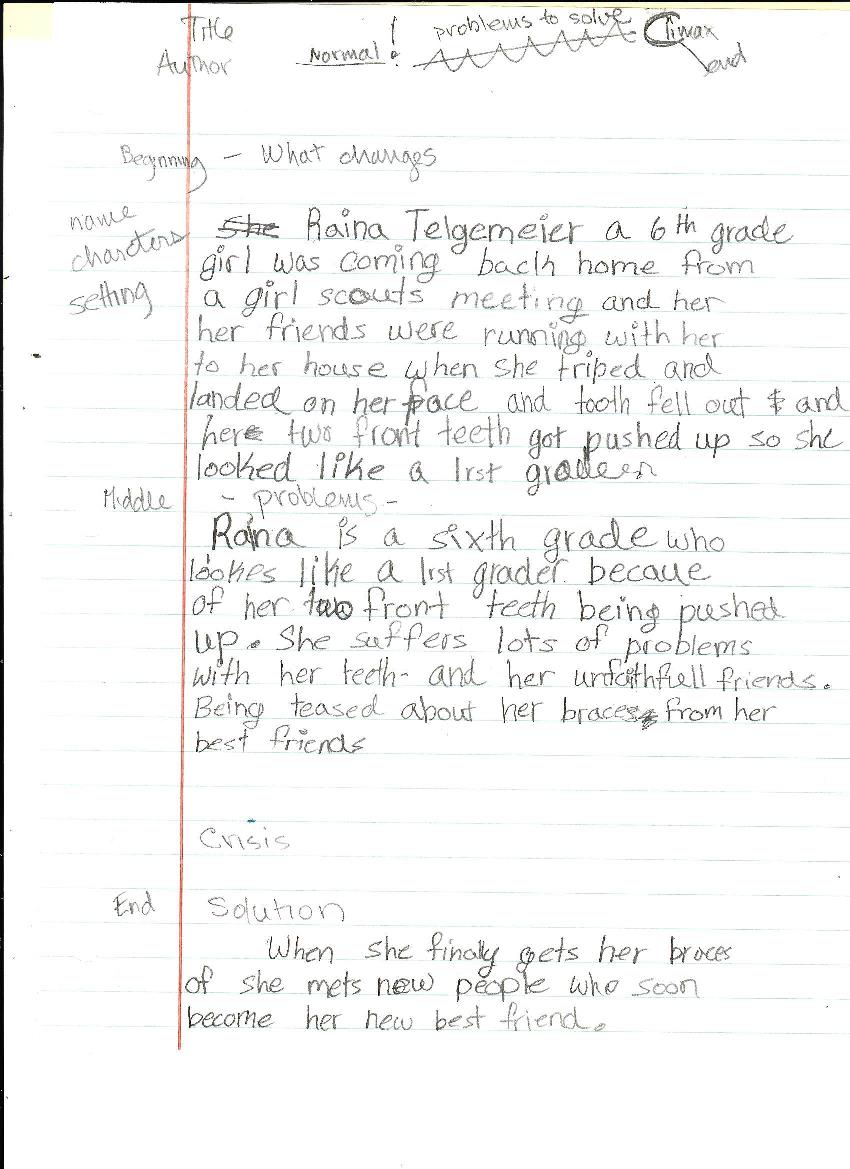
Above is a prewriting organizer in the form of a time line which a sixth grader used to write about events in a book she read. What follows are the two-page revised first draft and finally, the typed draft.


Smile, page 2 001

Handwritten revised draft of student essay

Handwritten revised draft of a student’s essay

Typed version of student's essay

Typed version of a student’s essay

When I type student essays on my computer, I print two final versions. One is for the student to take home, attached to the earlier, revised drafts, the list of verbs, the math showing the number of words per sentence and the range, and the mind web or other prewriting organizer. This package of papers shows a paper trail from the development of ideas through revision and the final draft. Parents can look over the changes the student has made to his essay and discover what the student already knows—that writing is a step-by-step process.

The other printed version I use for publishing. More about that in the next blog.

How to edit an essay

Because my students’ first drafts are so messy, I sometimes ask them to rewrite them during the revising stage. Many students make clean drafts without my encouragement since they have no room left for changes or since they can hardly decipher their changes any more.

I have learned that when students try to edit using a sloppy, revised draft with cross-outs and insertions, they miss errors.  Even though they have skipped lines to leave room for changes, and have left margins so there is room for insertions, sometimes they need to write a clean draft or type and print  a clean draft for editing purposes.

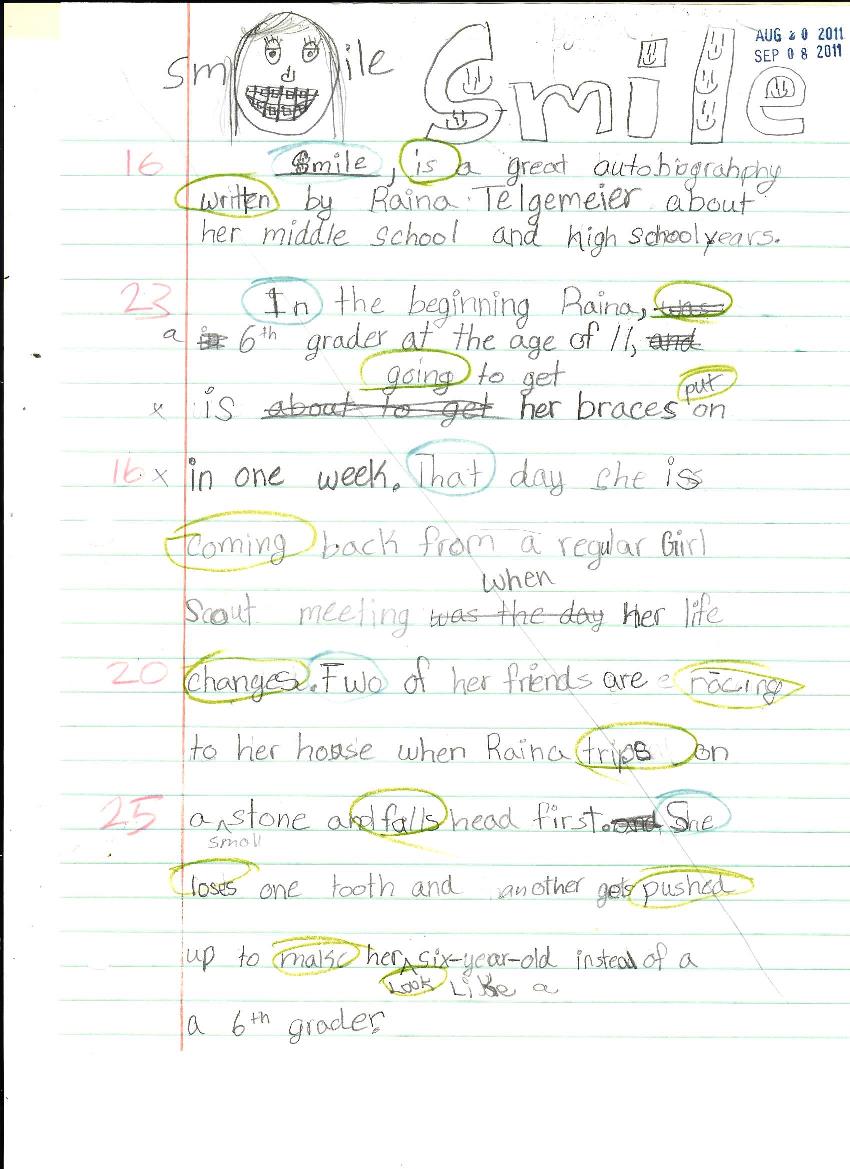
student essay to be edited

This portion of a fifth grade student essay has been revised but is difficult to edit because of all the cross-outs, circles and insertions. A clean draft would help the student to edit well.

Once they have a clean almost-final draft, students edit. They read every word of their essays, looking for errors such as in spelling, capitalization, verb tenses, plurals, parallel structure, subject-verb agreement, pronoun antecedent agreement, possessive nouns, its and it’s; they’re, there, and their; to, two, and too; and punctuation. Students who overuse certain words (and, then, so, and just, for example) hunt for them and either eliminate them or replace them.

One trick I learned long ago when I was a copy editor is to read each sentence out of order, starting with the last sentence and ending with the first sentence. By listening to sentences out of order, mistakes are easier to hear. My students think this technique is silly until they try it, but then they realize its usefulness. Usually I wait until a student is in middle school to suggest this editing technique.

As students edit, I try to read along with them, to suggest grammar and usage problems they might not suspect. At this point I sometimes teach a grammar lesson on the particular problem the student has encountered, especially if this problem is recurring.

When the student finishes editing his final hand-written copy, the student or I type this draft on the computer, leaving any remaining errors as they are. At our next meeting, the student edits for a second time, usually finding a handful of errors he missed during the first edit. (It’s so much easier to find errors when the writing is printed rather than hand-written.) Sometimes the student will make significant changes at this point, but not usually. Since I am aware of what the errors are, I point out errors that the student has not found.

Next we’ll talk about the value of typing and printing a final version of a student’s essay.