On many SAT exams, students face choosing either “its,” “it’s,” “its’,” “their,” they’re,” or “there” as an answer to a prompt. For example, what is the correct answer for the following clause?
“Toward the end of the 1400s, as the Renaissance was reaching its height. . .”
- NO CHANGE
- it’s
- its’
- their
Colleges must think knowing how to spell “its” and “their” correctly is an important skill for college-bound students to use correctly. Otherwise, why would questions about their spelling be on the exams? But is knowing if an apostrophe is needed and how to use it really that important?
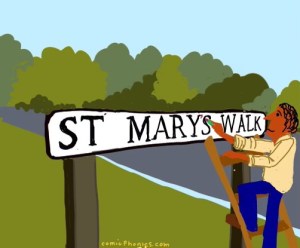 In northern England, the North Yorkshire Council voted recently to remove apostrophes from street names. So, the former “St. Mary’s Walk” has been changed to “St. Marys Walk.” Another change is from “King’s Walk” to “Kings Walk.”
The meaning of each street name is slightly different without the apostrophe. But would you be confused if you were looking for an address? When we say, “St. Mary’s Walk,” we don’t mention the apostrophe, yet we are understood.
English teachers spend hours of classroom time instilling in children the importance of using apostrophes correctly. In the phrase, “the sisters bike,” do you know where the apostrophe goes? Or even if an apostrophe is needed? (Yes, an apostrophe is needed. If it is one sister, the answer is between the “r” and “s.” If it is two or more sisters, the answer is after the “s.”)
In contractions, the apostrophe takes the place of missing letters. But don’t you understand “I dont know” as well as “I don’t know”?
What is spurring the dropping of apostrophes? Computers. Data bases. Text messages. Multitasking. Frantic lives. In our increasingly digital world, apostrophes are deemed unimportant. On my phone, I need to shift to a different screen if I want to use an apostrophe and then shift back. I still do that, but it takes time. I notice my children don’t bother. If we understand speech without apostrophes, why complicate things by using them in writing?
Grammar teachers may wonder if they have wasted their lives focusing on the correct use of apostrophes, quotation marks, and commas. Cursive writing teachers may wonder the same. For past generations, apostrophes were signs of a well educated person. Today they still are, but that is changing.
By the way, the correct response to the question at the beginning of the blog is NO CHANGE.



 English Writing Teacher