Monthly Archives: January 2020

What is a rhetorical précis?

A précis is a highly structured summary of a text, focusing on the text’s argument and presentation.  It is a type of academic writing presenting factual information only, without opinions of the précis writer.
One way of organizing a précis is to write a four-sentence summary:

The opening sentence names the text, its author, genre and publication date followed by a clause naming the thesis of the work.

The second sentence explains how the author develops the thesis, with information usually presented in the same order as in the original text.

The third sentence explains why the text was written, often followed by an “in order to” phrase.

The fourth sentence either describes the intended audience or the tone of the text.

Let’s look at a précis I wrote about the Declaration of Independence:

In the Declaration of Independence (July 1776), Thomas Jefferson argues that because King George III usurped the liberties of British citizens in the North American colonies, those citizens were declaring their independence from Britain.  Jefferson divides the Declaration into four parts:  the preamble, a short paragraph explaining that the world has a right to know why the colonies are separating; second, the most quoted part, the philosophical justification for the separation; third, the longest section, the list of grievances against King George III; and fourth, another short paragraph declaring independence.  Jefferson’s purpose was to present a logical and legally sound justification for the separation in order to gain the support of all 13 colonies and of potential international allies.  The author’s tone is formal as befits the seriousness of the purpose.

Why are students asked to write a précis?  A précis demands summarizing, analyzing and culling a text into a concise format, eliminating opinion.  Writing a good précis proves whether a student understands a text and whether a student can write.

The only three organizers elementary and middle school students need

To write well, students need to plan their writing before they write.  They need to organize their ideas on paper, tablet or computer before they write sentences.

Some workbook publishers suggest students need a different type organizer for almost every essay or narrative they write.  Other publishers suggest as few as six.

This is a graphic representation of a third grade student's handwritten mind web.

This is an example of a mind web.

I suggest three.

A mind web (sometimes called a spider web or mind map) suffices for most expository and persuasive essays. The topic goes in the center, and then, like spokes of a wheel, three or four subtopics connect to the center.  The student augments each of these subtopics with details.  Then using colored pencils or markers, the student loops the information for each subtopic using a different color.  Lastly, the student numbers the subtopics in the order in which they will be written about.

Use a chart for comparison and contrast essays.

This is an example of a chart.

A chart suffices for comparison/contrast essays. The student draws a horizontal line across the top of the paper (or online page) and then draws three equally-spaced vertical lines.  At the top of the middle and right columns the student writes the two topics to be compared or contrasted.  Down the sides of the left column the student writes the ideas to be compared or contrasted.

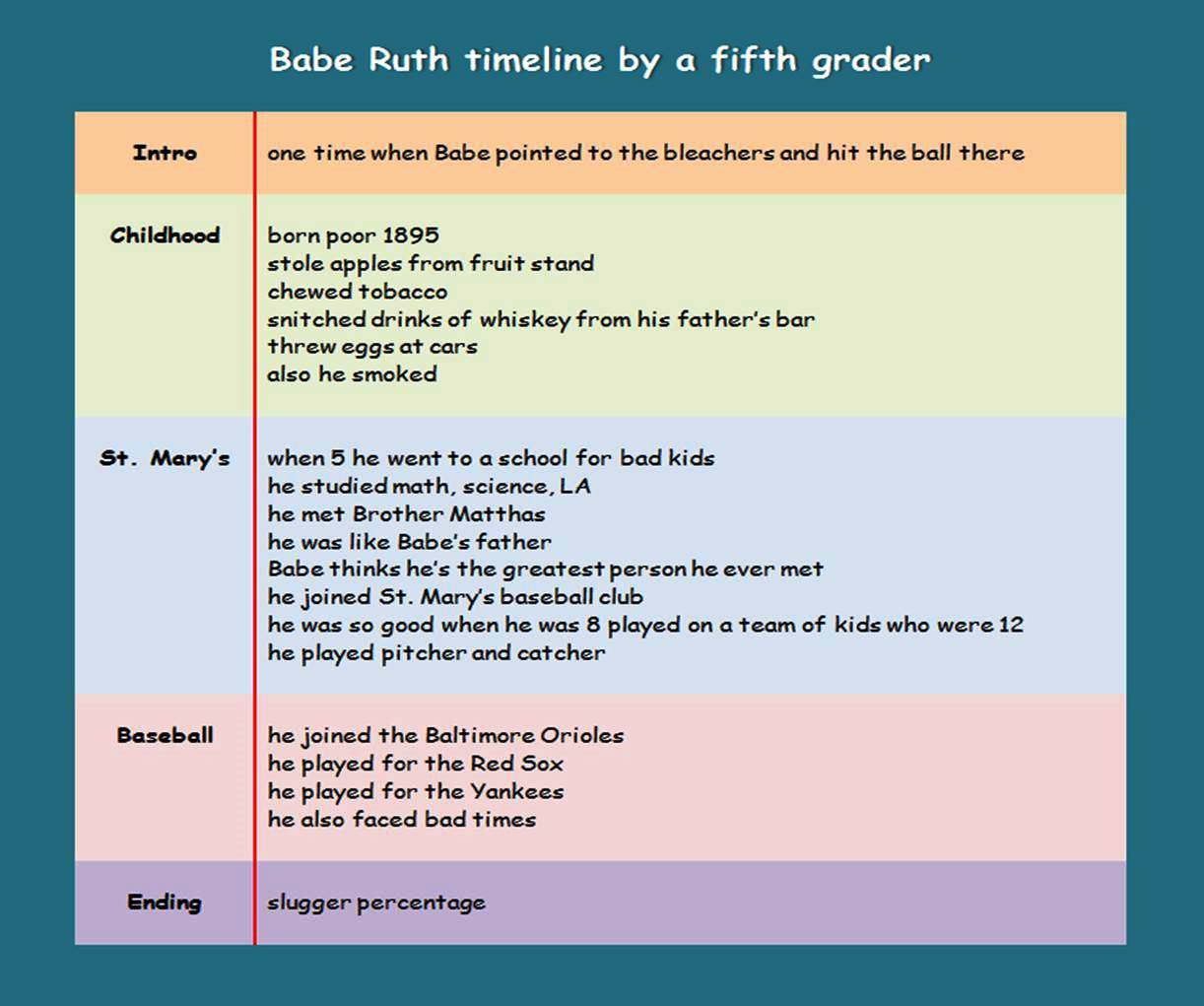
An example of a modified timeline organizer on Babe Ruth's life--childhood, school years, and baseball career.

This is an example of a modified timeline.

A modified timeline works great for narratives. At the top of the page on the left write “beginning.”  Next to it stack the words “setting,” “POV,” “characters,” and “inciting action.”  Below the word “beginning” write “middle,” and near the bottom of the page on the left write “end.”  Next to “end” write “climax” and “resolution.”

These three organizers cover the situations elementary and middle grade students need to write about.  I particularly like the mind web because it is so flexible.  The more “sloppy” a student is allowed to be in creating an organizer, the more apt a student is to create one.

I also recommend creating these organizers on notebook paper which can be placed next to an electronic surface if the student is writing online.  That way the student can easily glance back and forth to use the organizer.

For more on organizers, click on the cover of my book How to Write a 5th Grade (or any other grade) Essay in the  left side of this blog.

How do you write the possessive of dress? Dress’s? or Dress’?

In the sentence, the “The dress’s / dress’ sleeve is too long,” how do you write the possessive form of dress?  Dress’s or dress’?

I tried to find the answer in my English handbook at home and in various internet sites.  But I couldn’t find an answer to the situation of a noun already ending in “ss.”

“Dress’s” looks funny because three letters s come together.  But “dress'” also looks funny because we pronounce a second syllable which seems not to be represented by a single apostrophe.

This question was presented to me by a high school student studying for his SATs.  I told him that it’s probably better to use the apostrophe s even though that creates three letters s in a row.  Other words which add a second pronounced syllable such as box’s and church’s add the apostrophe s.  So based on pronunciation, I would add the apostrophe s.

Anyone know what the answer is?