Yearly Archives: 2017

Does studying music help with learning English grammar?

Is there a connection between musical rhythms and grammar?

child playing violinResearcher Reyna Gordon* thinks so.  She is training students in music, hoping that by doing so they can learn complex English grammar.

In music and in grammar, human brains get used to certain patterns, according to Gordon.  For example, when a person says a subject and a verb in a sentence, the listener expects to hear an object of that verb next.  Young children learn this pattern of expression subconsciously as they are learning words themselves.

When children start to speak, it is in single words—”Mom,” “Dad, “mine.”  By two years old they are speaking in phrases and little sentences such as “Teddy’s hat,” “Give me” and “Me want.”  Little sentences become longer ones, morphing from simple sentences to compound sentences joined by “and.” By five years old, most children have evolved their ways of expressing themselves into complex sentence patterns.

But some children never reach the complex pattern stage, says Gordon.  A small percentage of the population has what is called “specific language impairment.” They continue to express themselves in phrases and in short, simple sentences.

gordon thinks training such children to listen to and to produce musical rhythms can help them expand their English grammar.  This is because the same parts of the brain which are involved with understanding musical rhythms are involved in understanding English grammar.  By exposing children to music patterns, Gordon hopes to expand their grammar patterns.

Other research has shown a strong correlation between studying music and learning languages.  Children who study music before seven years old can process subtle differences in sound better than other children, and this helps them learn languages, both their mother tongue and foreign languages.

For more on Gordon’s research, go to https://www.ncbi.nlm.nih.gov/pubmed/25195623.

*Director of the Music Cognition Lab in the Department of Otolaryngology at Vanderbilt University Medical Center

Lockstep sentences, one after another, bore readers

What is a lockstep sentence?  Usually, it’s a sentence which begins with a subject (a noun or pronoun) and is followed by a predicate (a verb and a direct object, or a verb and a linked noun or adjective).  If there is a prepositional phrase, it comes at the end of the sentence.

Here is such a lockstep sentence pattern.

1  John watched the television news.  2  He saw an interesting discussion.  3  New York’s Congressman Newman debated Delaware’s Congressman Doe.  4  Congressman Newman took the conservative position and Congressman Doe took the liberal position.  5  “That’s a good discussion,” thought John.

Notice the sentence patterns:

1  subject, verb, direct object  (five words)

2  subject, verb, direct object  (five words)

3  subject, verb, direct object     (eight words)

4  subject, verb, direct object, conjunction, subject, verb, direct object  (13 words)

5  subject, verb, predicate noun, verb, subject (six words)

These five sentences follow a lockstep pattern.  They all begin with a subject.  Two have adjectives before the simple subject, but all start with the complete subject.  Each subject is followed by a verb which is followed by a direct object in four cases and a predicate noun in the other case.  The longer sentence is actually two simple sentences following the same pattern, but connected with a conjunction to form a compound sentence.

In this case, the lockstep sentences contain few words, adding to their tedium.

A lockstep sentence pattern needn’t be this particular pattern, but it is a pattern which repeats over and over, sentence after sentence.

For some writers, the pattern is a single subject and a compound predicate.  “I ate dinner and took a walk.  The night was warm but humid.  I stood under a tree and waited for the rain to stop.  Then I went home and drank hot tea.”

For other writers, the pattern is an adverb to start the sentence followed by a subject and a predicate.  “Playfully, my dog licked my ankle.  Then she walked to her mat.  There she scratched herself.  However, she heard thunder in the distance.  Immediately, she returned to my side.”

For some writers, the pattern is a series of complex sentences with the subordinate clause always coming after the independent clause.  “I stopped the car because a blue light flashed ahead.  Soon cars parted as a fire engine passed.  Then an ambulance wailed while I checked my GPS.”

What can a writer do to avoid lockstep patterns?

First, analyze your own writing.  See if you consistently use a pattern.

Next, as your write, be aware of your tendency to use that pattern.  Look over your work, and if you notice that pattern, change the sentences.  If you usually begin with a subject followed by a verb, start some sentences with prepositional phrases, adverbs or gerund phrases.  If you usually begin with an adverb, cross out half of them, and then cross out half the rest.  If you write mostly short sentences, turn some of them into complicated simple sentences or complex sentences with double the words.

Lockstep sentence patterns are like familiar car routes.  We become so comfortable using them that we don’t explore new ways of expressing ourselves.  But we should to keep our writing fresh and our readers engaged.

10 picture books with simple illustrations

Picture books with simple illustrations and bland backgrounds—the kinds which appeal to toddlers and children with sensory integration problems—can be hard to find if you search online or on shelf.  Even harder to find are such books which tell a story.

But they are great boks for reading aloud to sensitive children.  And they are equally valuable for suggesting story ideas for children to write.

Here are ten such books from all over the world which your child might enjoy.  Many have won awards.


Why Mosquitos Buzz in People’s Ears by Verna Aardema

The Enormous Crocodile by Roald Dahl (the version illustrated by Quentin Blake)

The Snowman by Raymond Briggs

Puss Jekyll Cat Hyde by Joyce Dunbar

The Farmer and the Clown by Marla Frazee (wordless)

Flora and the Penguin by Molly Idle (wordless)

The Great Paper Caper by Oliver Jeffers

The Snowy Day by Ezra Jack Keats

Snow White and the Fox by Niroot Puttapipat

Lon Po Po:  A Red Riding Hood Story from China by Ed Young

For kids with sensory integration issues, choose picture books with pared down shapes, colors, focus

If your child resists using certain picture books to retell a story, it could be the pictures themselves that discourage writing.

3rd grader writing an essay.

Choose picture books with plain or no background, solid colors, one or two characters and a single, focused idea in each drawing

Picture books with detailed backgrounds or with copious patterns can turn off children with sensory integration issues.  Such children have difficulty focusing if there is too much pattern, noise, motion, or texture in any experience.  They prefer plain painted walls and plain bedspreads, not papered walls and patterned bedding; low, instrumental music by a single instrument, not loud music or music with lyrics; sitting or standing still, not rocking or dancing; and loose knit clothing, not clothes with tags or clothes that are tight-fitting.

When you choose books for children who show sensory integration issues, search for picture books with these characteristics:

  • Pictures with no backgrounds, or just the hint of background—a wash of green to represent grass and trees, for example, or one or two birds in the sky, not a whole flock.
  • Characters dressed in solid colors without shading or patterns in their clothes. If you have seen Pippa the Pig books or cartoons, with their simplistic images, that is the kind you want to show your child.
  • Pictures using flat shapes and limited colors, the kind that children themselves produce. (Think of the way Peanuts cartoon characters are presented—Charlie Brown with his round head and Lucy with her dress of a single color.)
  • Pictures focusing on one or two characters, not groups. Look for pared down, minimalist images which have removed everything but the essential elements.

When you look for picture books for children with sensory integration issues to write about, search for picture books with the features just mentioned.  Some wordless picture books offer these kinds of pictures, but not all do.

Finding such books in your library or book store is not easy.  A section labeled “simplistic art” doesn’t exist.  I have had to scour shelves to find what I am looking for.  But the search is worth it to entice a reluctant child writer.

Next blog:  A list of books with the kind of art which appeals to children with sensory integration issues.

Show writers how important first sentences are

The first sentence of a story can lure readers in, like a wiggly worm on a fishing hook.  Or the first sentence can cause readers to pound the snooze button.

How can you show students how important first sentences are?

Here’s one way:

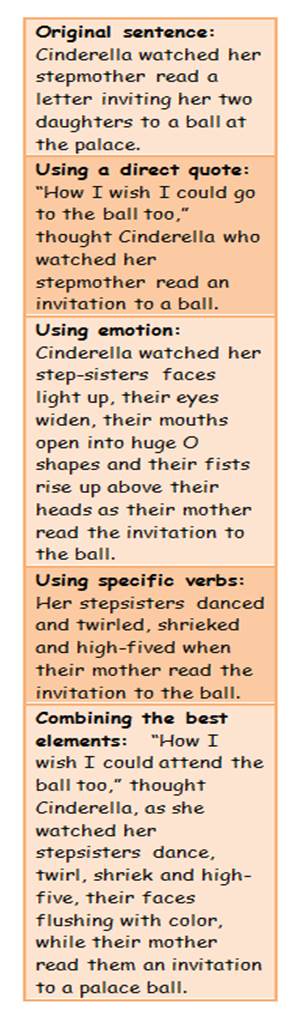
  • Show students a single drawing or photo in which some kind of human or animal action is going on. It could be the first page of a picture book (if so, cover up the words), a sports photo from a magazine, or something you’ve downloaded.  Try to find a picture which is clearly focused on one or two characters and without a lot of distracting background.Some creative sentence options.
  • Ask the students to write the first sentence of a story about the events in the picture. (No, you are not going to write the whole story.  No, I can’t offer any help.)  Let students muddle through how to approach the writing.  If they make a tentative suggestion, wanting your approval, affirm their suggestion, however good or bad you think it is.
  • Next, tell them to write another first sentence for the same picture, but this time they are to start the sentence with a direct quote. It could be someone speaking aloud or someone musing.
  • Next, tell them to write another first sentence for the same picture, this time focusing on descriptive detail. The weather, clothing, posture, the look on someone’s face—any details which seem noteworthy are okay to write about.
  • Now tell them to write still another first sentence, focusing on the emotions of a person or animal in the picture.
  • Now write a sentence focusing on using specific vocabulary, especially specific verbs.

That gives you and the students several sentences to evaluate.

  • Ask the students to read aloud each of their sentences.
  • Ask which one seems the weakest or least alluring. If there are two somewhat bad sentences, that is fine.  Ask the students to identify why those sentences seem not as good as the others.
  • Ask which sentence seems the best. If the students think one, two or three are superior, ask why.
  • Go slowly, offering the students plenty of time to consider and reconsider their choices and reasons. Evaluating takes time.  Accept all responses.
  • Now, ask the students to take the best elements of the good sentences and combine them into one final sentence.
  • Ask them to read that sentence aloud, and to explain why they chose particular elements to include.

Lastly, ask the students what they have learned about writing from this exercise.