Monthly Archives: March 2015

How should academic vocabulary be taught?

The new Common Core Standards call for students to learn “academic vocabulary.”

What many well-meaning teachers and parents do to “teach” this vocabulary is to ask students to look up in dictionaries or thesauruses the meanings of unknown words. This method of vocabulary instruction often fails because children don’t like to do it and so they pick the first meaning of a word, often the wrong meaning. If the children go online to look up the word, the result is even worse since online results list words but not nuances of meaning or usage.

So how can academic vocabulary be better taught and learned?

Cartoon of a waterskiier withe the caption, Aquatic:  relating to water

Aquatic: relating to water

One good way is to follow the advice of Robert Marzano, author of Building Academic Vocabulary (2004). He recommends

  • First, a teacher (or parent) explains the meaning of a new word to a child, giving an example that the child can remember. (I have found that the funnier the example, the easier it is for the child to relate the word to the example later on.)
  • Second, the child explains the new term in his or her own words. (If a word is difficult to pronounce, make sure the child says the word several times. I write the word phonetically, using syllable breaks, to help the child pronounce it.)
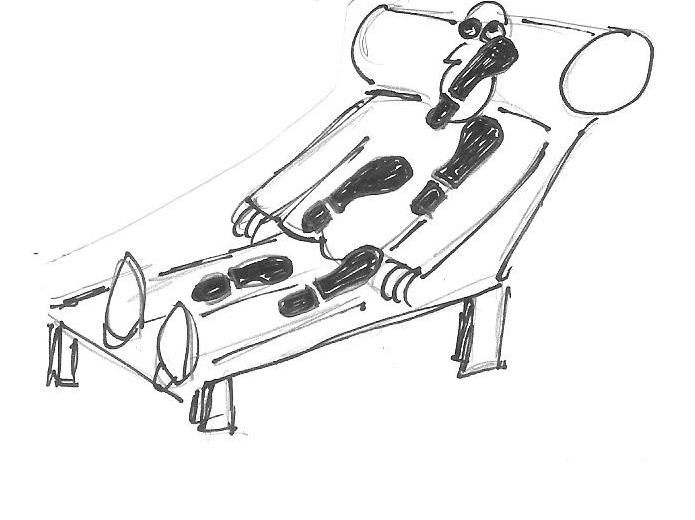
Cartoon of a man with footprints up his body and the words, Unassertive:  wimpy

Unassertive: wimpy

  • Next, the child makes a drawing of the word. (Stick figures are fine, but the meaning needs to be clear. Again, humor helps the child to attach the picture to the word.) A more dramatic child could act out the word. The idea is to explain the word not using words.
  • In the days after learning a new word, and from time to time thereafter, the child should encounter the word and the teacher or parent should ask what it means. If the child forgets, start the process again. If the parent makes a habit of using the word when talking to the child for a week or more, the child will better remember it.
Cartoon of a man with footprints up his body and the words, Unassertive:  wimpy

Mutilate: to cut in order to disfigure

  • From time to time, the teacher / parent and the student, or the student and her peers, should discuss vocabulary words. This could be every Monday, or twice a month, but regularly reviewing what a child has learned cements the ideas better each time they are reviewed.
  • Children should engage in fun games to help them remember vocabulary. (I use BINGO review games: a board labeled with 24 or 25 vocabulary words and a stack of definition cards. In a classroom setting, either I or a student student calls out a definition, and the children cover the correct word.)
Cartoon of a skull and crossbones with the words, Lethal:  deadly, toxic, fatal

Lethal: deadly, toxic, fatal

Adding one more idea to Marzano’s suggestions, I suggest that the word be used correctly in sentences. Many students I have taught can tell me the definition of a word, but when it comes to using the word correctly, they cannot do it. They use a noun for a verb; they don’t use the past tense or past participle of a verb; they leave off the “s” of plural words or of third person singular verbs; and when adding suffixes, they misspell. This usage work can be done orally so that it goes faster and so students don’t balk at it.

What is academic vocabulary?

One of the Common Core Standards in writing is using academic vocabulary.

When I was a child, my mother would call everyday, overused words “five cent words.” She encouraged me to use specific, adult-like “fifty cent words.” What my mother called “fifty cent words” is what today’s teachers call “academic vocabulary.”

Two lists of words, one simple words under the image of a nickel, and one more specific words under the image of a 50 cent piece


    • The Common Core Standards define academic vocabulary as “words that are traditionally used in academic dialogue and text.” These are not the high frequency, single meaning words that most preschoolers use. Nor are they words an elementary school student would use in everyday conversation with peers. But they are words which students might hear their teacher or a well-educated person use. These words are more precise (stroll instead of walk, doodle instead of draw) than the usual words children use, or they might include a less well-known meaning of a well-known word (a set of dishes, she set her hair, set the record straight).
    • Academic vocabulary also includes “domain specific” words used in a field of study. In an English class, words like synonym, noun, paragraph, punctuation, and dialog would be considered academic vocabulary. In a math class, numerator, decimal, digit, transform and rhombus would be considered academic vocabulary. These words are infrequently used outside the field of study, but they are important to know and use correctly within a field of study. Usually they are found in expository (informational) writing.
    • Direction words that a teacher would use are included in academic vocabulary, including words or phrases like “I need to take attendance,” or “Can you contrast Junie B and Lucille?” or “Yes, you may read aloud, but do it quietly.”
    • Usually, but not always, academic vocabulary is multi-syllabic vocabulary whose derivation is either Latin or Greek. Many times academic vocabulary passed through the French or German languages before it reached English.
    • These longer academic vocabulary words often contain prefixes and/or suffixes added to root words. (The longest English word, antidisestablishmentarianism, is a string of prefixes and suffixes added to the root word establish. Fortunately, it is not an academic vocabulary word, at least not for elementary and middle school children!)
    • Academic vocabulary is concise vocabulary—using a single, specific word to take the place of a phrase.

The English Language Arts Standards of the Common Core recommend direct vocabulary instruction to students, focusing on “understanding words and phrases, their relationships, and their nuances and on acquiring new vocabulary.”

For an excellent list of academic vocabulary words; suffixes and prefixes; and root words with prefixes and suffixes categorized by parts of speech, go to http://www.englishcompanion.com/pdfDocs/acvocabulary2.pdf.

When you think “academic vocabulary,” think of the lowly nickel and the mighty fifty cent piece.

In our next blog, we’ll discuss how academic vocabulary can be taught.